


Stories from “la Frontera”
La Espiguita
Mom was from the south, way south beyond the Equator closer to the Strait of Magellan, from a thin lengthy winding strip of land. Mamá came from an immigrant nation, looking remarkably like the other white women in the United States. Long white-blond hair and light blue eyes, a slender sparrow, her South American identity doubtless the moment her accented English was heard, succinct and direct speech patterns were her trademark. She was a firecracker, quickly enraged by signs of injustice, with a profound sense of independence despite her displacement from her homeland, and the fact that until the late 20th century, it was isolated from the world. Mountains and distance gave her people a singular sense of security while keeping them insular and provincial.
Mom spent a lifetime working with those less privileged, admired but feared, no one wanted to get on her bad side because despite her small stature, her scathing tones were at best uncomfortable and at worst a clawing of your conscience to do the right thing. Her generosity came at the price of her evaluating every aspect of your life and giving you in no uncertain terms her prognosis for improvement. A living example of principle, it was hard to grow up with a mom whose primary goal was to save the desolate, abused, and disenfranchised.
As her daughter, Liz had a wild upbringing, working in solidarity from a young age and playing at being an adult from the time she was a tween, an extra pair of hands to make protest signs, another bilingual to write press releases or take photographs, another companera was always needed. She spoke Spanish in its various forms, with the South American expats the accent traveled down the Pacific Coast and with the Puerto Rican girls from the barrio the vocabulary and cadence switched to New York Spanglish. Mom made sure Liz spoke and wrote in formal Spanish sending her to the homeland for an education, giving her books in Spanish to read and analyze. The extended family in New York who climbed their way up the rather rigid social classes there made sure she received some slathering of the expected etiquette and comportment typical of a South American middle class young woman.
Mom fostered her independent spirit, and inspired by her example, Liz escaped to the West Coast soon after high school. While there, she took odd jobs, went to community college, and continued her work in solidarity, having inherited Mom’s resilience and sense of justice. In her early twenties, she went to the homeland where the violent dictator still ruled. Liz worked with a group of intrepid journalists and photographers who strove to get the stories photographed and told to the world. It was there that her lifelong devotion of writing her thoughts and questions in a little black book began, one that continues to this day.
In her mother’s homeland, Liz’s physical and psychological integrity were constantly at risk but with the innocence and guilelessness of youth, she walked in and out of situations that would have killed another. In a country wracked with inequality and racism, it helped that she was young and had inherited Mom’s light coloring.
Her Spanish gained even greater nuances to accommodate the class structures of the home country, she had to speak the dialects of the upper classes fluidly if she were to survive. The language skills of a lifetime came formally into her toolbox back then. She was the English teacher at an upper-class establishment, she worked in translation with the solidarity movement and interpreted professionally for conferences and symposiums.
Her adventures in the farthest reaches of the South American continent reaped a future husband, older and quite the revolutionary intellectual powerhouse, who would father her child and later come to the Bay. He benevolently shared the pleasure of his great stature (physically small) as a revolutionary of the intelligentsia in the local radio broadcasts and newspaper articles. In fact, he lorded it over the younger folk and told them all about the road to liberation. In romance books, he would have been her partner and confidante, but real life broke into the reverie, revealing him as an egoist machista who could barely care for himself, let alone a wife and child.
Liz picked up the pieces and continued building her life, some of which was noted in her ubiquitous little black book. She continued her grassroots organizing and got jobs at community nonprofits and when time and money allowed, she gave college courses another try. She began her work as an independent interpreter and her voice gave voice to countless immigrants, worker’s comp and hospital patients, and the working poor. Living on the outside of corporate society, her own medical care became an issue. So, she gave up some of her independence and began to work for a local hospital directly as a medical interpreter, community organizing continued late into the night and her connections to the world only widened as the Internet and all its tools came into use.
A letter in the mail informed her that she had been left a $20,000 gift for her work in her community by an anonymous donor. Liz took the funds to her mother’s homeland to deliver prosthetics to all the young folks who had lost their eyes during their battle to be heard. The homeland had been a pseudo democracy for a while now, but the inequalities and injustices of the military regime were deeply entrenched in the legal system, and youth who had never seen the dictator took to the streets to demand better. The system took this attack on its integrity and brought out the rubber bullets and chemically laced water cannons to battle the threat. Liz knew all about the battles, her hopes pinned on a kinder homeland, she hoped against hope for changes in the government, she would write those in the little black book as a prayer, perhaps an incantation. In the meantime, she would take her unforeseen good fortune and go help the kids who needed it.
She needed new furniture and her computer could have been upgraded and updated but Liz’ pure generous soul made those ephemeral concerns vanish. Her friends tried to convince her to keep a part of the funds, but she said her expenses could be covered by credit cards and besides that is why she kept working at her hospital job. She could retire in a couple of years to work full-time in her community organizing and interpreting. It turns out Liz really was just like her mom, the fiery hope for a kinder world inspires her every breath.
About the Creator
Marci Valdivieso
Hopeful dreamer, intrepid entrepreneur, writer, visual artist and songstress... so many hats, with a dash of love poured into each.
Keep reading
More stories from writers in Families and other communities.
Wise~Guys
— Look Behind what's in Front of You ~ Make Good Choices — Hey, So how you Doin'..! Made~Men — Mobster Movies romanticise a distinctive, elegant appearance, impeccable attire style, along with the 'Families' expressive lingo. Making their 'Bones' gave them Panache — with vintage fedoras, tailored pin-striped suits, mirror-polished wing-tip shoes adorned with tassels; with their 'Gun Moll' gorgeous dates on their arms.
By Jay Kantor22 days ago in Families
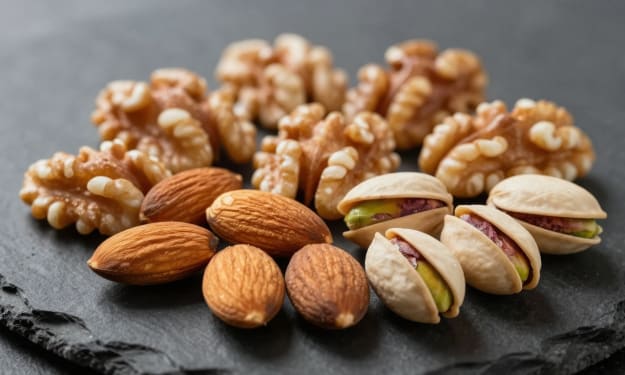
Men who eat nuts tend to have better quality sperm
Peak Potency: How a Daily Nut Habit Elevates Male Sperm Quality Male fertility rates have dropped in recent years. Many couples struggle to conceive, and men often overlook their role in this challenge. Your diet can make a big difference here. Nuts stand out as a simple fix. They pack antioxidants and healthy fats that support better sperm quality. Think of them as fuel for your reproductive system. Studies show men who eat nuts regularly see real gains in sperm health. If you're planning a family or just want peak vitality, adding nuts could be your smart move.
By Story silver book 5 days ago in Families
Autonomy Is The Real Privilege
Good morning, freedom-seekers! Today we’re gonna be looking at autonomy. A strange word, I know; one many would probably look at blankly and run away from on sight. We’re gonna figure out what it actually means, consider how it’s achieved, and decipher just how deeply most of us are tangled up in dependence without realising it.
By That ‘Freedom’ Guy2 days ago in Humans



Comments
There are no comments for this story
Be the first to respond and start the conversation.