
Starlights
I no longer know if I can trust the taste of peppermint
I no longer know if I can trust the taste of peppermint.
When I was young- much younger, the age when memories have just started to truly stick- my father drove a 1989 Ford Tempo. My brother, three years older, and I, used to simply call it the Brown Car, though that was generous; in truth its color was a muddy shade of gray not unlike that of spoiled meat. The 80’s weren’t nice to cars.
At that age, going to the store with Dad was special for several reasons, the first being that for many of my formative years, he worked the night shift, and I rarely saw him. For this reason, ventures out in the Brown Car were rare; more often, my mother would load my siblings and I into the Green Car, a slightly more attractive vehicle which was not, in fact, a car, but a blocky Chrysler minivan the color of pine needles. What the Brown Car had that the Green Car didn’t, apart from my father, was peppermints.
He kept them in the glove compartment, that secret chamber which is the delight of all children in vehicles. Of course, I probably should not have been allowed to ride in the front seat at my age, but I was a tall kid, and those were different times.
“Who wants to go to the store?” he’d ask on the rare weekend afternoons when he was home, awake, and not occupied by any of the hundreds of running projects associated with the upkeep of our home, which my parents had built themselves, and which remained in a state of perpetual unfinishedness throughout my childhood.
He always knew before he asked that I’d jump at the opportunity, just as he knew that I’d race to the Brown Car ahead of him to snatch a Starlight mint from the glove compartment. Sometimes I’d manage to fumble away the clear cellophane wrapper and pop the hard red and white disc into my mouth before he opened the driver’s side door, and think, with a six-year-old’s infallible wisdom, that I’d pulled one over on him. Other times I was too slow, and would hold the candy tightly in my fist for the duration of the drive, then the grocery run, and finally the trip home. I’d race upstairs to my room, only to find the mint sticky, half-melted from the heat of my palm.
Once, on finding the not-so-secret stash depleted, I slipped up, and accidentally revealed the truth of my mint-pilfering. In a truly impressive sprint out the front door, I had beaten my father to the car, only to find the glove compartment empty but for a thin layer of dust. I stared, and in my distraction, my father got in and started the car.
“No mints?” I gasped accusingly. I looked up just in time to see him give me a sly, sidelong smile.
“Huh,” he said softly as he backed down the gravel driveway, feigning a dawning understanding. “I didn’t think you knew those were in there. No wonder they’ve been disappearing so quickly.”
“I only have them when we go to the store,” I mumbled, red-faced, though this was not entirely truthful; the week prior I had snuck out through the garage one afternoon when he was sleeping and my mother was occupied somewhere, and took not one but two mints, hiding the second in my room for later.
He chuckled.
“I guess we’ll just have to pick up some more.”
At the store, our last stop was the small candy stand near the checkout. After grabbing the usual pack of Starlights, he nudged me and pointed to the sign: two for a dollar. I picked out a packet of butterscotch discs in gold cellophane to go with our mints, and we each ate one on the way home.
The following year, he crashed the Brown Car.
It was succeeded by the Red Car, which, with two younger brothers added to the ranks, was another minivan. My parents now exchanged vehicles regularly, and the mints never made a reappearance. But with a small allowance from chores and a bike that I was allowed to ride to the convenience store down the street, they faded from memory. Swedish Fish were three for a penny, and something felt good about using my own money, hard-earned by plucking hornworms from my mother’s tomato plants, to buy them.
The Red Car was crashed a few years later, and the Green Car having died not long before, we stopped referring to family vehicles by color. My older brother started driving a little grey stick-shift that reminded me of a mouse, and three years after that I got my own small pickup truck, teal green and sturdy. My mother’s ventures out of the house grew increasingly less frequent before stopping altogether.
My dad went through a string of leases in the final decade of his commute to the city for work. The mints returned then, in the form of Altoids and TicTacs. But it was different.
As a child, the smell of alcohol was the smell of home, but I never knew it. Not until I was twelve, and my best friend, a neighborhood girl who came and went from our house nearly every day, spent the night. My parents rarely allowed sleepovers, and even after that night, I didn’t fully understand why.
My mother came upstairs to my room to tell us goodnight. I remember that my room then was painted a pale blue-green, the hue of the ocean surf, and edged with a wallpaper border of colorful fish. She found us reading contraband Teen magazines and launched into a slurred story of what was meant to be maternal wisdom, words of warning against the pressures of society on young women.
Bulimic and suicidal, she’d starved herself nearly to death at sixteen. This was the first I’d heard of it.
Beside me on the carpet, my friend was pale and quiet. When my mother started to cry and shout, my father heard from downstairs and came to collect her. He quietly apologized to us before leading her, bowed and slumped against him with wrenching, hiccuping sobs, back down the stairs. My bedroom was filled with her breath, yeasty and stale. For a long moment, neither of us spoke.
Finally my friend broke the silence.
“Is your mom drunk?”
My parents were so simultaneously nonchalant and secretive about their drinking that I scarcely knew what the word meant. But every night my dad came home with a twenty-four pack, and every morning it was packed neatly by the garage door, full of empty cans.
“No,” I said, uncertain. “This is just what they do at night. This is just how they are.”
At seventeen, my clashes with my mother grew unsustainable. My older brother had left as soon as he legally could, leaving me at the center of a building storm. One night in January, she screamed me out of the house and threw an ashtray for good measure. I heard my father’s voice raise in my defense as it shattered on the door, but I was already gone. I crossed one state line without ever wondering where I was going, and nearly made it to another before I grudgingly turned the truck around. I parked in a field two miles from home and lay in the bed of the truck wrapped in a cargo blanket. Frost settled as I waited out the morning, watching stars disappear as the sun started to rise.
I left home for good the following autumn. I went far away for college, breathed the heavy, salty air of a coastal state, and slowly cut all ties to the quiet peninsular town I’d been raised in. But two years after I graduated, I was called back.
She lay in a hospital bed, legs grotesquely swollen under the sheets, the rest of her impossibly thin. Seeing me, she smiled in the lopsided, bobble-head way of someone who may have had a stroke, and began to chatter inanely about the policies of a man who had not been president for six years. She asked me when I would graduate from college, then asked again, with no recollection of her initial inquiry. I could only stare, my lungs empty of breath.
Christmas was different that year. At fifty-six, she was preparing to die, and the rest of us were pretending not to be preparing to lose her. She was a pitiful thing then, weighing in under 90 pounds, suddenly unable to walk. She manipulated my father and the doctors expertly, dancing around addiction diagnosis and treatment, all the while consuming little besides Bacardi and Xanax.
Little by little, my brothers and I watched our mother die, and our father shrink. I began a balancing act of coming around the house to see him, but avoiding the living room, which for years became her sick room. I wanted to be there, to feel connected to them, but I couldn’t bear to look either of them in the eye. So I would make the long drive home, greet my parents, and then retreat to the woods.
When I was sixteen, my father taught me how to hunt. None of my brothers ever took up the interest, but I liked being in the woods more than most kids my age, and the idea of self-sufficiency appealed to me. Together, we built a blind in the woods behind the house. It was a simple, tidy arc of sticks built up to conceal the two folding metal chairs where we would sit, waiting for a passing deer. I was an excellent marksman, and the first shot I ever took at a live animal dropped it on the spot.
I remember being taken aback by my own act of violence, and I remember a sorrowful pride in the cleanliness of the kill; the young buck hadn’t suffered. I silently thanked it for its life, and with my father’s help, gutted it.
I’ve sat in that blind many times since. Only a few of those times did I have a gun in my hands, and not once did I aim or fire.
One November, I sat still for over an hour, my breath freezing in tiny icicles on my scarf as a dozen wild turkeys quietly kicked up the leaf litter around the blind, looking for hidden insects. They passed on without ever having noticed me, and I remained still until their soft clucking had moved off into a dense cluster of spruce trees to the south.
Another year, I went out several evenings in a row in the frigid Midwestern cold, sitting in the blind with a thermos of hot coffee, enjoying the stillness and solitude of the forest. I only half wanted a deer to pass in front of my sights. Squirrels and rabbits were all I saw the first two days, but on the third I witnessed a creature so ethereal that to this day I wonder whether I may have dreamed it.
“See anything?” my dad asked later as I kicked snow off my boots, as he always does when I return from the woods.
I paused, for a moment struck by a strange impulse to lie.
“An owl,” I said quietly, nonchalantly.
His eyebrows raised as he peered at me from the kitchen, where something sizzled over a burner. After the hours I’d just spent in the woods, it was nearly dinner time.
“An owl,” he echoes, impressed. Nocturnal and elusive, they’re a rare enough sight that in my countless hours spent in the woods, this is the first I’ve ever seen in the wild. “Good luck, I think. Symbolic.”
Despite myself, I smiled. My dad is a walking encyclopedia of strange knowledge, like the symbolism of owls.
“Symbolic of what?”
He considered my question for a moment, sifting through a lifetime of obscure trivia and absently stirring his pan.
“Wisdom, if I recall correctly. Or intuition. Having any intuition lately?”
I shook my head, chuckling quietly, but despite the oppressive heat of the house in my winter coat, I felt my insides go cold. For as much as I’d been trying to repress it, to carry on with life as usual, my intuition was to run. To get as far away from that dying place as I could.
That night, plagued by insomnia, I replayed the morning in the woods over and over in my head.
The forest had been utterly still. A light snow was falling slowly, unstirred by even the slightest wind. I sat entranced as thick flakes drifted in lazy sinking patterns to the forest floor, slowly coating it in white. The trunks of hundreds of old trees stretched out before me, maple and oak and cherry, fading into a dark, grey distance of overlapping branches. As dusk fell steadily, the dark pushed nearer. A deer would have to walk right in front of me now to present a clear shot, but the snow and the silence held me transfixed, rooted in place with half an inch of powdery snow accumulated on my clothes.
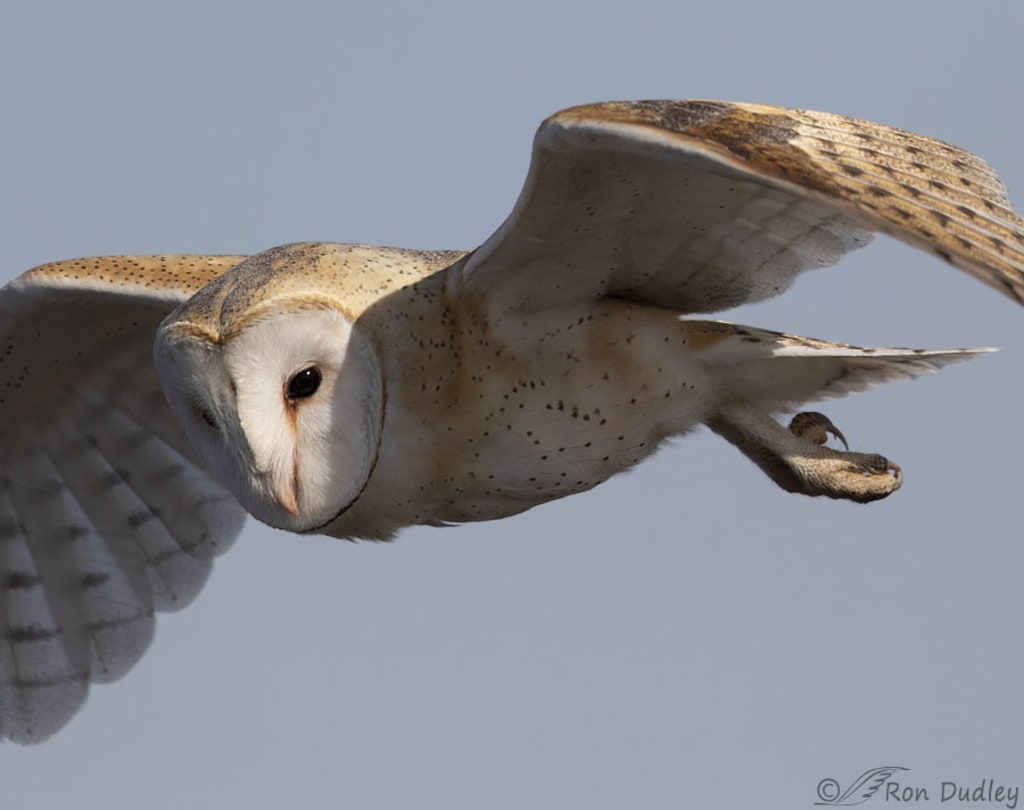
Then a ghostly, drifting shape sliced silently and gracefully through the falling snow, weaving, unhurried, through the colorless trees. Soundless wingbeats carried it within twenty feet of me, and I saw in perfect clarity the heart-shaped face of a barn owl, its eyes stark and black against the cream-colored plumage. The dying dusk light leached most of the color from the pale cinnamon feathers of its back and wings, making it seem an avian incarnation of snow.
In July, I got a call from a neighbor, wondering why the police and the fire department were at my parents’ house. Bracing myself, I called my father, who tiredly replied that my mother had tried to light the house on fire in an attempt to kill herself.
By the time I got there, the fire department was gone, but the police remained to escort us to the hospital. We managed to coax her, frail but fiery as ever, into my father’s car. I got in the backseat, silently watching their exchange on the ride to the psychiatric ward. While it was my first time accompanying such a trip, it was the fourth time for both of them. The police and hospital staff knew them by name.
The dying, stale liquor smell of her filled the car, and my father reached across to open the glovebox.
He nudged her, quietly saying her name. He said it with a tenderness and sorrow that I couldn’t bear to hear. I wanted out of the car. Then, with an incoherent mumble, she took the peppermint from his hand.
Nearly a decade after that first hospital visit when Mom couldn’t remember who was president, I’m sitting across the table from my father, a tidy pile of paperwork between us. The document that he’s signing is for court-ordered rehabilitation. The one under my pen will make me my mother’s legal guardian. Beside it, an open pamphlet titled Wernicke’s Encephalopathy : Caring for Patients with Alcohol-Induced Dementia.
With the diagnosis, we were finally able to stop her drinking. Her mind and memory are gone, but with them, so are her violence, her deceit. It’s a bitter tradeoff.
“What are you two working on?” she asks for the third time this morning, oblivious to the tiring loops and glitches in her memory. But she’s calm and seems content. She has put on weight. It’s a stark contrast to the raving, unpredictable skeleton that used to be my mother.
“Just some paperwork, honey,” Dad says quietly, for the third time. A moment later, he caps his pen and sits back. I fill out the last few lines and sign, then do the same. We look at each other, not quite sure if a weight has been lifted. But we both know that these things take time.
My father stands.
“I think I’ll brew a pot of coffee and make a sandwich,” he says, and asks my mother if she wants anything. She does. It’s good to see her eating.
I sip my coffee, looking out the window towards the woods. My parents are talking about nothing in particular, and their voices haze out as a light snow starts to fall. Something stirs in me, an eagerness for the chill air and solitude. I am drawn to the woods, as always, but this is different. For the first time in a long time, I’m not going into the woods to escape.
I stand.
“Going for a walk?” my mother asks, as she always does, but this is more due to my consistent routine than to her ruined memory. I nod, donning my coat.
“Well, have fun,” she says, as she always does. “I hope you see something.”
I think of the owl, and intuition.
“Me, too.”
About the Creator
Keep reading
More stories from writers in Families and other communities.
Wise~Guys
— Look Behind what's in Front of You ~ Make Good Choices — Hey, So how you Doin'..! Made~Men — Mobster Movies romanticise a distinctive, elegant appearance, impeccable attire style, along with the 'Families' expressive lingo. Making their 'Bones' gave them Panache — with vintage fedoras, tailored pin-striped suits, mirror-polished wing-tip shoes adorned with tassels; with their 'Gun Moll' gorgeous dates on their arms.
By Jay Kantor29 days ago in Families



Comments
There are no comments for this story
Be the first to respond and start the conversation.