

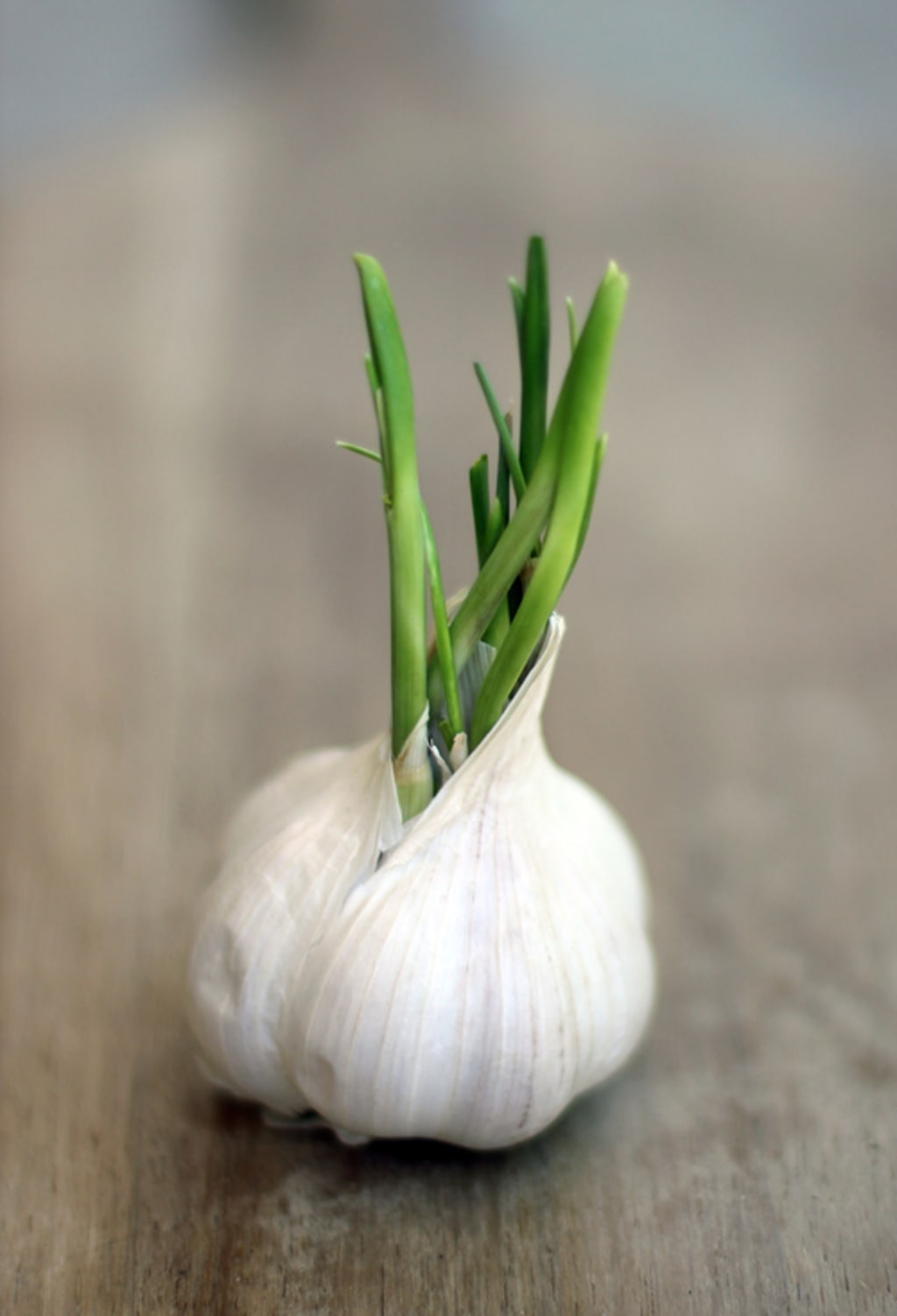
I jabbed the garlic bulb with a five-inch kitchen blade.
The cloves had begun to sprout; slivers, like fingernails on wide-set digits. They darkened, lengthened and thickened: raised brown spots and a thicket of green stemmed, inching ceiling-ward until Mama told me to dice it for the chicken parmesan—my favorite, which I’d begged her to make for dinner.
When I’d asked Mama if sprouting on garlic meant it had gone bad, she simply said, “It’s not going bad. It’s just changing.” Of course, Mama said the same thing about her and Daddy, and he was gone by my next birthday.
When I asked her why things had to change, she pulled me into her lap, settled her chin on top of my head and said, “That’s the only real way to measure the passage of time.”
The phone rang. “I’ll get it,” I sang, turning to retrieve the landline phone, and Mama shook her head.
"Chop, Cassandra," she said gently, bounding for the phone. She pulled the phone from the receiver, crossed our two-bedroom home in her mustard-colored dress, and walked into her bedroom before saying, "Hello, the Taylor residence." She shrank into a lower tone, closing her door.
I tipped-toed backward, trying to eavesdrop. With John Coltrane's "Blue World' beginning on the wireless speakers on the other side of the room, I couldn't make out anything. A part of me hoped it was Daddy wanting to come home.
Mama reentered the room, her face red. She returned the phone and set back to cooking, focusing wholly on the tasks on her side of the counter.
“Was that Daddy on the phone?” She was already shaking her head before I finished the question.
“No, baby, it wasn’t.” She rested against the counter for a moment.
“Is everything okay?”
"It’s fine," she said, correcting her posture. The symphony of kitchen pans, plates and appliances recommenced. Her beautiful clay-colored hands massaged, seasoned and then dredged the chicken.
“Did you learn to cook from your mother?” I mused.
Mama waited a long time to respond, and I realized I’d hit another button, but there were so many.
Around eight-years-old, I found a picture of my grandmother behind my parent's bed. It was folded and tucked into a little black notebook like it was a secret. She almost looked like Mama but was leaner and had straightened hair with gleaming grey bits, but they had the same hazel eyes. Grandma looked happy.
I showed the photo to Daddy and asked why Mama didn't talk about Grandma. He frowned and patted my head, "Honey, your grandmother’s died. Put this back. Don't go through your mother's things again." I returned the photo, and the next time I’d gone to retrieve it, it was gone.
"My mother only taught me how to change a tire and disappoint people," she said, then cleared her throat, indicating she was done with the conversation.
Within one hour, we’d cooked, said grace and sat down to dinner. John Coltrane’s saxophone continued, entering its fourth hour.
“Can we play something else?” I begged, delivering a satisfying forkful of chicken into my mouth. Mama gave me a skeptical look. She smirked and nodded, continuing to eat.
“Yes!” I exclaimed, standing when there were three loud knocks on the front door. We both checked the time on the stove—7:47 p.m. We weren’t expecting company.
Peering through the peephole, I saw a tall, dark figure beneath the dim porch light. I couldn't make out the man's face but I knew it wasn't Daddy.
“Who’s there?” I asked. Mama frowned and walked to turn down the music.
"Um, I'm here to speak with Nina Taylor,” the man said. “My name is Mirian John. She’s my, ahem, mother." I looked at my mother, her birth name Nina Taylor. She looked flustered but not surprised.
“Don’t open the door,” she demanded. “Come here.”
“I don’t understand,” I said, confused. “Who’s Mirian?''
“No one,” she quietly, “Get away from the door.”
I didn’t move, so Mama walked over and tugged my left wrist. I held onto the doorknob with my right hand.
"If he isn't your son, who is he?" Mama shook her head with tears and disbelief in her eyes.
"I just want to talk," the man said. "I don't want to cause any trouble.”
"I can't speak to him," she said, and before I could ask her another question, she'd hurried into her bedroom, closing the door.
“Maybe you should just go. You’ve disturbed my mother. Just go.” Mirian stopped knocking, and I looked through the peephole. He stood there with both hands pressed to the door.
“My father died,” he said. “I don’t have anywhere else to go.” The statement pricked me like a needle to the chest. I put my hand there to comfort the pain. I looked at Mama's door, still closed.
I unlocked the door, opening it slowly. He wasn’t a man; he was much older than I was. He looked like he hadn’t slept in days, and his nose was red, and he indeed looked a bit like me, a bit like Mama.
"You can come inside," I said unevenly. Mirian gave me an appreciative nod, and I gestured for him to sit.
He sat in Mama’s chair at the head of the table, in front of her partially eaten food, and I sat adjacent to him. I nervously scanned the room and my eyes landed on the chopping board, where remnants of the sprouted garlic laid, waiting to be tidied.
“My name is Cassandra,” I said, turning to him. “ Nora’s my mother.”
“Yeah, I figured,” he said, fidgeting and his lashes fluttering. “How old are you?”
“Thirteen. In five months,” I said, “And you?”
“Just turned sixteen.” I swallowed deeply. We were only a few short years apart.
“Your father?” I inquired, unsure how to broach the subject.
“He, yeah, died.” He gave a tearful laugh. “About two hours ago. Cancer.” He cleared his throat. " For weeks, he was declining in health. And last week, when going through his things, I found a marriage certificate, photographs, love letters and this..." He pulled out a bent envelope.
He began to choke up, and I touched his hand, not just to give him comfort but to ground myself, to make sure he was actually there. I took the letter from him, removing it from the envelope, recognizing Mama's handwriting.
Dear Evan,
Eggs don't have to sit on walls to welcome trouble. They only need to be mishandled to never get put back together again—shattered shells stay separate. And I don't want to be a culprit.
I've tried my best to raise him, but I can't do it. Anger cuts through me when he smiles, and hatred nags at me when he cries. I don't love him, and I don't say this to be unkind.
I’ve signed over and enclosed a $20,000 check. Let him forget about me. I’m not his mother.
-Nora
I pushed the letter away from me, feeling burning in my chest, stomach and face. That was horrible.
Mirian looked away from me, his lip trembling. I stood and walked down the hall to Mama's door and began to pound on it.
“How could you write those terrible things, Mama?” I shouted. “Please open the door.”
Silence. After a few minutes, I slid to the floor, still knocking, rapping at it until I heard the door creak as if someone leaned against it.
"Mama," I pleaded quietly. "Was it postpartum? If you say that, I'll understand."
She whimpered.
"Baby," she finally said. I pressed my ear against the door. "I don't want to talk to him."
At the end of the hall, I heard Mirian step forward. I extended my hand to him, and he hesitated before he slid down beside me. I laid my right hand squarely in his larger left hand, feeling the kinship. I managed a smile.
"Explain yourself, please," I begged, knocking, wading deeper into grown folks' business than I’d ever had in my life.
“Stop with the knocking,” she finally said, followed by a pause. “He isn’t my son, but he’s family.” Mirian and I looked at one another, confused.
"What does that mean?" Mirian asked, scanning the letter in his hand as if it'd reveal some clues.
Mama forced a little black notebook through the tight space at the bottom of the door.
“You remember this?” Mama asked. I picked it up and touched the cover.
“Yes,” I said.
"Look at it again." I held the notebook between us so Mirian and I could look at the same time. I parted it. Doodles, lists, resolutions, prayers, poems and plans. I turned the notebook over and shook it, and the picture of Grandma fell out. Bright eyes, beautiful teeth, and red lips. I started to put down the image in place of other clues, but noticed her hands' placement on her slightly protruding stomach. She sat on a bed with her hand extended, resting on a small pile of books: "Oryx and Crake" by Margaret Atwood; "Leaving Atlanta" by Tayari Jones; and "Purple Hibiscus" by Chimamanda Ngozi Adichie.
"'I did not even think to think what Mama needed to be forgiven for,'" I said aloud, quoting "Purple Hibiscus." Mama had read me the book once, and I’d read the book twice myself. It was the line that most struck me. The book was published in October 2003, just seventeen years ago.
"Mhmm," Mama said.
"What does all this mean?" Mirian asked, frustrated. My grandmother's lips were curled into a gratified smile, her eyebrows arched and neat, and her eyes filled with thrill and steadiness, but none of my mother's sadness or softness.
“Cassandra,” Mirian stressed, and I looked at him. "What?" I suddenly wished I was on the other side of the door with my mother.
“I don’t think my mother was ever pregnant with you,” I said, handing him the picture. “I think that’s your mother, my grandmother.”
He laughed.
"No, my father was married to your mother… our mother. What you're saying isn't making any sense," he boomed.
I opened my mouth to speak, but just then, Mama’s door groaned. Mirian and I stood as the door opened. She sidestepped us without looking at us, but soundlessly request we follow her to the dining room.
“Sit,” Mama directed. We did. She took her seat, rubbing her face before focusing on Mirian, fighting the urge to look away.
The room was silent except for the analog clock's tick and the leaky faucet from the kitchen.
“You were a beautiful baby,” Mama finally said, giving him a sad smile. “You learned to jump before you learned to crawl. You loved to laugh. You were just like her. Too much like her.”
My mother, Donna, carried on with your father for months before she became pregnant with you. I don't know the sordid details, but when my mother gave birth to you, there were complications, and she died." Mama paused, and I felt her hand, and she braced me firmly, both hers shaking. I looked at Mirian, and he seemed to be rocking in his seat, and I touched his hand, also.
"I was suddenly a mother to a child born from betrayal. And lord help me, I tried. I fed and bathed you, stomaching a year before it became too much. You were innocent, but I knew that I couldn't give you the kind of love you deserved. So, I packed my bags, signed over the money my mother left me, and I took off. It was the right choice."
She seemed winded, unpacking some of what she'd been holding onto for nearly two decades. It made me think about her and Daddy. Accusations flew early and often. She once told him she never trusted him, never trusted anyone but me.
Mama squeezed my hand, crying, and I reassured her with a smile.
"I shouldn't be here," Mirian said suddenly, standing and releasing my hand. He could barely walk, so it was evident that he shouldn't drive. Mirian made for the door, and I quickly jumped to my feet and stood in front of the door.
“Mama, tell him he can stay,” I pleaded. We both watched Mama. She parted her lips, but she remained silent.
“Right,” he said, placing his hand on my shoulder. “Move.”
"No!" I said, pushing him away. My mother closed her eyes for a long moment and looked at me. "You made the right choice then; make the right choice now. He's lost his father, and he just learned he’d lost his mother. He's our family."
Mirian stood before me, frozen, watching for my reaction as I watched for hers. She swallowed deeply, stood and walked over to us. She hesistated before she turned Mirian and collected his stubble-free face into her hands.
“You are our family,” Mama said. He closed his eyes. Head bowed, he looked as if he was praying. The action stooped him, making him look about my height. She kissed his forehead, and he collapsed into her. She held him up, hugging her arms around him. “I’m so sorry.”
He sobbed for three long minutes. As he recovered, he backed out of the embrace.
“I’m sorry.” He laughed strangely, embarrassed, covering his face. “I don’t know what to say.”
"Neither did we," I laughed, stepping forward. I looked at Mama, who was still blotting her face with a tissue. I nudged her toward the table so that she could return to her seat, and I collected the plates at the dinner table into my hands.
"Mirian," I said. He and Mama looked at me. "Now, I hope you're hungry. Mama and I made plenty of chicken parmesan and pasta. And there's lot of garlic in it, so I hope you don't mind bad breath."
He simpered. "That sounds perfect."
"Good," I said, walking into the kitchen to reheat the food.
I looked over my shoulder at Mama and Mirian. Mama quietly broke bread and passed it to him so so he could eat. When the food was hot, I'd filled the plates and tiptoed back over to the table, ready to see what changes lay ahead.
About the Creator
Keep reading
More stories from writers in Families and other communities.
Wise~Guys
— Look Behind what's in Front of You ~ Make Good Choices — Hey, So how you Doin'..! Made~Men — Mobster Movies romanticise a distinctive, elegant appearance, impeccable attire style, along with the 'Families' expressive lingo. Making their 'Bones' gave them Panache — with vintage fedoras, tailored pin-striped suits, mirror-polished wing-tip shoes adorned with tassels; with their 'Gun Moll' gorgeous dates on their arms.
By Jay Kantor16 days ago in Families
8 Thriller Movie Masterpieces So Great That They Became the Blueprint
The best thrillers are those that don't just entertain but redefine what the genre itself can be. Ranging from unforgettable villains to groundbreaking storytelling and reality-bending concepts, there exist quite a few masterpieces that have set the standard that countless movies would later attempt to follow.
By General gyan5 days ago in Families
Do You have a Support Network?
Life is harder when you’re on your own. Human beings are social creatures, and we usually feel better when we have support from a strong social network around us. For most people, it’s our families that hold us together like glue.
By Elizabeth Woodsabout 12 hours ago in Psyche



Comments
There are no comments for this story
Be the first to respond and start the conversation.