


Though the hot-dog failed to bait crustaceans, it seduced an expensive fly-fishing vest; it’s mesh exterior caught on the wire cage of an old crab trap. Vivian, knee-deep in marsh, hemmed by sedge and palmetto, cut the fabric free and brought his treasure to shore. Cross-legged on an oak stump, he examined his trouvaille. Rubbed his thumb over the tag. Durable straps. Water Bladder. Ten pockets plump with possibility. My man’s gotta have a wallet in here. Vivian cracked his knuckles, eager for the rummage. Unzipped the first cavity. Silver bodkins. Shiny, without rust. Mama will like these. Pliers and line clippers. Insect repellent. Bobbin holders. Castille soap. Come on man. I know you have a blade. He wanted a hatchet to add to his knife collection. Vivian unzipped the last pocket slowly, prolonging the unknown. Please God let there be some money or a Case Trapper. He reveled in those ephemeral flickers of opportunity, yet, he remained grateful when he pulled out a sardine tin. Knew better than to wallow over chance.
Vivian wore his treasure on the walk home, dripping sludge. There wasn’t a path carved out between the rivulet and their mobile home. The bayou didn’t allow walkways. Water spilled where it wanted to. Land appeared and disappeared. Only the Live Oaks and patina vehicles stayed in place, albeit, the cars were beginning to sink. Dad’s gonna need a crane to lift that Porsche out. Before his dad’s cancer spread, he collected and sold antique tourers. Knew how to rig the engine of a two-door torpedo. Turned every car into a racing car, but after several years and four hurricanes, whips began to rust. Mud swallowed back wheels and trunks. Unable to drive, they stood as path markers, like paint on a tree, pointing Vivian in the right direction.
A 1951 red Ford Anglia served as the first landmark past the creek. Vivian stood on the hubcap, searching west for the 1914 Humber. The vest dripped sludge over the Saints jersey his grandpa got him for his twelfth birthday; that was last year when folks were still allowed to have birthdays. Now everything’s like fast-food. A line-up of cars. Masks on, even though it wasn’t Mardi Gras. There wouldn’t be Mardi Gras, at least not this year. Not with the pandemic. This dumb virus ruins everything. The good times had stopped rolling in Louisiana.
Only the wheels of his tec-decks (tiny, finger skateboards) continued moving. Vivian spent virtual school without his video on, hand-carving a miniature skate park on the lower half of his bunk-bed, half-listening to whatever diatribe his teacher concocted. If his dad managed to get out of bed and check on him, all Vivian had to do was throw a blanket over his creation and scrunch his eye-brows at the computer screen. Meanwhile, he chiseled tiny half-pipes from tupelo branches, full pipes from mangroves. Oak bowls and pools. Trash from the creek morphed into park benches, street lights, and garbage cans.
Wood-carving used to be something he did with his brother. Then Henry had to go and jump someone, get himself stuck in a detention center. At least he left his notebook, a thick journal with a velutinous cover, water damaged from falling in the bathtub twice, turgid with skate sketches, ephemera, and “naps” or nature raps. Vivian read it the way his Mom read the gospel, feverishly, hunting for an angel, trying to decoct a miracle. Henry was “the smart one.” Everything he said seemed quotable, erumpent with meaning. Just the way he’d ask, “how it be Viv” felt like a strophe. Surely, Vivian thought, he left his journal with me so I could finish the park.
As soon as he got past the 1930’s dodge, he saw his mother between the trees, fixing something to eat. She sat at a glass table, underneath bulb lights that stretched from the trailer to the brick oven. The soft luminescence made her skin atroceruleous, like a blue swallow. With her shoulders arched, she seemed destined to fly away.
“Vivian. Where yat?” Mama asked. Purple scrubs still on. Stain on the left breast pocket. Braids piled on her head. Suddenly she appeared weighted, like a boulder. Feathers exchanged for obsidian. Volcanic ash.
“How’d you know I was there? ” Vivian wiggled out of the foliage.
She could always hear him coming. Despite being small and bony, Vivian walked like a bicorn, slamming his feet into the earth.
“What you got on?” she asked, setting her knife down. Eyes puffy from lack of sleep. Too many bodies in a hospital. Even at home, she worried about where to put patients. Still checking for available rooms and ventilators. Working even when she wasn’t working.
“It’s a fly-fishing vest Ma! It got stuck on the trap!” Vivian pulled out the bodkins. “See how clean these are? It’s cause the pockets are waterproof. This a good vest!”
Mama inspected them, skeptical. Garments might be water-proof, but bayou-proof was rare. That rich dark soil got in everything.
“Hmmm...,” Mama said, taking them out of his hand. She held a blunt, thick needle up to her eye. Still sharp. The silver glittered. “And you didn’t wipe these off?”
“Nope.” Vivian took a slice of ocher off the cutting board and sucked the juice out.
“They look brand new,” Mama said, awed.
“And, I found this too.” Vivian said, whipping out the sardine can. He knew she liked anchovies on pizza. Sometimes Mama ate them plain. He liked to imagine her belly as a goldfish bowl.
“Is it open?” Mama pocketed the bodkins and picked up the can. “Doesn’t seem like the right weight.” She shook it, listening for slosh. “I think this is one of those trick boxes. Know what I’m saying? Like the bubblegum stick that shocks you..”
“Why would someone go fishing with a trick can of fish?” Vivian asked. Spinning around to watch the sun dip. Looks like watermelon marmalade. Whip cream clouds.
Determined to prove the can’s fraudulence, Mama tried to pry the lid open. It looked as if the top lid should slide off the bottom, but no matter which way she pushed, it stuck.
“Vivian, can you help...oh baby,” Mama cooed. She noticed the blood stain on the back of his pants. “You know you’re bleeding?”
“Huh?” Vivian panicked, glancing at his legs. “Where?”
“You’re period,” Mama said gently, hoping it wouldn’t become a thing. I’m too tired for this. Please God, just give him some grace. The month prior, Vivian tried to wash his cycle away with testosterone pills. Nearly overdosed, which according to the doctor, is almost impossible.
“Oh,” Vivian said, watching his mom for cues. Last time he got his period, she cried and asked, what’s so bad about being a girl? Questions like that made life seem insufferable.
They both gazed at another, waiting.
“Well, go be a man and take care of it,” Mama finally said. “I got pads under my bed. In that little green bucket. Just be careful. Your father’s still sleep, so be quick and quiet about it.”
“Okay.” Vivian could handle that reaction. Still slightly problematic, but he knew she was trying.
“Okay,” Mama repeated.
She took a deep inhale after the door swung closed. Thought of work, the hospital. Thought of her sons. Her husband. Where would we put them? If they were to get sick, where would they go? What room? Would they get shoved in a hallway? How would Vivian be treated? Lord knows some of these nurses wouldn’t treat him too kindly. Who would protect him? Henry can’t always be there to defend his little brother. Though she’d never tell her boys this, she thought Dontrel got what he deserved; a two-week coma, a short nap, time to recharge and rethink. I would have done worse. She hated thinking about “it.” It being the moment Dontrel realized his boy had tits and hips. Last March, right before schools shut down. “It” being the moment Vivian finally showed him “his.” “It” being the moment Dontrel, Vivian’s best-friend since first grade, called him a cock-sucking, dyke-faggot because Dontrel felt confused or tricked the way Mama initially felt confused or tricked. “It” being the moment Dontrel grabbed Viv and put his fingers where Vivian’s balls should have been. Though there’s no such thing as a “should have been.” There’s just infinite variations of what actually is.
Mama pressed her palms to her cheeks. Closed her eyes. Blocked out the world for a second. We just need to save a little bit of money. Get enough to move. Be closer to the radiation center. Find a school where the kids are more accepting. Things will be better then. We can make this work. These bodies. This life...We’ll find a room somewhere.
The back door swung open. Light footsteps.
“Baby?” Mama asked.
“Guess who?” Omarr slid his cold hands over her eyes.
“What are you doing up?” Mama laughed, straightening her back.
“I found our son, digging for tampons under our bed,” Omar chuckled, sitting beside her.
“I told him to be quiet. Boy can’t go anywhere without slamming his…”
“Shhh,” Omarr said, staring at the arrangement of bowls. Rice. Mango. Jalapenos. Ocher. Everything diced with precision. “It’s fine. I wanted to be up anyway.” He reached past the bowls and grabbed the sardine tin. “It’s funny. Never thought I’d say something like that.” As a child, Omarr used to make tin-can-cars with his sister. They’d peel the lid back. Peirce four bottle caps with old nails and attach them as wheels. Omarr always had a fascination with movement, going somewhere. He obsessed over the magical notion that nothing had to remain stationary.
“What? That your son’s looking for a tampon?”
“Exactly. Can you imagine if my parents had been in our situation?” Omarr asked, taking the knife off the cutting board. He pierced the short end of the can and began rolling the tin back. “Had Vivian been born in Morocco he’d be sent to Tazamamart.”
Mama quivered at the thought, watching as Omarr revealed the can’s contents.
It wasn’t filled with sardines or any type of fish. Rather, it was compact with seventeen, thousand-dollar bills, rolled up in one lump and rubber banded.
“What’s this from?” Omarr pulled the rubber-band off the wad of cash. He stretched one of the bills to examine it, assuming it was some sort of monopoly money. Then he counted out the bills. “Twenty-thousand. Woah! Looks like we’re rich.” Omarr joked. “Do they even make one-thousand dollar bills?”
“But why would someone go fishing with a trick can…” Mama repeated what Vivian asked, staring at the money the way one might stare at a ghost. It dawned on her that Vivian was right. Grown fishermen who can afford bayou-proof vests, do not fish with trick cans or trick money. But do grown fishermen fish with trick tins full of real money? She doubted it, but something in her soul or perhaps the goldfish in her belly, whispered sugar, this here is legit.
“Omarr,” Mama said, gently touching his wrist. Unable to blink. “I think...I’m thinking that’s real money.”
“Babe,” Omar chuckled, pulling out his phone. “They don’t make one-thousand dollar bills.” He quickly typed his inquiry into Google. “See...this here says...wait, let me scroll down...it says here they stopped making these bills in 1969 and that they’re actually worth more now...Hmmm.” It took him a couple seconds to conceptualize that the play currency might actually be bona fide. “Jesus.” He instinctively flung the money from his hands as if he’d been holding onto a spider. Spooked. “Nah, baby. That’s fake.” But he felt it too, the possibility of a better life.
They gazed at the green, crinkled paper, spread over the bowls and table. Ogling the way Vivian ogled at Henry’s notebook, rich with scintillating imagination. They saw their resolution sketched out, a panacea to an impossible leap, levitating the way a board hovers over a 90 degree angle right before landing.
About the Creator
Keegan
Keegan is a writer, miniature-maker, and 7th Grade English teacher in rural Louisiana. Previously, they taught Creative Writing classes in rehabilitation centers throughout Pittsburgh, PA. Eight years later, they're writing the same novel.
Keep reading
More stories from writers in Families and other communities.
The Family Portrait
I have a thing against confident men. Don’t get me wrong—I do not hate them. I am just amazed by their sheer arrogance. To look life in the face and turn it to stone, Medusa-like. To smile at a camera and not be fazed by the lights flashing millisecond by millisecond. To wear jewelry and not fear that it will slip from sweat on their wrists, their necks, or their fingers.
By Brian Kennedyabout 16 hours ago in Families
Early March 2026: 4 Goals Accomplished
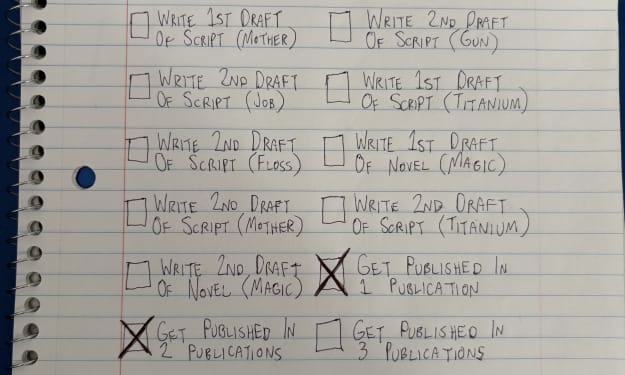
It's early March and I've now accomplished my 4th writing goal for the year of 2026. Before diving into the behind-the-scenes of it... why not tell you up front what that accomplishment was? I was published in a 2nd publication for this year. Published in Helix Literary Magazine out of Central Connecticut State University. You can read it for free right now!
By Stephen Kramer Avitabile7 days ago in Writers



Comments
There are no comments for this story
Be the first to respond and start the conversation.