
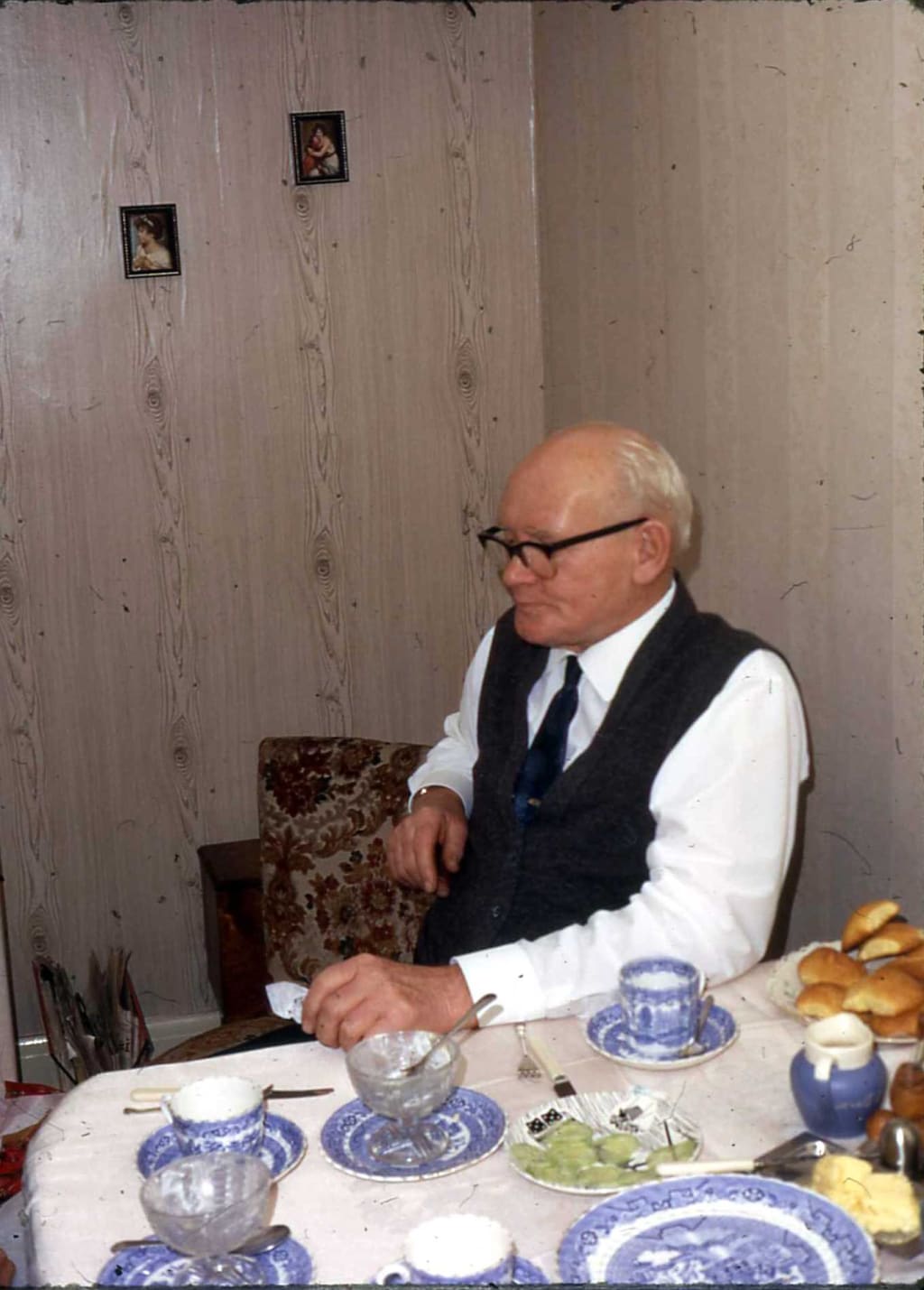
My Grandfather, Bill Hunt ,was born in 1894 and had left school by the age of 14, when he was given an apprenticeship to the silversmith at Joseph Rogers and Sons in Sheffield. Bill was a popular young man who played in both his local cricket and football teams, and who liked going to the pub with his friends at the weekends. Later he met and fell in love with his future wife, Ethel Purseglove: life was sweet.
Meanwhile however, trouble had been brewing in Europe for some time before it escalated in the summer of 1914. Germany was at loggerheads with France; Willhelm wanted the French out of the way so he could get to Russia; if France and Russia were conquered, he thought, he was well on the way to becoming a world power. Therefore he devised a plan to send his troops through Belgium to get to France. However when he asked King Albert’s permission to carry this out, he was refused, Belgium not wanting to get involved. Thereupon Willhelm invaded Belgium and sent his troops through anyway. By now Britain was getting somewhat twitchy, thinking a French defeat would leave Germany well in charge of Europe, and so gave Willhelm a deadline of 2 o ‘clock on 4th August 1914 to remove his troops from Belgium. Wilhelm ignored this deadline, and so at 4 o clock on 14th August 1914 Lloyd George declared to the nation that we were at war with Germany. Now a lot of young men didn ’t wait to be drafted, they joined up voluntarily, eager to do their best for their country.Bill Hunt was one of these young men, although he wanted to stay in his comfortable life, he thought it was his duty to go and fight. He told Ethel, that he’d been called up early ( a lie, albeit a little white one) , but, as he thought, it will all be over in a couple of months and things would be back to normal and normal life could resume.
So he was drafted into the Pals Battalion where his uncle was already a serving officer. Bidding a tearful farewell to his friends and family, he was packed into an overcrowded train, then boat until he reached the front where the fighting was in full throttle. Conditions were dirty, dire and wet, the trenches serving the soldiers as a temporary home, not the most salubrious of dwellings , being muddy, stinking and rat infested. As time went on the Battalion was sent to fight on the Somme, and the conditions there were truly horrific. To quote one Australian soldier, ‘ The conditions are almost unbelievable. We live in the world of Somme mud. We sleep in it, work in it, fight in it, wade in it, and many of us die in it. We see it, feel it, eat it but we can’t escape it, even by dying.’ Who could imagine the fear, the filth, the homesickness that these soldiers experienced? And, after 10 months or so, being given home leave, what would it be like going back to normal life, knowing that they had to go back to that hell. In 1916 my Grandfather was given home leave; he came back and married my Grandmother. How on earth would they have both felt when it was time for him to go back, for Grandfather, knowing what he had to go back to, and for both of them not knowing whether they would see each other again.
On his return to the front, the Battalion was fighting at Ypres. It was the third battle to be fought here and was also known as Passchendaele, and if possible, conditions here were worse than ever. The rain began on 31st July and was relentless, it didn’t stop for three weeks, creating mud so deep that sometimes soldiers, horses and even artillery literally drowned in it. On one of the Sorties the British were advancing along the road to get to a better vantage point, when the Germans renewed their shelling. Hand grenades exploded, bullets were whining through the air which was thick with smoke, screams and the smell of death. Hundreds of soldiers were killed, many more were wounded, my Grandfather being one of the latter. A piece of shell hit him and lodged in his skull, causing him to collapse. He lay on the side of the road drifting in and out of consciousness, trying to keep as still as he could , because in his more lucid moments he heard the clump of boots, the guttural sound of the German accent, gun shots and the screams and groans of the dying men. He realised that the German soldiers were coming along the road shooting anyone who moved. The rest of Grandfather’s battalion had by now disappeared, who knows where. I can’t imagine the fear and panic, the absolute terror those soldiers must have felt. My Grandfather said he couldn’t think how long he lay there , but at last British soldiers were walking down the road looking for survivors. By sheer coincidence my Grandfather’s uncle found him and took him to the nearest first aid station where they patched him up prior to shipping him home.
He landed in England and was sent straight to Bangour Hospital in Edinburgh where he was operated on, and became one of the first people to undergo brain surgery, having a metal plate inserted in his head to replace the part of the skull that was shattered. One of Granfather’s friends from the same Battalion had been injured earlier and had been invalided out, and he lived in Corstorphine, a suburb of Edinburgh, so when Grandfather was recovering a little, he used to abscond from hospital occasionally and meet up with Starkey as he called him, and hit the town, getting well told off on his return! However, he was a great favourite with the nurses by all accounts, and he pursuaded one of them to write a letter to Grandma assuring her that he was ok; but this wasn’t enough for her, so she duly packed a bag and hotfooted it to Edinburgh to see for herself. Quite brave really considering she had a bad dose of laryngitis and had lost her voice completely. But somehow she managed to get to the hospital and find Grandfather, and they got permission from his doctor to have the afternoon out. How they managed I have no idea, as Grandma had no voice so couldn’t speak, and Grandfather had both his eyes bandaged so couldn’t see - and all this in a strange city which neither of them knew well. Speak no evil, see no evil!
A little later, when he had almost recovered, Grandma went up to Edinburgh again to collect him from hospital, this time being marginally better, as Grandma could speak and Grandfather could see a little, although he still wasn’t feeling totally in the pink. To add insult to injury, as they were walking down the road to the station, a young girl approached him and pressed a white feather in his hand, which was the fashion at the time to give to so called cowards who refused for whatever reason to go and fight. I asked Grandfather what he said to the girl and he said ‘ I didn’t say anything , she was young, she wouldn’t know, she did it through ignorance.Hmmm. However this story ends on a note of hope as Grandfather went on to live a fulfilling life (albeit not as a silversmith as he had unfortunately lost the sight of one eye)! and the doctors went on to make more and more progress in brain surgery.
About the Creator
Keep reading
More stories from writers in Families and other communities.
Wise~Guys
— Look Behind what's in Front of You ~ Make Good Choices — Hey, So how you Doin'..! Made~Men — Mobster Movies romanticise a distinctive, elegant appearance, impeccable attire style, along with the 'Families' expressive lingo. Making their 'Bones' gave them Panache — with vintage fedoras, tailored pin-striped suits, mirror-polished wing-tip shoes adorned with tassels; with their 'Gun Moll' gorgeous dates on their arms.
By Jay Kantor25 days ago in Families
The Kind-Hearted Friend
In a lush forest, there lived a troop of monkeys. Among this troop were two young monkeys who were notorious for their mischievous behavior. Their constant pranks and antics had even exhausted their parents, who often scolded them for their wildness. In the same forest, there was a young giraffe, a gentle and innocent creature, known for his simplicity and good nature. One day, while grazing on the green grass, the young giraffe wandered into a part of the forest where the mischievous monkey duo was busy plucking leaves and fruits from the trees to eat.
By Sudais Zakwan3 days ago in Families



Comments
There are no comments for this story
Be the first to respond and start the conversation.