

By Carrie Chantler
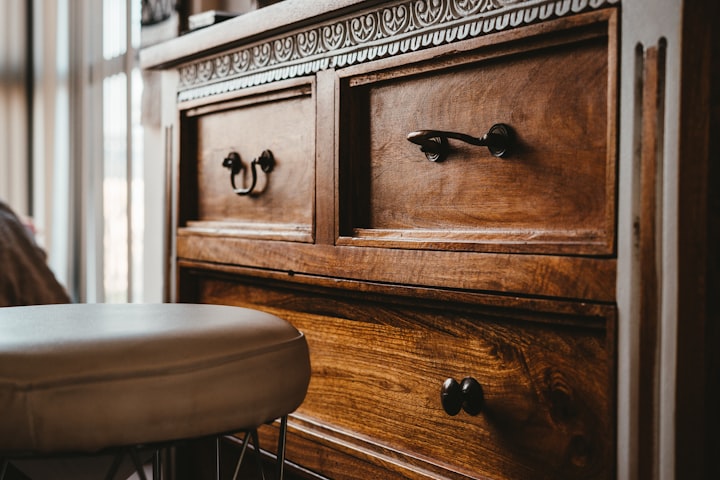
The drawer stuck that day and Kelly almost walked away in frustration. But, answering some inner voice telling her to keep tugging, she pulled at the stubborn drawer.
The swollen wood wailed at her last good yank and the drawer opened just enough for her to reach a hand in and feel for what was inside.
She felt the edges of folded flannel sheets, unused for more than a dozen winters. And peering in could see the flowered drawer liner between them and a messy stack of papers. Her hand moved over old check stubs bound together by rubber bands, a small framed photo of her older brothers as babies taken long before she showed up, childhood artwork.
She was after the Redweld expandable file in the corner, stuffed, closed by an elastic.
Kelly grabbed for it; her clutch awkward. She braced her other hand against the bureau’s dark cherry finish and wrenched it through the opening, the fat file ripping a bit.
She moved to the bed and sat, happy to be off the floor.
Inside were envelopes full of folded documents, old birthday cards, her Dad’s dog tags tumbled out on the bedspread when she jostled the file open. There was her grandmother’s birth certificate and a carbon copy of a loan document that helped pay for her brother’s college. Square black & white photos dumped out.
She’d seen images of her father during his time in the Army Air Force. But the ones she saw now amongst the random contents were unfamiliar. There he was, but in these he’s not in Guam where he’d been stationed after enlisting at 17, but somewhere entirely different.
In one, he faced the camera and wore a heavy woolen coat hanging long to his knees, buttoned all the way up, his collar tipped up to fend off the cold. He had gloves on, dark sunglasses; he was bundled up, a cap pulled over his ears. In another he stood near a motorcycle parked on the shoulder of a road, a thicket of tall trees behind him. A cigarette hung from his lips, the slightest bend of a smile too. That she recognized.
Seeing her father as a young man always jarred Kelly. Her mother was one thing. Didn’t bother her so much to see her shy mom as an introverted teen. They, at least, shared the common experience of growing up as a girl in the world. She loved knowing her mother played basketball, sucked at math, and snuck out to the roof to smoke cigarettes.
But seeing her dad in his youth, his Black Irish good looks, his athletic physique, this just felt odd. She didn’t recognize herself at all in him. And these images were new to her, but old clearly, bent and fragile. She flipped one over, “Ambleve Valley, Winter 1944” written in pencil in her father’s hand. His compact lettering uniform and straight.
She shook the folder again and more pictures fell out along with an old tie tack, a half-spent book of matches, and a small black book its once dark cover faded, worn.
The small book had a built-in rubber band to keep its cover closed. She loved that detail. It sent the signal that whatever was written inside was weighty, meaningful and unsolicited access meant peril to those with nosy intentions. She’d never owned one herself. Jotting ideas down, thoughts, occurrences, observations, memories, phone numbers how old-fashioned she’d thought.
She caught a glimpse of color amongst the black and whites of her father. In one photo, there was a woman, her head wrapped in a scarf, her face visible. Like her father, this woman wore dark sunglasses, but she could tell she was beautiful, her trench coat buttoned up, belted.
Kelly blinked several times, but the colors in the scarf remained. A white scarf with a floral pattern -- pale yellows, pinks and greens prominent against the greyscale.
In subsequent photos the scarf moved, as if blown by a breeze on that long-ago afternoon. Kelly rubbed her eyes and looked again at the pictures. In each, the colorful scarf moved by a wind, animated in the otherwise stopped-in-time images. Each one. All other images stagnant, but for the gentle movement of this woman’s floral scarf.
There she is standing close to her father. Their hips touching. His arm slung across her shoulder. Her arm crossing over herself, her hand resting on her dad’s tum.
She turned the picture over. “Anneke. June 1945. Ardennes.” Again, her father’s tight script. She may not have sensed a connection with her father in these images, but she thought she could feel the heat of his passion for this woman. Anneke. Who was not her mother, Ruth Denise Pisternak Sullivan.
Kelly took the little black book in her hand, moved the rubber closure over and opened it.
Notations she read on its pages didn’t make sense to her.
“Low points. Must stay.” “Demobilization stalls.” “Don’t mind. Could remain.” “Les troupes se sont réunies dans le dos des commandants. Les manifestations semblent imminentes.” “12 got got.” “Les agents acquièrent de l’or. La Suisse est spectaculaire.” “Anneke, tu es sublime. Tu es mon amour. Tu es ma vie.”
What was this? Her father was a military mechanic who repaired machinery, that’s what he’d always said. Agents? Agents of what? Switzerland? When did he learn French?
Kelly sat on the edge of her parent’s big bed, still, but her body vibrated both with wonder and confusion, warmth and dismay.
Her father had lived part of his life unknown to her. Kelly shielded parts of her life from her parents too, but never imagined they’d done the same. The equanimity of the moment suddenly meant everything: her parents were adults with adult pasts, just like her. Kelly wanted only to tread water in that instant forever.
Losing her dad, years before, was nothing to the more recent loss of her mother. Somehow the job fell to Kelly of cleaning out her parent’s house, her childhood home. The boys, her brothers, would come next week to handle the estate sale.
She reached for the Redweld with one hand and began to return to it the photos and papers.
But she could feel there was something else in the folder. Kelly fully upended the old file and slipping out was a tin can with the words “Genuine Phillips Milk of Magnesia Tablets” blazoned across its dented lid.
Given the sound made when the tin landed, Kelly figured it held loose change, maybe foreign. Like the drawer, gaining entry was not easy, but her fingers pried open the pinch of the shut lid.
The coins inside weren’t old francs though. When she opened the tin the light from within shocked her. There neatly stacked in three rows were twelve one-ounce ingots of gold. Untarnished by time, their glow beaming up at her, Kelly’s mouth opened and she stopped breathing.
Each ingot was engraved with the words “Swiss Bank Corporation,” “One Ounce Fine Gold 999.9.” Twelve of them.
She stood up holding the tin in her hand and walked into the fresh air of the sun porch off the bedroom, all of its windows wide open, the buzz of the neighborhood coming through the screens.
Kelly had left her cell out there, on the bookshelf. She set the tin down and grabbed her phone. With shaking fingers, she Googled the price of gold, that minute’s rate. $1,732.10. Times 12. $20,785.20.
“Thank you, Dad,” she said. “Thank you, thank you, thank you.”
About the Creator
Carrie Chantler
I'm an editor who works in the non-profit sector. I am a former newspaper reporter and remain a news junkie. Prior to my journalism career, I was a professional actor in Chicago working in comedy and musical theater. I reside in Central NY.
Keep reading
More stories from writers in Families and other communities.
Wise~Guys
— Look Behind what's in Front of You ~ Make Good Choices — Hey, So how you Doin'..! Made~Men — Mobster Movies romanticise a distinctive, elegant appearance, impeccable attire style, along with the 'Families' expressive lingo. Making their 'Bones' gave them Panache — with vintage fedoras, tailored pin-striped suits, mirror-polished wing-tip shoes adorned with tassels; with their 'Gun Moll' gorgeous dates on their arms.
By Jay Kantor21 days ago in Families



Comments
There are no comments for this story
Be the first to respond and start the conversation.