
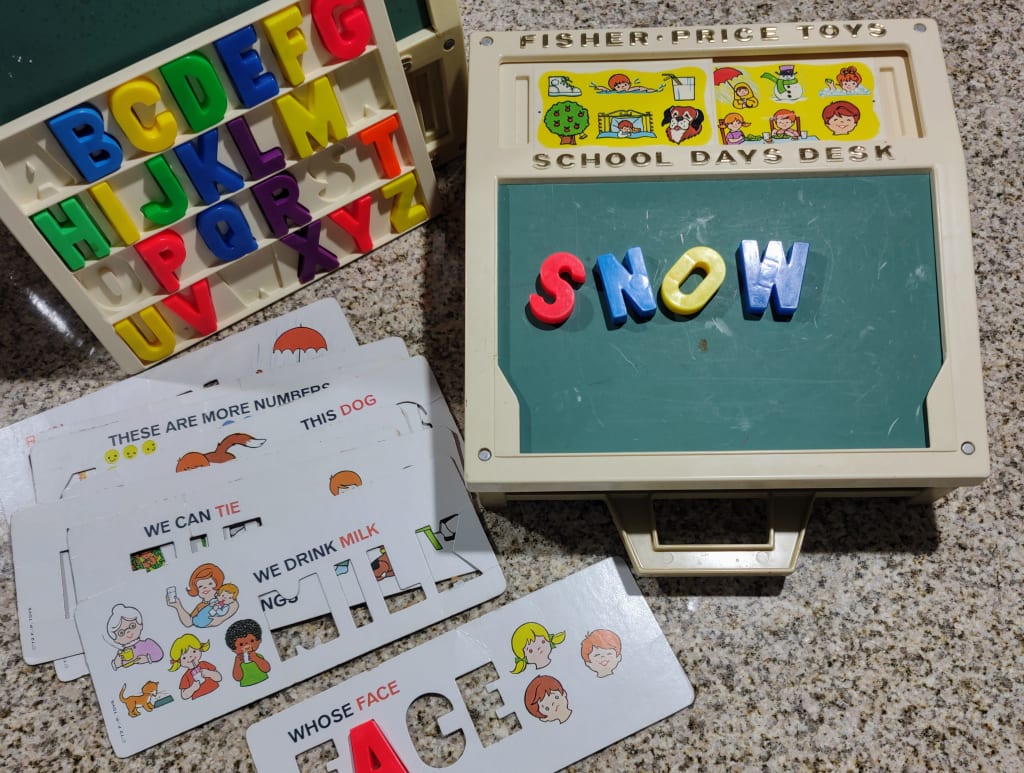
SNOW was the first word I recall learning to read. I was around three years old in the early 1970’s and had a wonderful contraption called a Fischer Price school desk. It had large cards with holes in them that the chunky, plastic alphabet letters that are still stuck to refrigerators all over America today, nestled into perfectly. Each cutout card spelled a three-to-five letter word and had a simple sentence and picture to match drawn upon the face of the card. The SNOW card was my favorite. Living in southern Louisiana at the time, snow was not something I ever remembered experiencing first-hand. Something about the smiling snowman in his warm scarf and hat looking on as children played with their dog in the falling snow and deep drifts always made me long to play in the snow. I can close my eyes and picture that card with the letters so lovingly placed in the holes. It’s one of my earliest memories and is as clear as the day I first played with the cards.
What is it that makes certain memories so indelible? It makes sense that traumatic events etch themselves into our memories as they have certainly shocked us and caused a permanent change in our lives. But what about others, such as the memory of SNOW. I don’t remember any of the events surrounding that picture memory. I don’t remember who gave me the gift, how my bedroom looked, my other toys, etc. Just that fleeting glimpse of SNOW painted in color in my brain’s recesses, destined to pop up at odd times when looking for toys for my own children, or peering out the window to see the world blanketed in white fluff.
Perhaps it was a prescient knowledge that I was stepping into an entirely new universe. Did my young mind recognize what a monumental difference reading would make in my life? Surely it couldn’t anticipate the worlds and cultures and knowledge reading unlocked? But perhaps it did. My mother and adoptive father were both highly educated and read constantly. They were well-spoken and very doggedly encouraged proper grammar from the moment I talked. With noses always stuck in books and discussing ideas and new knowledge when they came up for air, perhaps I felt like I was finally to be admitted to the elite cadre of those who can read!
Over the years I’ve learned about new cultures, historical events, scientific principles, fantastical ideas, how to survive pregnancy, how to draw and paint and knit and play guitar. I’ve laughed and loved and wept in sorrow along with such devastatingly real characters that they seemed alive and possibly just next door. I’ve adapted my mothering and leadership style with lessons learned from four-star generals, storytelling grandmothers and Winston Churchill. I’ve known intimately the thoughts of Marines and ladies’ maids and shivered in terror with monks awaiting Norse conquest. I fell in love with Sci-fi and fantasy and dreamed of dragons and elves and magic with which to thwart evil. I became more open-minded as I read about cultures that are foreign to many Americans. I learned to respect and admire parts of foreign cultures and philosophies from books such as Shogun, The Thornbirds, and War and Peace. I learned about ancient civilizations from The Iliad and the Odyssey, books on Egypt and Mesopotamia, and even from the mysteries from Elizabeth Peters that involved archeology and from Lindsey Davies that were set in Rome A.D. 72 under the rule of Emperor Vespasian. With every page read, I understood more and more of the endless ways that humans devise to shape their lives. One can’t help but become more open-minded when presented with the thoughts and philosophies and cultures of others. If you pay attention at all to the lessons presented in such an endless education, you must become less judgmental, more compassionate, and understand the depth of the human experience. In my opinion, we do ourselves and our nation more harm than we realize by not treasuring good books.
What of television and videos? There is no movie, no matter how good, that can accomplish in 2 hours or less what a book can. While I do love to watch movies, the details that get lost in translation make their story lose at least a bit (and often a quite large amount) of their color and depth. Movies are usually a pale shadow of the original story. It pains me when friends and family who don’t read talk about how much they love a movie that is based on a great novel because I absolutely know that they are missing an even greater story most of the time.
I remember my astonishment the first time I met a family who didn’t like to read. How sad, my young mind thought. Followed by a rapid, I wonder what in the world they do for fun?! I also remember moving into my first apartment and the very first thing I set up was my own set of homemade bookshelves. They were stained pine boards, 12” wide and 8’ long, held up by painted, black, concrete blocks. Over the years I’ve owned thousands of books though they now inhabit classier digs. At one point I committed heresy and sold almost all of them except for my absolute favorite few series by my favorite authors. My mother was shocked. But I had to make room for more and I had no more room as my family grew.
My children loved to read books with me when they were small. Many of my most treasured memories involve sitting in a large recliner or rocking chair, one child draped over each leg and one in the middle, reading a story to them and cuddling. I made the voices come alive, wove emotion into the words, and shared my love of deliciously written tales with them. We read the Laura Ingles Wilder books and the Harry Potter series. We read Shakespeare and Sherlock Holmes and the original Tarzan and Kipling poems. We read about Dora, Bob the Builder, Clifford, and Jedi Knights. Sometimes I read treasured books I kept from my childhood and the children loved them as well. Richard Scarry’s Best Storybook Ever and Uncle Remus’ tales of Brer Rabbit, Brer Fox, and Brer Bear were two of my favorites! I memorized Brown Bear and Fox in Sox to the point I could recite them in my sleep.
The two oldest, both girls, loved to read and took off on their own into the reading world. They were quite disenchanted with the AR program at school because, in my humble opinion, the books are horribly dull and wouldn’t hold the interest of a gnat. Rewarding quantity over quality is a good way to make children hate reading. I started giving them rewards for reading the books they picked for themselves. One became Valedictorian and they now send me recommendations on books to read. They both are strong, independent, and compassionate women and I can't help but think that early reading gave them a headstart in life.
My youngest, my wild and headstrong son, took longer to catch on. He loved to be read to but did not like to put the time and energy into reading for himself. I began to despair of him ever loving to read on his own until the day he picked up a book about a clan of warrior cats, by Erin Hunter, that his sisters had read a little of to him. No one had time to read more to him that day so he finished it himself. From that day on every time he asked for another I bought the next 3. I eventually bought every single one of those books until we ran through all I could find, over 25 books at the time. He would play-act the scenes and his eyes would shine with excitement as he battled imaginary evil foes with a stick-sword and bathroom-towel cape. This is what I had been waiting on for him! From there he progressed to a young Jedi Knight series and eventually to historical and military non-fiction. He still prefers to watch tv and You-Tube and listen to podcasts. But at least I know that when he really gets into something he knows where to find even more information. His reading skills and vocabulary also were on a college-level by middle school. He placed high on standardized reading tests and this was a kid who hated school in-general! He never excelled academically but that was o.k. Not every child has to go to college and compete academically. He is a born leader and an individualist. He built his own forge at 14 years old and made his own knives. He learned survival skills and land navigation and by 16 I would have trusted him before most grown men if lost in the forest. He is self-taught on the guitar and exceeded my abilities years ago. At 20 he is a confident and eclectic old soul who listens to music of every genre and makes others around him laugh. Expanding his mind started with reading. Challenging a mind to think is like working your muscles at the gym. If they aren’t used, they atrophy.
Reading now is space-age stuff. I have, in my pocket, instant access to more books than the famed Library at Alexandria. With just a few touches of my fingers, I can read biographies, romance novels, and books on the miracles of controlled breathing techniques and calligraphy. I can meet and know the thoughts of a person dead some 2000 years or a girl on the other side of the globe in the Australian Outback who happens to love saltwater fish and wrote a small pamphlet about their care. Sometimes I miss the feel of paper under my fingers and the comfort of curling up with a weighty tome in my hands while I snuggle under a lovely blanket and perhaps have a snack and a warm drink. But the benefits of being able to read so easily and less encumbered while in the waiting room, a restaurant, or on the biking trail usually outweigh these thoughts. I still buy hardcopy books too. Especially my art books and my favorite books that I want to be able to read even if an EMP hits the Earth. I only collect hard copies of select series but I’m still inching back up towards one thousand again. Just 100 years ago such a collection could have only been owned by the very wealthy. We are lucky to live in such an age that we can touch other worlds so easily and that allows anyone at all to join that elite cadre of those who can read!
About the Creator
Kellie Griffin
ER Nurse, Mom, watercolor painter and student of life. I love to write anecdotes and observations on nursing, motherhood, life and humanity.
Keep reading
More stories from Kellie Griffin and writers in Families and other communities.
The Trauma After the Trauma
It was my turn on the Trauma rotation in our ER that night. My first patient was from a head-on motor vehicle accident or MVA as we call it. He came in with a serious facial laceration that had hit an artery and with a compound left leg fracture obvious to all by the sideways right angle his lower leg made to the upper.
By Kellie Griffin5 years ago in Journal
Wise~Guys
— Look Behind what's in Front of You ~ Make Good Choices — Hey, So how you Doin'..! Made~Men — Mobster Movies romanticise a distinctive, elegant appearance, impeccable attire style, along with the 'Families' expressive lingo. Making their 'Bones' gave them Panache — with vintage fedoras, tailored pin-striped suits, mirror-polished wing-tip shoes adorned with tassels; with their 'Gun Moll' gorgeous dates on their arms.
By Jay Kantor20 days ago in Families
Family Is Complicated
No one tells you that family is the first place you learn contradiction. They tell you family is love. Blood. Home. They don’t tell you it is also silence that stretches for years, arguments that begin over nothing and end with everything, and love that sometimes arrives disguised as disappointment.
By Jhon smith4 days ago in Families


Comments
There are no comments for this story
Be the first to respond and start the conversation.