
Leaving Hope Behind
An Uncomfortable Immigration Tale


My great-grandmother, Cristiana Coppa, and her four daughters, one heavy with child, climbed gingerly up the slimy ladders of steerage section in the White Star Line's Ship, RMS Romanic, stated to be the fastest in the fleet. Her son-in-law, Antonio Putano, had heard they were approaching the dock at Boston Harbor and roused them all to join him on the deck to see, for the first time, their new homeland, America.
They stood topside in the raw, biting winds of Massachusetts in February, surveying a bleak, colorless brick and glass building set on a wooden plank dock. Not what they were expecting, having heard from previous immigrants about the magnificent Statue of Lady Liberty and the elegant grounds of Ellis Island in New York City.
Still, though, this was America, where they would no longer have to forage for food in the woods, hiding from the rebels and bandits, while struggling to barely survive. They would soon all be employed and become wealthy Americans.
Wiping the grains of sleep out of her eyes, Agnes Coppa, the 18-year-old raven-haired beauty of the family, who had left behind admirers plenty in their little village on the side of a mountain in the region of Abruzzo, was unimpressed with the bare-boned dock and the utilitarian processing center. In her native tongue, a regional dialect of Roma Italian, Agnes complained, "Mama, this is America? Where are the gold streets and beautiful homes? I don't think I'm gonna like it here."

Mama Coppa, distracted by her other daughter, 7 months along in her pregnancy, enduring yet another bout of seasickness, simply shook her head at Agnes and replied angrily, "You always make the trouble. Agnes. You never satisfied. If you get a rose you want the whole rose bush. You'll make do. You'll make do, just like everyone. stai zitto"
With that, Agnes furiously flounced back down to steerage to help Antonio and Margrete with their luggage, thus avoiding Mama's evil eye, which she had seen one too many times during this long, disgusting voyage.
Seasickness, which affected the crew just as much as the passengers had made a nauseating mess out of the bunks and hammocks in their section of the boat. Steerage was where the paupers and lower crew rode and no one except Agnes complained. They were just lucky to be given the opportunity of a lifetime, most believed.
For the poor from other countries, going to America was like buying a lottery ticket. You might not win the grand prize. But you wouldn't stand a chance of winning unless you bought the ticket.
Antonio, Margrete, and Agnes hauled up bags and cardboard suitcases from the lower deck, slipping and sliding on the wet ladders. It took them three trips to retrieve all their belongings. When they finally stopped to rest and find Mama and the other sisters, they were told the line for the medical inspection had begun to queue, and they had to quickly haul their belongings to the pier and get in line, all the while scanning the bedraggled crowd to find Mama and the other girls.
Antonio calmed the ladies down by promising they would find them before the train left that evening for Albany and all points West. Waiting in that line seemed to take forever and the wind blew chillier as the sun began to fall over the new land they had just arrived on. They finally made it to the Immigration and Customs building, stomping their feet and rubbing their chapped, red hands to warm up as they waited for their turns.
An Italian-speaking man in a dapper business suit addressed a group of 100 new arrivals and announced the procedure. First, they had to produce their identification, then get in another line, one for the women and girls and the other for the men and boys. That line was for the medical and mental inspection.
Antonio and the ladies passed the doctors' inspections for yellow fever, cholera, typhus or ship fever, smallpox, eye disease, scarlatina, diphtheria, measles, or relapsing fever. All these diseases were subject to quarantine at ports of entry.
They also passed the mental illness verbal questions recited off to the group by the official, as none responded with a yea to these questions, 'Does your mental condition prevent you from work? Raising a family? Interacting with fellow citizens normally? Are you prone to the vapors or impure thoughts?'
With a few more questions of parentage, country, state of origin, name, occupation, and sponsors, the family group made it onto the last line where their visas would be stamped and they would be officially pre-Americans. It was in this line where they found their youngest sister, Antoinette, sobbing inconsolably, even though she grasped her coveted visa in hand.
"Anty, Anty, what is wrong? Where is Mama and Maria?" Agnes was the first to blurt out.
"They took them away. We cannot see them," Antoinette sobbed.
"What? Why, why would they do this? Who do I speak to?" Antonio demanded.
"It's no use, Antonio. They give me this paper for the family," she handed the official document to Antonio.
He could read just a bit of English and he deciphered the rest from the inference, " Persons unable to take care of themselves and will become a burden on public funds are to be deported immediately upon arrival,"
"I knew it. I knew I should be the one to accompany Maria. I was afraid this would happen. To arrive in America pregnant without her husband was not a good way to start her new life. She and Margrete could have switched identities to come into the country," he opined, feeling guilty for not offering his suggestion until it was too late.
"I should have told her to do this," Margrete commiserated with him, also feeling the guilt wash over her.
"Nooo!" Wailed Agnes, as she turned in circles, looking for an official to scold in order to make them change their minds. With the throngs waiting in the cavernous room, she was unable to locate anyone who looked important enough to help them.
"Where, Where, you ninny? Where are they? I will go and get them," Agnes shrieked to Antoinette, shaking her sister by the shoulders.
"I, I don't know. Stop, Agnes. They are gone. They are going back to the ship. You're hurting me," a frightened Antoinette snapped back.
At that, Agnes sunk to her knees onto the dirty linoleum wailing her heart out theatrically, and cursing in Italian loudly enough for a guard to approach the group with concern.
Upon seeing the uniform, Agnes gazed up at him through tear-filled eyes and moaned, "They have taken my Mama and my sister away. I will never be happy again. You must get them back!"
Not understanding her words but seeing her anguish, the guard simply patted her on the shoulder and murmured gently, "There, there, young lady. Everything will be alright," handing her his handkerchief and walking away, head down.
Hers was not the first meltdown he had comforted that day and it would not be the last. Strange language, strange rules, strange customs with strangers all around them. The ship landings were either joyous or heartbreaking for the newcomers, and this group had experienced the latter that day.
In a flash, all three girls were Antonio's responsibility, and he had to rise to the occasion. Herding them all back to the wharf to retrieve their bundles and luggage, he tried to comfort them with promises of getting Mama and Margrete on a later ship once they themselves were settled in America. There were trolleys leaving the pier every couple of hours and they managed to squeeze aboard one with all their goods, including Mama's and Maria's, which had been forgotten in the rush to deport them.
He warned them of one thing only as they left the dock, searching in vain for glimpses of Mama Coppa and Maria on the top deck of the departing ship, Romanic, "We stay together from now until we reach our family in America. Stay tight. Don't let people crowd in between us, even if we lose our belongings. Understand? Familia!"
They sulkily agreed. Agnes was still pouring out tears and wiping her nose on her coat sleeves as the trolley lumbered down the line to the Boston/Albany train station. Once the trolley dropped them off at the station there was another immeasurable line to wait in. At least this new line was inside the steamy warm station which was lit up with gas-fueled lighting. Amazing! Not a single candle in sight!
Arriving at Union Station in Albany to board The Westshore Train that ran all the way to Buffalo, NY, they stuck together, as told. There was a three hour delay, which they spent huddled over their baggage, listening to their stomachs growl. When they finally boarded they talked about the future and what it would be like living in this new place.
Agnes could not join in the conversation. For her all the future happiness had been stolen by the deportation of Mama and her sister. She planned on never smiling again and decided that, as soon as she could, she would wear her black dress and shawl in mourning, taking them off only to launder.
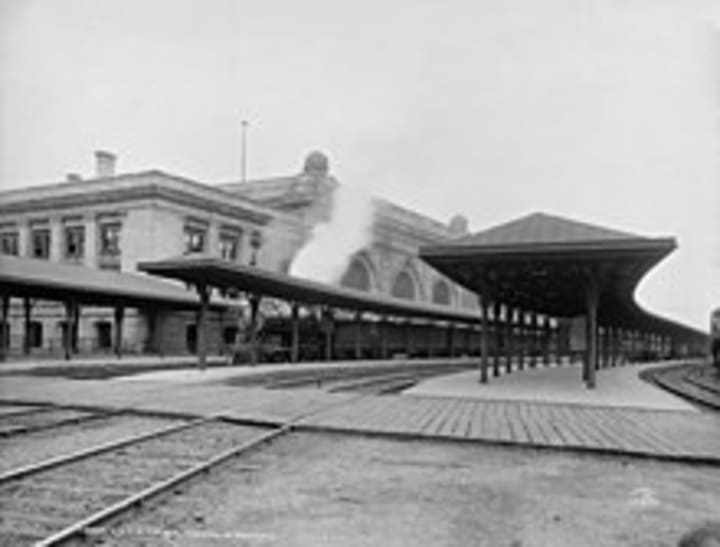
The family departed the train at Medina, NY, to begin their new lives in America, disheveled, sad, but safe and together.
The New York Central Train Station in Medina, New York, was a marvel for its time. It was the largest ever wooden plank train station in the country. Medina was a growing, bustling community due to the fact that both the New York Central Rail Road and the Erie Canal ran through the city, bringing people and goods from all over the world.
It was a hub of commercialism, home to one of Heinz Ketchup's early factories, and talented artisans and tradesmen from every country in the world. This is the city that many of my ancestors called home after arriving from Italy. This was also the first American home of my grandmother, Agnes Coppa, the histrionic young woman who had lost her Mother and older sister at the port in Boston.
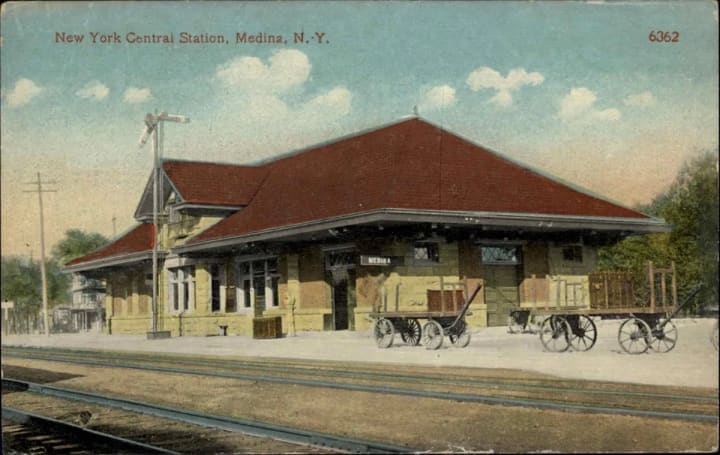
The family stayed together at a relative's home until Antonio and Margrete departed for a better opportunity in Binghamton, New York. Antonio was a boot maker by profession and the Endicott/Johnson shoe company was hiring skilled artisans.
There was a joke passed among the Italian immigrants in the cities surrounding the shoe company. "When an Italian gets off the boat, what does he say first?"
"Which way EJ?"
Binghamton, Johnson City, and Endicott were all, in effect, factory towns fueled by the intuitive dreams of George F. Johnson. Johnson believed that workers who made a business successful needed a fair deal, and their lives should be pleasant and enjoyable as well. Many people have since argued that factory towns were despicable in some way, shape, or another. However, my immigrant family benefited greatly from the EJ Company towns.
Agnes, now alone in Medina with her 15-year-old sister, Antoinette, longed for her family to be whole again. She never recovered from the loss of her Mama and older sister, Maria at the Boston Port, and she never saw them again in her lifetime. It was a constant, putrifying wound to her psyche that she would not recover from, and adding to that was the loss of her other sister, Margrete, and brother-in-law, Antonio.
Being a talented seamstress, Agnes supported Antoinette and herself by working at a small sewing operation in Medina. The pay was $6.00 a week plus room and board. That was the average pay in the early 1900s. More than she would have made singing in her family band in Abruzzo, and more than any other work she could have found in her hometown.
She missed her many suitors in Italy and felt ignored as just another "Italian girl" in the American city she lived in. At night she would dream of the picnics her family band played at and the adoring men applauding her singing and Mandolin playing in her picturesque Italian village on the side of a mountain.
One evening after dinner at the boarding house she was sitting on the front porch playing her Mandolin and singing for the group of Italian girls she met at the house when a short, trim, very handsome man stopped on his way down the street to listen to her beautiful voice.
Too shy to speak with her, Edigio Ruspantini kept walking by the boarding house every evening he was in town, hoping to see the raven-haired beauty again. Weeks went by without seeing Agnes, but he kept walking her way.
It didn't take the other girls long to figure out that this man was interested in one of them. They just couldn't guess who, until another evening when they convinced Agnes to sing for them again on the porch, so they could display themselves attractively for this possible suitor.
Giggling, the girls approached Agnes, "Please, Aggy, Please sing for us again. We miss hearing your voice. Play your country songs for us- we are homesick!"
She finally agreed, and dressed in her mourning clothes with a black crochet shawl over her head, still in distress over family members she missed. She brought out her Mandolin and began singing a soulful melody from her family band's repertoire. Tears fell from her eyes as her soprano voice soared in sorrow for those left at home and those who had left her alone to fend for herself and Antoinette.
The porch was resplendent with beautiful Italian women wearing colorful skirts and carefully coiffed hair. But, when Egidio heard the sweet melody and hurried closer to listen, all he could see was Agnes. Even in her mourning clothes and black shroud over her beautiful hair, she shone above the fancy gaggle surrounding her. He was in love and love emboldens even the most timid of men.
Approaching the porch he humbly removed his hat and stood silently listening to his siren's songs. The giggling pack of girls became quiet when they noticed who this handsome man was concentrating on. Disappointed, but curious, one of the girls nudged Agnes and whispered, "My Bella, this one is for you."
One by one the others made their way into the house and all immediately ran to windows in the sitting room to spy on Agnes and her new suitor.
"Please, come sit," Agnes crooned, "what can I play for you?"
"Play a wedding tune for me, please, and for you also by my side," Egidio replied in perfect Roman Italian. A man of few words, he always knew just the right ones to say.
Three months later they married, surrounded by the family who preceded them on their journey to a new land, a new life, and a new love.

About the Creator
Tina D'Angelo
I am a 70-year-old grandmother, who began my writing career in 2022. Since then I have published 6 books, all available on Barnes and Noble or Amazon.
BARE HUNTER, SAVE ONE BULLET, G-IS FOR STRING, AND G-IS FOR STRING: OH, CANADA
Reader insights
Outstanding
Excellent work. Looking forward to reading more!
Top insights
Expert insights and opinions
Arguments were carefully researched and presented
Eye opening
Niche topic & fresh perspectives
Heartfelt and relatable
The story invoked strong personal emotions
Keep reading
More stories from Tina D'Angelo and writers in Families and other communities.
Waking in the Ether
A fragile world existed inside of my toddler mind. A world which my mother never had the patience, nor the interest in understanding. Each violent tremor and panicked scream, resulting from my insidious night terrors brought only derision and a scolding from this paragon of warmth and motherly tenderness.
By Tina D'Angelo3 years ago in Families
A Transparent Look at Vocal Challenges and Top Stories
Almost three years ago, we shared a resource article that served as a place for people to suggest new challenge prompts. We thought it would be a good idea to refresh that thread, and take the opportunity to answer a few common questions about top stories, how challenges are judged and how submissions are reviewed.
By Vocal Curation Team2 days ago in Resources




Comments (3)
My heart broke so much for Agnes but I'm so happy she got a happy ending!
I could read more of this.
Very interesting family history. People are always complaining about immigrants but they forget that only 2 or 3 generations back their families were immigrants. Great story!👍👏