


For some, Christmas is the most exciting time of the year. For others, it is one of the main religious holidays of the year. For me personally, Xmas is about spending time with our loved ones, giving and receiving some lovely gifts --- and eating good food!
We all know that Christmas is the celebration of the birth of the Lord Jesus Christ, and some of the church services are beautiful with candles and carol singing, and, of course, “The Christmas Message.”
For some, who may be of different ‘faiths,’ Xmas is still celebrated but for different reasons.
In Scandinavia, the Norse celebrated “Yule” from 21st December through to January = the “Winter Solstice.” The worst of the winter was behind them and they looked forward to the longer days and extended hours of sunlight. In recognition of the return of the sun, fathers and sons would bring home large logs, and they believed that each spark from the fire ‘represented’ a new pig or calf that would be born during the coming year.
In Germany, people used to honour the pagan god Odin during this time. They were terrified of Oden because they believed that he made nocturnal flights through the sky to observe his people, and he decided who would prosper and who would perish. They chose to stay indoors ‘because of his presence.’

“Saturnalia” was celebrated in Rome, in honour of the god of agriculture --- “Saturn.” Starting with the week leading up to the Winter Solstice and for the whole month, this was a ‘hedonistic time.’ Food and drink was plentiful and the normal Roman social order was turned upside down --- the slaves became the masters, the peasants were in command of the city and businesses and schools were closed so that everyone could enjoy the celebrations.
Also at this time in Rome, the “feast of Juvenalia” was observed which honoured the children of Rome. Those of the rich classes of Rome celebrated the birthday of “Mithra” who was an infant god, born of a rock. This day was 25th December and for some it was the most sacred day of the year.
To unite all the people into Christianity, Pope Julius I chose 25th December as the day Jesus Christ was born, and along with this, many of the traditions were continued under this celebration. The Bible does not tell us when Jesus Christ was born, but as the shepherds were herding their sheep outside, it is thought to be around springtime. For me personally, celebrating the birth of a new baby (at any time of the year) is a wonderful time as it is celebrating new life --- and life on this Earth is beautiful!

“The Feast of the Nativity,” as Christmas was first called, spread to Egypt by 432 and to England by the end of the 6th Century. It’s quite interesting to read that by the Middle Ages, Christianity had near enough replaced pagan religions. At Christmas, ‘believers’ attended the church services, then went home and celebrated raucously (boisterously and disorderly) in a drunken, carnival-like atmosphere (similar to today’s ‘Mardi Gras). Every year, a beggar or student was ‘crowned’ the “Lord of Misrule” and others played the part of his subjects. It sounded great fun. The poor would go to the houses of the rich and demand their best food and drink. If the rich refused, they would be ‘plagued’ with mischief (sounds like ‘Trick-o-Treat’ at Halloween!). It became a time when the rich, reminded of their ‘Christian duty,’ would entertain those less fortunate than themselves.
Christmas hasn’t always been celebrated in England. In 1645, Oliver Cromwell and the Puritan forces ‘cancelled’ Christmas. When Charles II re-took the throne, Christmas was restored. When the English separatists (pilgrims) moved to America in 1620, they did not celebrate Christmas. In fact, the celebration was outlawed in Boston for the years of 1659 to 1681 (anyone celebrating Christmas was fine 5 shillings). Christmas was finally declared a federal holiday in 1870.
The famous English author, Charles Dickens, wrote the classic holiday tale “A Christmas Carol.” The message from this tale is: “the importance of charity and good will towards all humankind,” and this struck a very powerful note in the United States and England. It also showed members of Victorian society the benefits of celebrating Christmas.
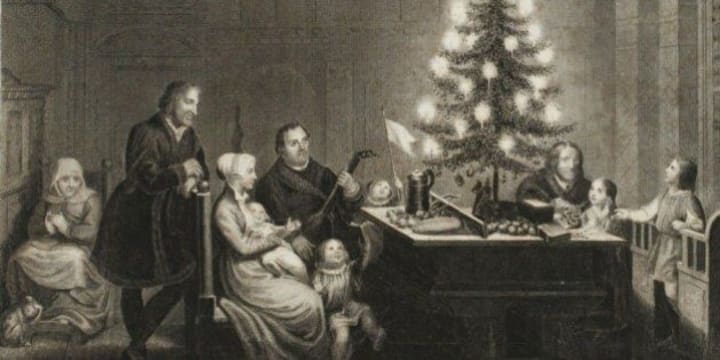
As time went on, more and more ‘traditions’ were absorbed into the Celebration = giving gifts to children / decorating the tree / sending cards / and so on = until we have the Christmas we have today, in 2020 --- and what fun it is too!
Here are some “Christmas Facts”: 1) each year, 30-35 million real Christmas trees are sold in the United States. 2) The first “eggnog” was made in the United States in 1607 in the Jamestown settlement. 3) The Salvation Army has been sending Santa Claus dressed donation collectors into the streets since the 1890’s. 4) “Rudolph” was the product of Robert L.Mary’s imagination in 1939. 5) The “Poinsettia” plant was named after Joel R.Poinsett, the American minister who brought the red and green plant from Mexico to America in 1828.
The English = Christmas --- “Mass on Christ’s Day”
The Spanish = Navidad
The Italian = Natale
The French = Noel
The German = Weihnachten --- “hallowed night.”
Today, buying for Christmas can start in the January sales (if you can remember where you put the stuff for December!). Certain shops start their Xmas promotions in August, and we all know about the sales in November and December. This year is different because of covid-19 and the rules that are in place to protect us, but as long as we follow those rules --- we can still have a Cheerful and Happy Christmas. It may be quieter than normal but, to a certain extent, it is up to us to make this Xmas a really fantastic one!

“It’s Christmas!”
(My research comes from History.com and Britannica)
About the Creator
Ruth Elizabeth Stiff
I love all things Earthy and Self-Help
History is one of my favourite subjects and I love to write short fiction
Research is so interesting for me too
Keep reading
More stories from Ruth Elizabeth Stiff and writers in Families and other communities.
MISHELLE'S SPECIAL DREAMS
CH.1 HAPPY 18TH BIRTHDAY There was such a happy atmosphere on Mishelle’s birthday that even the sun seemed to be smiling. The sky was royal blue and there was no breeze to stir the carnations that were growing enchantingly in the grounds of the mansion. Jack and Anne, Mishelle’s parents, had hired a banqueting room within the 15th Century mansion to celebrate their eldest daughter’s 18th birthday. And what day it proved to be!
By Ruth Elizabeth Stiff5 years ago in Families
Christmas Abroad: Celebrating the Holidays Without Family
I moved to South Korea in 2017. I was twenty-two years old and excited to start my career as an English Second Language Teacher. With a Bachelor's degree and six hundred dollars in my bank account, I set off for Busan.
By Kera Hollow28 days ago in Families
Mutants for Dividends: How Bioengineered Animals Feed Profits, Not Life
That little “bioengineered” sticker on your groceries? It’s not a warning—it’s a confession. America didn’t just change food; it rewrote nature’s code to keep profits flowing. Too bad your body—and the animals—are the crash test dummies.
By Living the Greatest CONSPIRACY Theory. By RG.7 days ago in Families




Comments
There are no comments for this story
Be the first to respond and start the conversation.