
Is Television a Major Factor in Children’s Aggression?
Is your child aggressive sometimes?

The influence of television on children's aggression has become a hotly debated topic in recent decades in psychological, sociological, or interdisciplinary studies.
With the 1960s - when the mass expansion of two phenomena was observed at the same time: that of school violence and children in general and that of the development of television (this is the period when any family began to have at least one television), it became a direct correlation between them.
In the debate over the influence of television on children's aggression, an initial distinction is needed: that between large TV consumers - over five hours of daily viewing and small TV consumers - under two hours of viewing.
Children are, unfortunately, the most exposed and often fall into the first category, as parents sometimes rely on television to occupy their time. Thus, television is considered largely responsible for the occurrence of certain aggressive behaviors in children and adolescents. Combined with today's influence of extremely violent computer games, there is a doubled risk.
Specialists, who dealt with the subject of the influence of television in children's aggression, revealed a first risky phenomenon - that of desensitizing the child, who is no longer so sensitive to violence itself, to acts of violence and its victims.
Children become accustomed to the aggression shown daily on the screen, thus becoming accustomed in real life to seeing and even committing violent acts. Other studies show another effect on large TV consumers of early age: isolation, withdrawal from normal social life, alienation from peers, and withdrawal in front of the screen.
When we think about the influence of television on children's aggression, the essential idea is: the media is one of the main sources of stimulating violence by presenting aggressive messages.
Children are frequently exposed to various violent stimuli - violence in language and actions - stimuli that increase the possibility of giving birth to violent behavior. In many shows and especially in movies, children learn that violence is the only or best way to solve a problem and get out of a difficult situation.
The positive way in which violence is often portrayed in many films - the positive hero adopts various violent behaviors, and these are admired - has a clear influence on children's attitudes, extremely influential. Moreover, if they find such a movie hero as a model, the influence grows risky.
Admiring and wanting to be just like a staff played by Chuck Norris (just one example) involves shaping your behavior to resemble your hero. Violence often becomes a value, the aggressive hero always finding justifications and being admired and applauded.
Some authors talk about the need to raise awareness and empower the media and key people in this industry, and to reduce the influence of television on children's aggression, they recommend: first, warning viewers of programs that will contain scenes of violence.
However, it is observed that this method has obvious shortcomings in the conditions in which children under or over 12 years old are allowed to watch movies which, although they do not show bloody scenes, instead present extremely diverse acts of violence valued and violence in language.
Another problem reported by specialists is the news broadcasts: they present real-life violence, are accessible both as a time and as a warning to children, and can thus lead to that desensitizing effect. Too much emphasis is placed not on the truth, but the shock of the audience, especially when it comes to the reconstitution of crimes or rape - which is far too brutal.
News broadcasts also pose a risk through shocking images of people killed in various accidents, abused children, tortured animals. Such real information may and should not be presented without relying on the audience's shock.
Especially because the news is present in an extremely accessible time slot and because there is a need for information, which makes adults watch these programs and allow children to watch them, it is necessary to hold those who create these shows accountable.
Thus, the influence of television on children's aggression is done through various programs, from movies, news, entertainment shows, and even cartoons (some channels broadcast without any warning certain animated series such as South Park or Family Guy, but these cartoons are created for adults, presenting various forms of violence in language and act and being extremely sarcastic and aggressive).
Although some experts believe that television only reinforces the existing aggressive potential - thus, only children who are naturally prone to age and those exposed to an aggressive family or school environment would be more likely to influence and adapt the models presented. on the screen, a series of universal negative effects are observed.
Thus, in addition to the influence of television on children's aggression, we can also talk about: affecting the intelligence and the thought process, because long-term viewing decreases the ability to concentrate, process, and abstract; promoting superficial values, such as stardom, money, physical appearance; a drastic decrease in the sense of reality - especially because it is difficult for young children to distinguish between fictional and real.
How to reduce the influence of television in children's aggression and connection with other negative effects: as stated, first of all, it is necessary to hold the key figures in this industry accountable, by warning about the presence of violence in broadcast programs, by broadcasting at inaccessible time intervals of risky shows or movies, by emphasizing real information and not shocking the audience.
But parents should not and cannot rely on these elements: it is their task and obligation to impose limits on the time spent in front of the small screen (two hours a day maximum), on the time interval in which the child is allowed to watch, regarding the content of the watched programs.
Moreover, it is important for parents not only to ban and limit but also to offer pleasant substitutes for leisure time: attractive books, fun or educational games, doing household chores with the child - for example, it seemed funny to help you in the kitchen. It's all about parents not relying on TV as a "nanny" for their children!
About the Creator
Keep reading
More stories from Michael Jeffery and writers in Families and other communities.
Impatiens Walleriana - The Plant Known as the House Spore, Ideal for Your Garden
Because the holiday season is approaching and everyone wants to start a new year with luck, a wonderful gift for your loved ones or your own home could be the houseplant - Impatiens walleriana, which is about she says she brings abundance if she is cared for with love.
By Michael Jeffery4 years ago in Lifehack
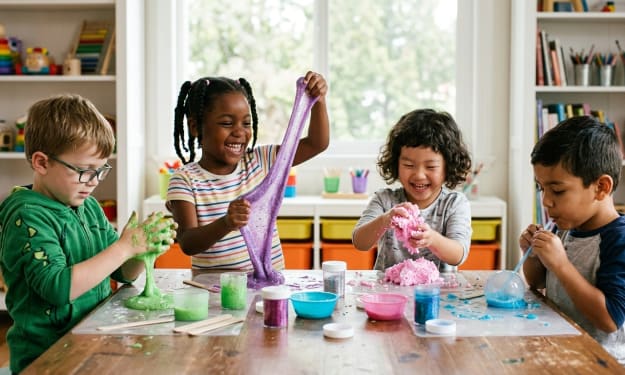
My Favorite Slime Recipe
A few years ago, making your own slime was all the rage. People swapped recipes and even swapped slimes. Now, you can buy all the pre-made slime you want, in a variety of colors, textures, and themes. But there is something special about creating your own slime. This activity is great for keeping children busy on a rainy day, or helping them learn to follow step by step directions.
By Angel Mann6 days ago in Families
Punch the Macaque: The Baby Monkey Who Found Comfort in a Plush Friend
Today we look back at one of the most unexpected viral stories of 2025—a tale that began quietly in a zoo in Japan and grew into a global symbol of resilience and tenderness. It is the story of Punch, a Japanese macaque born in July 2025 at Ichikawa City Zoo in Chiba Prefecture. His life began with hardship, but what followed has touched millions across the world.
By Haroon Pasha2 days ago in Families



Comments
There are no comments for this story
Be the first to respond and start the conversation.