
In My Father’s Shadow
son’s journey to understand the man who raised him.”

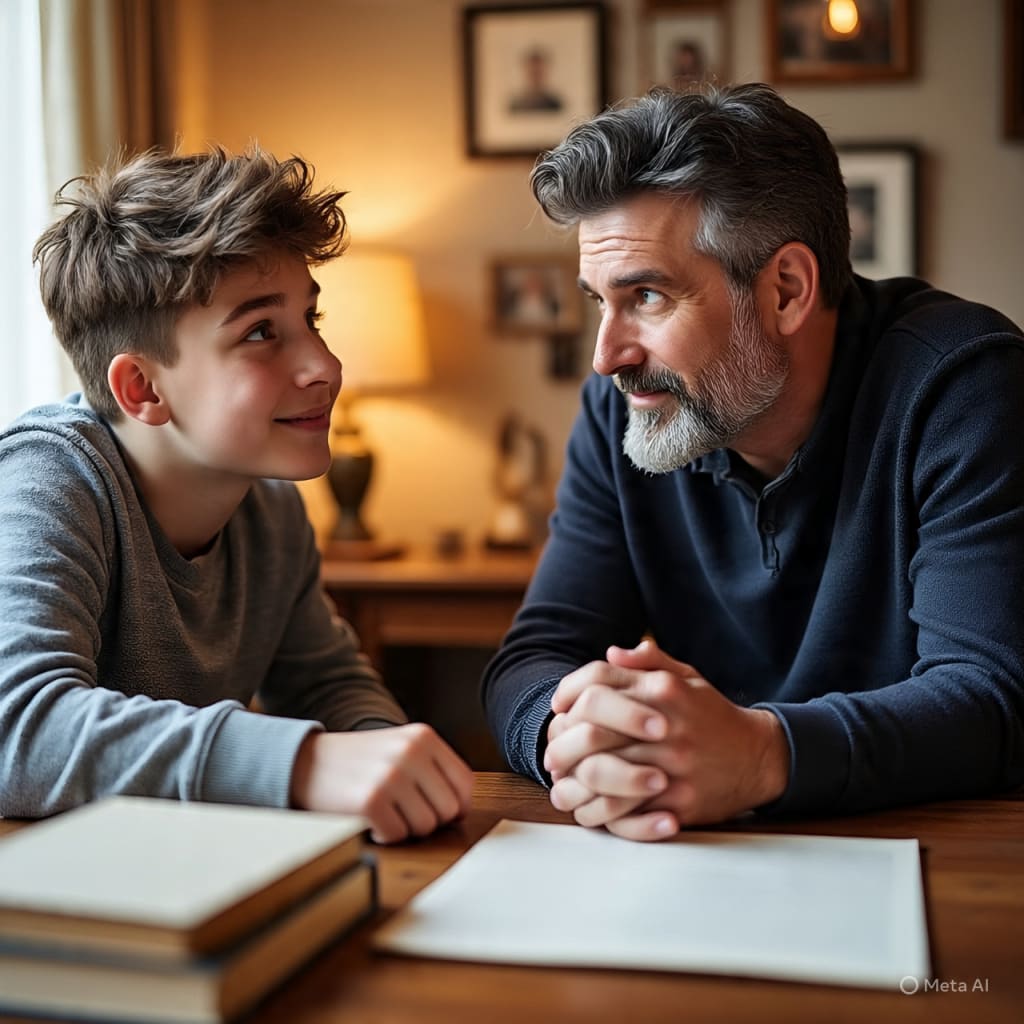
---
A son’s journey to understand the man who raised him
I used to think my father was made of stone. His words were few, his face unreadable, and his love — if that’s what it was — came disguised as silence. Growing up, I never once saw him cry, laugh out loud, or say “I’m proud of you.” He was a man of hard hands and harder habits, shaped by a world I couldn’t understand.
Our house was small, perched on the edge of a dying town. Every morning before the sun rose, I’d hear the floorboards creak under his boots. He’d leave for the factory, lunch pail in hand, and return twelve hours later, smelling of sweat and metal. Dinner was quiet. Mom would ask how his day was; he’d nod. If I spoke about school, he’d listen, but his eyes seemed somewhere else — always distant, as if life was happening behind him, not around him.
When I was ten, I started to resent that distance. Other kids talked about their fathers — men who taught them baseball, built treehouses, or laughed at their silly jokes. Mine never came to a game, never sat in the bleachers. “He’s busy,” Mom would say. “He’s tired.”
But I didn’t want excuses. I wanted him.
The first time we fought, I was fifteen. I had just won a regional debate competition and came home with a small trophy clutched in my hands. I placed it on the kitchen table, waiting for him to notice. He glanced at it once, then went back to his meal.
“That’s it?” I asked. “You’re not even going to say anything?”
He looked up, puzzled. “You did good,” he said flatly.
“Good?” I snapped. “That’s all you ever say. Don’t you care about anything I do?”
He put his fork down. “You don’t need applause to know you did something right.”
“That’s not the point!” I yelled. “You never show you care. You’re like a machine!”
The silence that followed was thick and sharp. Mom whispered my name, but I stormed out before she could stop me. I didn’t see the look on his face as I left.
For years, that moment replayed in my mind — me, standing tall and angry; him, still and speechless. I told myself I didn’t care if I hurt him. Maybe he needed to feel something for once.
---
When I left for college, he didn’t come to drop me off. Mom hugged me tight, slipped a few bills into my hand, and said he was “working.” I didn’t believe her. I told myself I’d never be like him — never so emotionally locked away that my own son would have to guess whether I loved him.
But the truth is, life has a way of repeating itself in quiet patterns.
Years passed. I graduated, got a job in the city, and barely went home. I called Mom on holidays, sent her gifts. But with him, I said as little as possible. Our conversations were short — polite exchanges about the weather, work, and car troubles. Beneath every word was the same cold distance we’d always shared.
Then one night, Mom called me crying. Dad had collapsed at work — a heart attack. He was in the hospital, stable but weak.
I left the next morning.
When I saw him in that bed, he looked smaller than I remembered. The man who once seemed carved from iron now seemed fragile, his skin pale, his breathing shallow. He opened his eyes when I entered, gave a faint nod, and tried to smile.
“You came,” he whispered.
“Of course,” I said, though the words felt foreign.
We didn’t talk much. I sat by his bed for hours, listening to the steady beep of machines. Occasionally, he’d drift off, his hand twitching slightly — as if reaching for something invisible.
---
A few days later, Mom handed me an old, dust-covered box she’d found in the attic. “He wanted you to have this,” she said.
Inside were notebooks, old photographs, and folded letters tied with a string. I opened one and saw my own handwriting — a Father’s Day card from second grade. “You’re my hero,” it said in crooked letters. Below it was a drawing of me and him holding hands. He had kept it all this time.
Beneath the letters were pages filled with his handwriting — messy, slanted, written in pencil. I began to read.
They weren’t diaries exactly. They were more like fragments — reflections written after long shifts, thoughts he could never say aloud.
> He asked me today if I’m proud of him. I didn’t know how to answer. I’m proud, of course, but I don’t know how to say it without breaking down. My own father never said it to me either. Maybe words aren’t what men like us are made for.
I work so he won’t have to. Maybe one day he’ll understand that this silence is love, just shaped differently.
I read until my eyes blurred. Each page revealed a man I had never met — a man who felt deeply, who worried, who loved in his own quiet way but didn’t know how to show it. All those years I mistook his silence for indifference, he had been trying, in the only language he knew.
---
When he woke later that evening, I sat beside him, the notebook in my hands.
“I read what you wrote,” I said softly.
He looked startled. “You shouldn’t—”
“I’m glad I did,” I interrupted. “I didn’t know.”
He swallowed hard, his voice rough. “I wasn’t good at saying things. My father… he was worse. I wanted to do better. Guess I didn’t.”
I shook my head. “You did what you knew. I just didn’t see it.”
For the first time in my life, I took his hand. His grip was weak but steady. We didn’t say much more — we didn’t need to. The silence between us wasn’t heavy anymore. It was full, finally understood.
---
He passed away two months later, quietly, just as he’d lived. At his funeral, I stood before a small crowd and spoke.
“My father wasn’t a man of many words,” I said. “But everything I am — my work, my drive, my strength — came from watching him. He may not have said ‘I love you,’ but he lived it every single day.”
Afterward, I went home and placed the old notebooks on my desk. I still read them sometimes, especially when I doubt myself or feel lost. In thospages, his voice lives on — quiet, patient, steady.
And in every reflection I catch of myself — in the mirror, in the way I work, in how I hold my son’s hand — I see traces of him.
I used to think I lived in my father’s shadow.
Now I know I was growing inside his light all along.
---
About the Creator
Punch the Macaque: The Baby Monkey Who Found Comfort in a Plush Friend
Today we look back at one of the most unexpected viral stories of 2025—a tale that began quietly in a zoo in Japan and grew into a global symbol of resilience and tenderness. It is the story of Punch, a Japanese macaque born in July 2025 at Ichikawa City Zoo in Chiba Prefecture. His life began with hardship, but what followed has touched millions across the world.
By Haroon Pasha6 days ago in Families




Comments
There are no comments for this story
Be the first to respond and start the conversation.