
“So, I’m dying,” my grandmother said, and her gentle laugh filled the corners of the pale pink living room. Part of me was relieved we had acknowledged it. Part of me was terrified.
I had played out this conversation hundreds of times in my head on the flight over, and already it was different than I’d imagined. But my grandma had a way of catching people off guard. She must have sensed my anxiety, my helplessness, and was trying to ease it. I shifted next to her on the floral sofa, trying to find my words.
“I’ve heard,” I said. This time we both laughed and for a moment the tension was broken. But the silence, and the reality of the situation, settled back in. I took a deep breath.
“How are you feeling?” I asked. Was she okay? Was she in pain? Could she really, truly, be dying? She looked slightly thinner than when I’d last seen her, like her clothes were a size too big. But she sat casually and comfortably on the couch. And her hand was smudged with ink, a familiar sign that she’d been writing. Surely, she was fine if she was still writing?
“I’m okay, Anna,” she said, pushing my hair back with her ink-smudged hand. “Your grandpa’s taking good care of me. It’s so wonderful to see you, kiddo.”
We’d last seen each other at Christmas. Now, the leaves on the oak trees outside were beginning to turn. Everything had happened so quickly between then and now. The unusual chest pain, the cautionary visit to the doctor, the grim prognosis: cancer. She had decided not to seek treatment, aside from pain medication. It was difficult to say how much time she had left. But her doctors had erred on the side of less.
I had not lived close to my grandma since I was ten or eleven. And now, graduate school meant I lived even farther—halfway across the country, studying zoology in California. I knew this might be the last time I would ever see her in person. But the thought was a weight I could not bear. I shoved it away. Just talk, I told myself. Just be with her.
“What are you working on?” I asked, gesturing to the smudge on her hand.
“Ha! I’m a mess,” she said. She rubbed at the ink absentmindedly for moment, like she was lost in thought. Then she smiled. “It’s my magnum opus,” she said lightheartedly, though not jokingly. My grandma had published several poems and stories in local newspapers over the years. But I had never heard her refer to something as her magnum opus.
“I’d love to read it sometime,” I said, and instantly felt like an idiot. But my grandma laughed.
“I’d like that too,” she said, “if only I can finish it.”
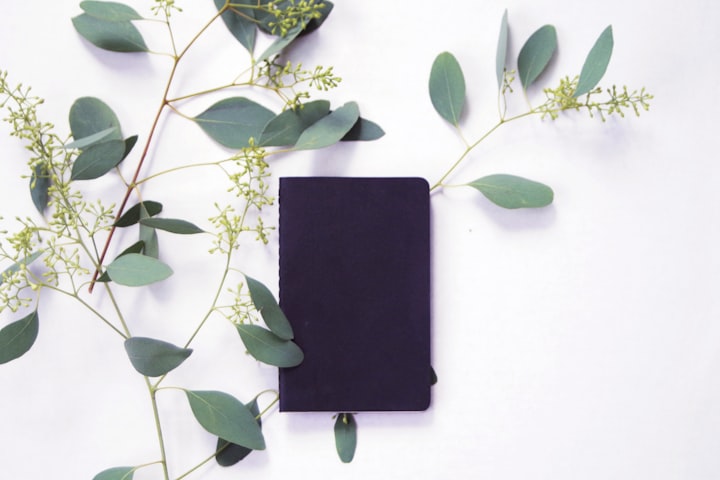
She patted her notebook, which rested on the side table next to her. For as long as I’d known her, my grandma had kept her home chaotic and colorful. Yet she always wrote in a simple, elegant black notebook. Easy to find in all the noise, she liked to say.
I was familiar with the lined pages of my grandma’s notebooks. When I was young, my mom’s job took my family from Minnesota to the blue-green hills of Kentucky. That’s when my grandma started writing to me—dozens and dozens of messages every year. Sometimes they were store-bought cards. But often, the notes were spur-of-the-moment messages scrawled onto pieces of her notebook paper. Her notes contained advice, encouragement, congratulations. Sometimes even a dollar or two, always with the same little joke: next time it’ll be a hundred! Love, Grandma Angie. We rarely saw each other aside from major holidays. But her notes made it feel like she was there alongside me, cheering me on. And when I felt down, or alone, or like a failure, her encouragements lifted my spirits.
“Oh, speaking of finishing things—your grant proposal!” my grandma said. “You finished it, didn’t you? Have you heard anything?”
I’d applied for a research grant to study the diverse, colorful species of birds that made their homes in the tropical forests of Indonesia. My grandma had encouraged me to apply, though I knew the grant was too prestigious for me. I hadn’t gained enough experience in my field to merit the $20,000 payout. But that was the vicious paradox. I needed experience to get the grant but couldn’t get experience without it.
Despite my doubts, I had spent long nights at the campus library pulling together my proposal. And in the end, I was proud of it. So proud that I let myself believe I would win the money. I knew it was stupid. And it was. When the rejection email came, I was crushed.
I hadn’t told my grandma yet. I didn’t want to disappoint her.
“I heard back,” I said, with a pause so long my grandma must have known what was on the other end. “And, yeah. I didn’t get it.” There it was, out in the open. I sighed.
“It’s okay,” my grandma said. She put her hand on my shoulder. “It was still the right thing to do, to apply. You may not have won, but that doesn’t mean you didn’t deserve to win.”
I nodded, feeling tears spring to my eyes. Here she was dying, and she was the one comforting me. And of course, she knew what to say. If I hadn’t been there in person, she would have written it down and mailed it to me.
“I know. I just—it’s hard,” I said, and it was about more than the grant. It was everything. Helplessness. Fear. One day, one day soon, her notes would stop. The words came tumbling out.
“You’ve always been there for me and believed in me and I don’t know what I’m going to do when….” I couldn’t say it. I wiped my eyes, tried to collect myself. “I’m going to miss you.”
We sat in silence for a moment.
“Did I ever tell you I wanted to be a writer?” my grandma asked softly, suddenly, once again catching me off guard. “I mean, I’ve always written,” she said. “But when I was younger, I imagined myself becoming a poet or a novelist.”
I hadn’t known this. I knew she had been the first in her family to go to college, had studied teaching there, had taught in elementary schools for decades before retiring. I guess I assumed she had always wanted to be a teacher. That writing was simply a hobby, albeit an important one.
“But it’s hard, isn’t it?” my grandma continued. “To do what you want. People pressure you to be who they want you to be. And even if you resist the pressure, there are other people who won’t take chances on you. There are doors you try to kick at, and kick at, but they just stay shut.” Her shoulders slumped, and I saw how thin and small she truly looked.
“I’m not saying I regret anything. Not exactly. I’ve lived a wonderful life. But I wish I’d had someone rooting for me when I was young,” she said. “It’s why I’ve always written to you. I know what it’s like not to have someone in your corner.”
I always knew her notes were meant to encourage me. But I never considered there was another reason behind them. Now, my heart hurt for her. I wished I could go back in time to when she was a young woman and show her the same love she had shown me my entire life.
“I love you,” I said, gripping her hand tightly. “Thank you.”
She hugged me, fiercely, with strength that pulled me off-balance into her arms. “I’ll always be in your corner.” Our tears came easily, raining onto the floral sofa.
####################################################
We last spoke on a Tuesday, about a month after my visit. My grandma’s decline had been sharp and sudden, and I strained to hear her over the phone. Her hospice bed was in the day room, overlooking the dazzling autumn fireworks alight in the trees outside. She said the view brought her peace.
“I’m almost finished with my magnum opus,” she told me. “I can’t wait for you to read it.”
At the funeral, my grandpa told me that she had been writing to the last. We stood outside the church, huddled in our coats. The air had turned cold suddenly—it felt like an early winter.
“She wanted you to have this,” he said, handing me a flat, silver gift box. I was about to peer inside, but he touched my hand gently.
“You should wait until you’re alone to open it,” he said. I kissed him on the cheek.
Curiosity ate at me until I was able to open the box. Inside, I found one of my grandma’s black notebooks nestled in spring green tissue paper. Was this her magnum opus? I carefully lifted the notebook’s cord. On the first page was a message in my grandma’s looping cursive:
Anna—I’ve sent you many notes over the years. They were to let you know that I was always thinking of you, even when I was far away. I’m farther away now. But I still want you to know that I’m here.
I wish I had been able to celebrate more milestones and memories with you in person. But I cherish the ones we shared. Somehow, even though I didn’t have nearly enough time with you, I have enough memories to last a lifetime.
This is a celebration of our time together. And, it’s a celebration of everything you’ll accomplish in the future. I’ll be cheering you on from wherever I am. Love, Grandma Angie.
P.S. Remember when I promised you hundred-dollar bills? Here they are. If they happen to add up to $20,000…well, life is funny that way. I figure it’s enough for a trip somewhere. Indonesia, perhaps. Or wherever your heart takes you.
I flipped through the pages, my eyes misting over. On each page, my grandma had written a note to me, just like she had done for years. Except this time, they were congratulations, encouragements, and advice for the moments she would not be alive to see. For my graduate school commencement. For when I felt like I couldn’t do something. For when I knew I needed to make a change. Attached to each page, I registered with shock, was a one-hundred-dollar bill. $20,000, she’d said.
She was putting her faith in me, as she had always done. She was telling me that my future was my own. The money would empower me to open doors for myself. The notes would do more. They would remind me that I was never, ever alone.
“Thank you, Grandma Angie,” I whispered. I held the notebook to my chest, infinitely blessed to have her in my corner.
About the Creator
Keep reading
More stories from Jessica Rusick and writers in Families and other communities.
Little Lamb
I remember when I figured it out. I had just brushed my teeth and was absentmindedly swishing out my mouth with water. Something about feeling clean and fresh made my mind wander to the incident years before. That’s when it hit me. I spit out the water.
By Jessica Rusick4 years ago in Families
Wise~Guys
— Look Behind what's in Front of You ~ Make Good Choices — Hey, So how you Doin'..! Made~Men — Mobster Movies romanticise a distinctive, elegant appearance, impeccable attire style, along with the 'Families' expressive lingo. Making their 'Bones' gave them Panache — with vintage fedoras, tailored pin-striped suits, mirror-polished wing-tip shoes adorned with tassels; with their 'Gun Moll' gorgeous dates on their arms.
By Jay Kantor20 days ago in Families



Comments
There are no comments for this story
Be the first to respond and start the conversation.