
"How to Choke an Oak Tree"
A story for sons who have watched their fathers wither away


As a child, I used to imagine that my town had been folded in on itself, as if God had gotten bored and tried his hand at origami but failed miserably. Because of this, I never understood the comfort that an early autumn breeze could bring. Those wild winds that I’d only ever seen on television screens never did last very long in our small, suburban backyard. Mom used to call it our “postage stamp.” The surrounding buildings caused the dead air. Looming like monstrous sentinels, old dilapidated homes from the turn of the century swelled in the sun all around us, overwhelming everything save for an old tree that had somehow survived the last several decades of suffocating progress.
Growing up, I could often be found in our back yard standing next to my father, drawing on the back of our neighbor’s garage with a stone as he tended our garden, though I only ever remember it as a patch of clean earth that sometimes found itself defaced by vegetation. As my father worked, I made small-talk.
“What type of tree is that?” I asked one day, pointing.
“Oak,” he responded in between his grunting as the damp soil sloshed around his spade. He paused for a moment to carefully space his seed, laying a pile of them off to the side on top of the mossy brick he’d used to line the garden’s perimeter. “It’s the strongest tree there is,” he said confidently.
“Then can you build me a treehouse?” I remember asking.
“We’ll see,” he said.
“Do you think it’s strong enough to hold a treehouse? Because my friend from school has a treehouse and I think —”
“I said we’ll see,” groaned my father. He paused again. Then, he looked up at me and smiled warmly. Pulling one hand out from his gardening glove, he wiped a long bead of sweat from his forehead. He sighed. “We’ll see. Now, go in and get something to eat. Your mother has been slaving,” he said.
I liked that version of the man.
By middle school, I’d learned that once October bled into November, it meant an early supper and a more sincere responsibility to follow orders. The change of seasons, that bitter cold that seemed to swoop in and nip at our noses, tired the man. A father has no tolerance for back-talk when he can see his breath and the sun is still high. On any given afternoon, my father could be found taking a long drag from a cigarette under the bare branches of the old tree before coming inside with his hands cupped over his mouth.
At dinner, my sister and I would sit quietly as my parents spoke over us, their words hovering like clouds.
“Squash came in good this year,” Mom would say, smiling cautiously. From where she sat at our kitchen table, she could see the back yard through the backdoor window. “That old tree, not so much. Poor thing just keeps on keeping on, though.”
“It’s an oak. It will be fine,” I remember saying confidently one night.
“I don’t think it’s an oak,” said my mom, smirking.
“It’s an oak,” said my father as he sipped from a small glass of homemade wine.
Mom buttoned up quickly.
By the time I’d reached junior high, weeds had overtaken our garden, a result, my father had said, of “rotten, no good soil”; however, the tree, sick and sagging, remained. By that time, most dinners had placed a strange man in front of me, one who seemed to look less like the proud gardener I once knew and more like that old, tortured tree. At that point, the only thing mom would ever say to my father would be something about what she managed to get on sale from the grocery; he’d respond in a faint, exhausted mumble.
It would go on like that for another thirty minutes or so until he dismissed us to the living room to watch television.
Before heading up to bed at night, with my mother already asleep on the couch, we’d kiss our father on his forehead.
“Say your prayers,” he’d say.
My sister and I would nod.
I’d be lying, and he’d know.
The next morning, he would leave early for work while the world was still dark, and sometimes it was as if he never came home at all, returning so late into the evening that we would already be asleep in bed. It wasn’t until I’d reached high school that I found myself brave enough to ask my mother about it.
“Your father is a strong, proud man. Strong, proud men make sacrifices to raise their families,” she had said to me. As she finished her sentence, I caught her tired eyes resting on the old tree.
“What?” I asked.
“Sometimes, I wish that poor thing would just die and get it over with,” she had said. And then she began to cry.
I never asked her about my father again.
Later, while driving me to one of my baseball games, my father said to me that he didn’t need help from the government to raise his family, a sentiment spurred on by a report bleeding out from the radio. Through his hard work, he could provide for us on his own, he had said.
In all the years I played ball, my father never stayed past the seventh inning.
He would say later on when I questioned him about leaving early that life was a matter of habits and priorities. Staying for the rest of the game wouldn’t help pay the bills, and he had things to do: cut the lawn and change the oil and edge the curb and plumb the sink before finding himself in front of the TV for the rest of the evening.
“Hey, dad…?” I asked one night while he sat reclined in his chair.
“Yeah?” he responded.
“I don’t think that tree behind the house is an oak tree.”
“Doesn’t matter,” he said. “It’s gonna die soon anyways. Everything’s chokin’ it.”
“Yeah,” I said. “But it doesn’t have to die. Maybe if we just gave it some help, you know? Maybe if they tore one of those buildings down and —”
“Everything dies eventually, son,” he said.
“Yeah…” I said.
About the Creator
C. Costa
Educator.
Writer.
Musician.
Hufflepuff.
Wise~Guys
— Look Behind what's in Front of You ~ Make Good Choices — Hey, So how you Doin'..! Made~Men — Mobster Movies romanticise a distinctive, elegant appearance, impeccable attire style, along with the 'Families' expressive lingo. Making their 'Bones' gave them Panache — with vintage fedoras, tailored pin-striped suits, mirror-polished wing-tip shoes adorned with tassels; with their 'Gun Moll' gorgeous dates on their arms.
By Jay Kantor17 days ago in Families
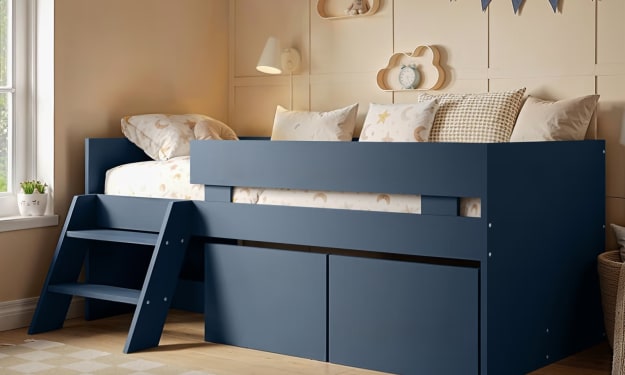
Kids Beds Suitable for Smaller Bedrooms: Smart Comfort Without Crowding
Not every child has a large bedroom. In many homes, space is shared or limited, which means every piece of furniture needs to be chosen carefully. A bed that is too big or bulky can make a small room feel cramped and uncomfortable.
By Shazad Khana day ago in Families



Comments
There are no comments for this story
Be the first to respond and start the conversation.