
How The Rich Use Debt & Taxes To Get Richer!
Mindset
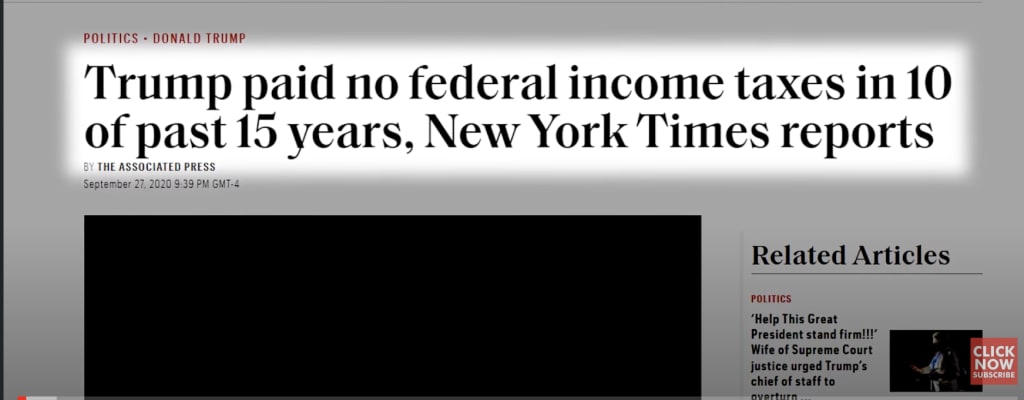
People know how to use the tax code to their advantage. I mean Warren Buffet talks about how he pays a lower tax rate than his secretary, and Donald Trump openly talks about how he doesn't pay any taxes. As an attorney, I can tell you that there's a difference between tax avoiding and tax evading. Tax evading is illegal, you're doing a crime, and you will go to jail. Tax avoiding is 100% legal; now you're using the IRS rule book as a guideline on what you can do legally to not pay taxes. This is what rich people specialise in. They want to know what the IRS rule book says, that way they can pay the least amount of taxes legally. The interesting thing is I never grew up learning about any of this. The first time I was exposed to any sort of financial education was when I read "Rich Dad Poor Dad" by Robert Kiyosaki. And not too long ago, I was in Arizona talking with Robert Kiyosaki, and he told me that the reason why he's so rich is that he's in debt. "I save gold; I don't save dollars. I borrow dollars. That's why you want to listen to Dave Ramsey. He's a good friend of mine; live debt-free." I go, "Why are my friends all billionaires and they're deeply in debt? I don't even need real estate. I use debt. I'm just looking for an excuse for somebody to give me a handling." Debt isn't for everybody. It requires a certain level of financial education. It increases your risk, and it requires some expertise in what you're doing. But what many rich people do, who have mastered debt and taxes, is they follow a system called BBD which stands for Buy, Borrow, Die. This system allows many rich people to borrow money, live their life wealthy, and pay zero dollars in taxes legally. So what I want to do today is go over how rich people use debt and taxes to their advantage to make themselves wealthier. That way, you can potentially use this to your advantage as well because the reality is this is how the system works, and this is how the tax code works. And you can either learn it and use it or not, but here in this video, I'm going to go over how it all works that way at least you understand. Wealthy people are not stretching themselves thin and going into debt so they can have a fancy car and wear Gucci and wear Louis Vuitton and go on fancy vacations. They go into debt for one reason and one reason only; it's for income. If it doesn't produce income, they're not going to go in debt to buy it. There are two general ways to do this; you can do this through business or you can do this through real estate. A third way that sometimes people talk about is through investing their money. But when you invest your money, either investing your money in businesses or real estate to take advantage of the debt and tax laws. So I'm just going to focus on the business and real estate side and just understand that investing is incorporated into both of these. The way the tax code is made, it's designed to incentivize people that are producing jobs, producing homes, and producing things for the economy. But if you're just a W2 employee, and all you do is you make money and you spend it, it is going to be extremely difficult, actually impossible for you to take advantage of the system because the tax code is not incentivising you to really do anything. The tax code incentivises you to invest and create and produce. It's not incentivising you to just consume.
Business is growing by seven percent a year. Then you came out a winner, so you don't take an income. You don't have to pay any taxes on a hundred thousand dollars. You borrow this money from the bank tax-free, and if you can grow the business by more than six percent, well now you're a winner, and you didn't have to pay any taxes. Elon Musk is probably the most popular example of this in action because he built Tesla. But while he was building Tesla for a number of years, he never paid himself a salary. So a lot of people were upset because he was worth billions and billions of dollars, but he paid zero dollars in taxes. The reason why he paid zero dollars in taxes was because he was paid not in dollars but in stock options. So he never really got any money in the bank from his company. What he did was he got these stock options, saying that he had the ability to buy Tesla shares for about six dollars a share. It was something like six dollars and some change, and he was given millions of shares. So when the stock price went up to a thousand dollars a share from six dollars a share, he saw a lot of appreciation in the value of the stock options. And considering that he had millions and millions of stock options, he had stock options worth billions of dollars. Now again, this wasn't cash that he had in his personal checking account. This was the value of his investment, of his asset, his stock in Tesla. But instead of actually selling his stock and having this cash come into his bank account from the sale that would be taxable, what he did was he went to the bank and he told them, "Hey, I have the stock worth a million dollars, just for example. Give me a loan for a hundred thousand dollars." The banks were happy to do that because then the banks would make six percent interest. And now all Elon Musk has to do is make sure that his stock is growing faster than the interest that he's paying. Because as long as he keeps doing that, he's coming out on top. He has cash in his pocket to live his life, and he doesn't have to pay a penny in taxes. Larry Ellison, the founder of Oracle, did the exact same thing. He had access to 250 million shares of Oracle. But if he sold those shares, he'd have a big taxable event. So instead of selling his shares and paying a whole bunch of money in taxes, he used the value of his shares to go to the bank and open up a 9.7 billion dollar credit line. And now, this is money that he can use to live his life. He's got to pay interest to the bank, but as long as the value of his company, his stock, is growing faster than the interest rate that he's paying, he's a winner. And then after that, they follow what I was talking about in the beginning of this video, which is BBD, buy, borrow, die. What that means is you can keep doing this again and again and again. And as long as the value of your underlying asset, in this case, the stock, the company, keeps growing, you can just do this until you die. Now you get to live your life, you get to have all of the nice things, and you never have to pay a penny in taxes. And then when you die, you pass your shares onto somebody else. And the person who gets your shares, your new company, they get something called stepped-up basis. And they don't have to worry about the major tax implications because of the stepped-up basis. What that means is, let's assume that you have a company worth a million dollars. Dollars in taxable income, so if you were to sell, you'd have a big tax bill. One of the things that you can do is the buy, borrow, die. Now, if you die, your heirs (let's assume it's your kids) get this million-dollar asset. When they get this million-dollar asset, they get a stepped-up basis. So, the IRS assumes that they don't get it for a thousand dollars, the IRS assumes that they bought it for a million. If a kid now sells this asset for a million dollars, they have zero dollars in taxable income. If they sell it for 1.1 million, then their taxable income is a hundred thousand dollars. So, you only have to pay taxes on any gains above the one million dollars, which is what the kids got. Now, at this point, if you're thinking, just breathe, that's really cool if you are a billionaire like Elon Musk or Larry Ellison, but I don't have a billion-dollar or a multi-million dollar business, so I can't take advantage of this. Well, there are some other things that you can do if you have your own business or you're a side hustler. Now you're not a W2 employee; you are a contractor. You have your own small business. What you have to remember is you only pay taxes on what's left. So, you have your income that comes in, and then you pay your expenses, which are your deductions, and this is your taxable income. What you have to understand is what can fall here into your taxable income because a lot of times people ask, is this thing deductible? Is it deductible for me to go on a particular trip? Is it deductible for me to buy a certain item? Well, a better question to ask is, how can it become deductible? Because almost anything can be a tax deduction if you know how to ask the right questions. This is where it pays, literally, to have a good accountant who's a tax advisor who can tell you what's going on and how you can use your money that way. You have less taxable income legally while you can still buy all the things that you want.
For example, one of the things that's going on until the end of 2022 is the tax code is giving bigger tax breaks for business owners that are eating out at restaurants. So, if you go out and you take employees out to eat, you get a 100 tax break until the end of 2022 as a way to incentivise people going out to eat at restaurants as a way to help stimulate the economy. So, if you have people on your team or if you are a side hustler, if you're a business owner, you have the opportunity now to get a tax break for eating out at a restaurant. We here at the Minority Mindset Companies went to a hybrid style work office after the pandemic hit, which means that people come in the office when they want. You can work from home whenever you want, but once a week, we do something called team day where the team comes into the office. And every week in this team day, we go out to eat at a restaurant. Now we didn't start doing this because of the tax break that we were going to get, we did this for fun, but it's kind of a nice bonus that 100 of the money that we're spending at the restaurant is a tax break on my taxes.
About the Creator
Keep reading
More stories from Rakesh Patel and writers in Families and other communities.
How The 1% Legally NEVER PAY Taxes
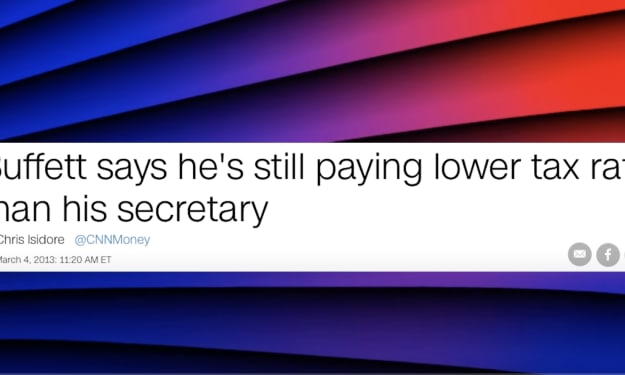
professional tax advisor to avoid any legal issues. Some of the richest Americans pay little to no money in taxes. We've all heard of President Donald Trump paying zero dollars in taxes, even though he's one of the richest people in the world. Warren Buffett, who's one of the most successful investors of all time, talks about how he pays a lower tax rate than his secretary. Even if we move beyond the famous people, what we'll see is that rich people, in general, pay a lower tax rate than regular people. And you want to know the craziest part? This is 100% legal. How do I know? Well, two reasons. For one, if it was not legal, all of these people would be in jail. And the second way that I know is because I've spent a lot of time studying the federal income tax code. As an attorney who's not your attorney, what I can tell you is that while the federal income tax code is over 2,000 pages long in super small font, it really only tells you three things. Number one, it tells you how to categorize your gross income. Second, it tells you what deductions you can take from your gross income, which brings you to your taxable income. And then it tells you what is the tax rate on your taxable income. That's all you get from this 2,000 pages. And then once you understand that, either you're going to have a big tax bill or a small tax bill. See, rich people are always trying to figure out, for one, how can I have little to no taxable income? And second, if I do have any taxable income, how can I have the lowest tax rate possible on this taxable income? There are four main ways that rich people do this. These are things that you can start doing right now, too. But I do have to advise you that before you make any changes to your financial situation or your taxes, make sure you talk to a professional tax advisor to avoid any legal issues.
By Rakesh Patel3 years ago in Education
Wise~Guys
— Look Behind what's in Front of You ~ Make Good Choices — Hey, So how you Doin'..! Made~Men — Mobster Movies romanticise a distinctive, elegant appearance, impeccable attire style, along with the 'Families' expressive lingo. Making their 'Bones' gave them Panache — with vintage fedoras, tailored pin-striped suits, mirror-polished wing-tip shoes adorned with tassels; with their 'Gun Moll' gorgeous dates on their arms.
By Jay Kantor18 days ago in Families
Bettijo Hirschi
Introduction Bettijo Hirschi is a multi‑talented creative professional from the United States. She works as a designer, art director, photographer, writer, and event planner. Bettijo has built a long career in creative work and media. People know her for her artistic skills, her work in magazines and television, and her lifestyle blog. She is also known in recent news because of changes in her personal life.
By Farhan Sayed4 days ago in Families


Comments
There are no comments for this story
Be the first to respond and start the conversation.