
Hope Beneath the Mulberry Tree
In a small village where hardship blooms like wild grass, a young girl’s faith becomes her mother’s only medicine—and her father’s only redemption.

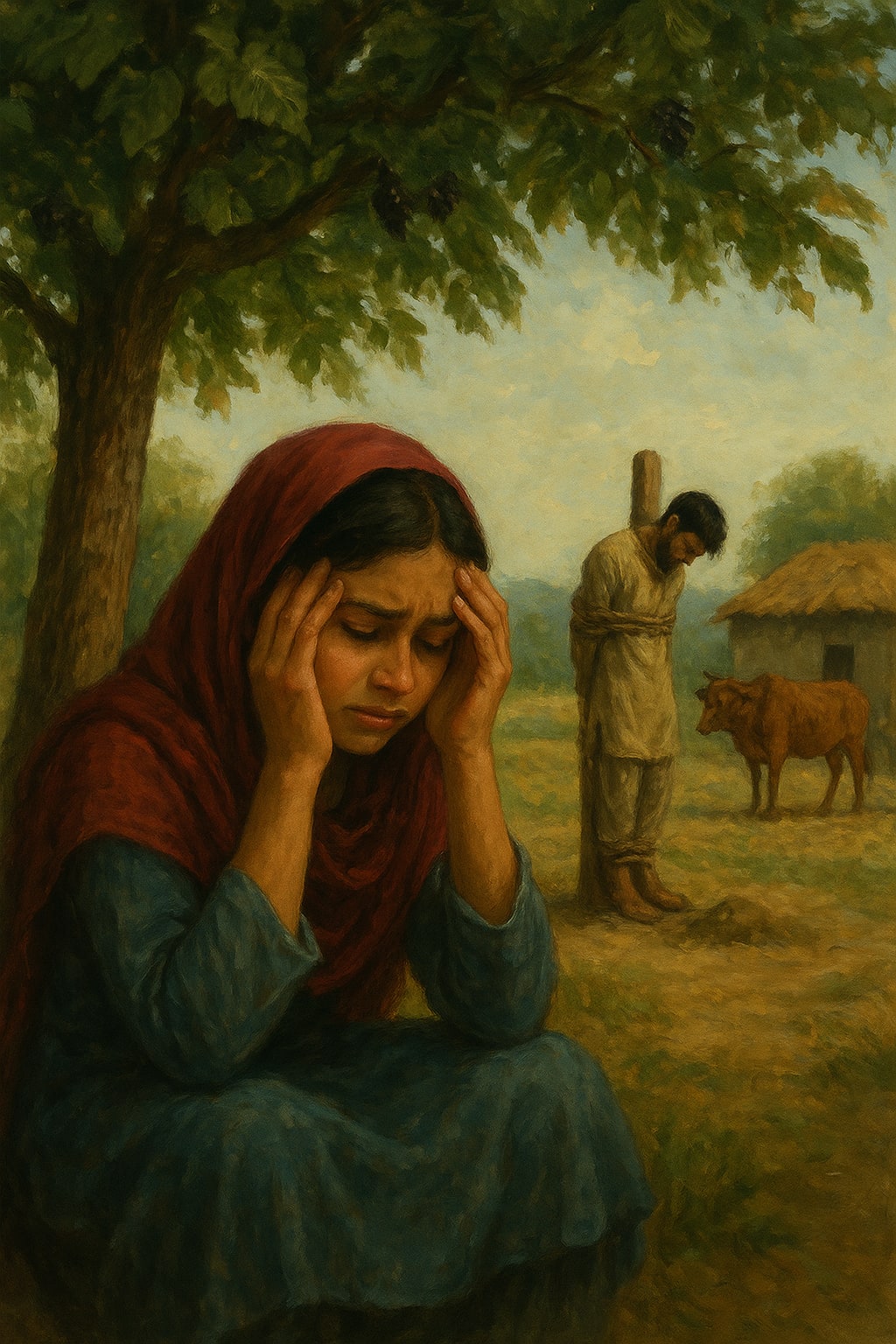
Someone is sitting in the shade of a mulberry tree, someone is lying without a bed. The owner is a teak tree, the farmer is tied to a pole. The farmer is drunk, his head bound tightly to the post. Fever has fled from the mother, the cow has been beaten, and the farmer has given Gulalai a mountain.
“Gulalai, God will destroy the enemy. Get out of this room, do something, go this way,” someone said.
Still, he screams, pressing both hands to his head. “It’s broken… I’m poor… there’s no doctor anywhere! Oh God, my head is broken!”
The men from the west glanced at him; Bebe looked with one eye, nodded, and smiled faintly. She whispered to herself, “It’s too dark for me to fetch the doctor. I warned him not to be angry. He’s filled my house with young men.”
Gulalai came out of the hut and called to Rozina again. “Give the cow some water, and then make tea.”
Now, if her father didn’t return soon, she would lose patience. She moved quickly — filled the bucket, gave the cow a drink, washed the pot at the pump, and filled it with clean water.
Gulalai is the eldest daughter of Rozina. She is only twelve, but her mother has already taught her every household chore. Her mother has no one else to help her, and her father is often harsh and distant.
They live a farmer’s life — with one cow and a calf at home throughout the year. Gulalai does half the housework herself. She once studied up to the third grade before her father made her leave school. But her mother was determined and enrolled her in the village madrassa. She even bought her a new sari.
Every afternoon, Gulalai goes to the madrassa. She has memorized twenty chapters of the Holy Quran and is now on her twenty-first. While doing housework, she softly recites verses from memory.
Gulalai has three younger sisters who still attend the government school. Rozina’s husband always complains, “You’ve given me only daughters. I need sons.”
Rozina, now eight months pregnant, prays day and night for a son. Tears fill her eyes with every prayer: “Oh God, if this child is a girl too, how will I face him? Please, don’t let this hope fade.”
One evening, Gulalai was cooling the tea when her father stumbled in from the street. He leaned against the wall, poured himself water from a jug, and gave the cows their share.
Rozina came out from her bed, greeted him weakly.
“Welcome, Kamal,” she said softly.
“Bring me a pillow,” he muttered, “and a glass of cold water.”
Rozina turned to Gulalai. “My daughter, please take the money from the kitchen and buy some greens.”
Kamal added, “And make sure the woman with the scarf gets her share too.”
Gulalai, though tired, obeyed silently. She brought the pillow, poured her father’s water, and went to the garden to fetch vegetables. Then she collapsed onto her bed, exhausted and feverish.
She suffered quietly all day, but no one seemed to care. Only her mother noticed.
That afternoon, when she went to the madrassa, she told her teacher about her mother’s sickness. The kind teacher gave her some cola and medicine to take home.
When she returned early, her mother was surprised.
“Why did you come back so soon, Gulalai?” she asked.
Gulalai entered the room, removed her burqa, and spoke gently, “Mother, I brought medicine.”
Rozina was startled. “Where did you get it?”
“I told my teacher about your fever. She gave it to me.”
Rozina’s eyes filled with tears. “Oh my God… I’ve lived to see the day my child has to beg for my medicine.”
Gulalai quickly embraced her mother. “Please don’t cry, Ammi. I can’t bear to see you in pain.”
They held each other and wept for a long time.
Days turned into nights, and life went on in the same sorrowful rhythm. Rozina’s health worsened, and her heart grew heavy with fear about the child she carried.
Finally, one night, labor pains began. She screamed in agony. Gulalai ran to fetch her father. Kamal sent for the village midwife, Bibi Kamil.
Hours passed before Bibi came. The whole house was trembling with fear and prayer. When the child’s cry finally filled the air, Kamal’s heart softened. He rushed toward the room, thinking Rozina had survived and the baby was healthy.
But when he entered, Rozina lay pale and exhausted. In her arms was a tiny baby — blind in both eyes, and without the use of his hands.
Kamal froze. His breath caught. His face turned white. Then, as if struck by lightning, he sank onto the other bed, silent and still.
After a long silence, he whispered brokenly,
“Indeed, no one can control what Allah gives. Sons and daughters, blessings and burdens — all come from Him. A daughter is a mercy, and a daughter like Gulalai… is a blessing.”
He looked at Rozina, then at the fragile newborn. He placed a trembling hand on the baby’s head and said,
“Omid, my son — I cried for you before you came. But now, I’ll hide you in my arms forever.”
About the Creator
Keep reading
More stories from shahkar jalal and writers in Families and other communities.
The Story of Scattered Words
God has given the mother great concern, which is why Bano Qudsia has written that if a mother has eight sons and seven are admitted to heaven and one to hell, the mother will remain restless even in heaven and will wish that the eighth son be sent to the one who is in hell. A mother never worries about herself, she always worries about her children.
By shahkar jalal3 months ago in Families
He Saved My Life With His Kidney… Then Asked Me to Pay Him Back
I still remember the day the doctor told me my kidneys were failing. The room felt smaller, the air heavier, and every word that followed sounded distant, like it was meant for someone else. Dialysis, waiting lists, uncertainty—it all came crashing down at once. I was terrified, not just of dying, but of what my life would become.
By Lukáš Hrdličkaa day ago in Families


Comments
There are no comments for this story
Be the first to respond and start the conversation.