
His Back Broke So Mine Could Stand Tall
He gave his strength to my future, and never once asked for anything in return.

When I was a boy, I thought my father was made of iron. Not the shiny kind, but the rusted, weathered steel that holds up forgotten bridges and railway tracks—silent, strong, and built to last. He didn’t speak much. He didn’t have time to. His life was measured not in hours but in callouses.
We lived in a modest home on the edge of a dusty town where opportunity came late and left early. My father, Rahim, was a bricklayer. A laborer. A man of few words and many scars. He woke before the sun, drank his tea in silence, and disappeared into the world before I even rubbed the sleep out of my eyes. I only ever heard his return by the creak of the front gate and the slow, heavy steps that followed.
I didn’t understand it then, but he was fighting a war with the world every single day. A war of bills, survival, and the silent shame of knowing he couldn’t give me the world, but still trying anyway.
He worked at construction sites scattered across the region. Some days, it was a factory wall. Others, it was a school foundation he’d never see completed. No matter the weather, no matter his pain, he worked. His hands were thick, his fingers forever stained with mortar, and his back—bent slightly, even when standing straight—told the story of a man who had given everything without complaint.
When I was seven, I remember asking him why he never sat with us to watch TV in the evenings. He looked at me with tired eyes and said, "Beta, if I sit too long, I won’t be able to stand again."
I didn’t know what he meant until years later.
We weren’t poor in the sense that we starved, but luxury was a foreign language. My mother stretched every rupee until it begged for mercy. My school shoes were hand-me-downs from cousins. New clothes only came during festivals, and even then, they smelled of compromise.
And yet, when it came time for high school, my father made a decision that changed everything.
There was a private school—St. Thomas Academy—across town. Known for its results, discipline, and expensive fees. I never imagined going there. I had already been enrolled in the local government school, where ceiling fans rarely worked and chalk dust danced in shafts of light like ghosts of forgotten ambitions.
But one morning, my father walked into my room, holding an admission form.
"Fill this," he said.
I blinked. "What is this?"
"St. Thomas. You’ll go there."
"But how will we—"
"Just study," he cut me off.
Later that week, I overheard my mother arguing with him. Her voice trembled with panic. "We can’t afford this, Rahim. You already work two jobs. You’ll break yourself."
His reply was calm but firm. "Better I break than his future."
I didn’t sleep that night. I stared at the ceiling, wondering how many bricks he would have to lay for each one of my textbooks. How many nights he would go without rest so I could have a desk to sit at.
At St. Thomas, I felt like a trespasser in someone else’s life. My classmates arrived in cars. I arrived in worn sandals. Their lunches came in thermal tiffins. Mine in reused foil.
But I studied. Hard. Every evening after school, I would help my mother in the kitchen and then lock myself in our narrow room with my books. I didn’t want to waste the blood my father left behind at construction sites.
One night, I found him asleep on the floor instead of the bed. His back was hurting again. The mattress was too soft. He needed something harder to support what was left of his spine.
Another time, I noticed the bruises on his hands hadn’t healed from the previous week. He laughed it off. "The cement likes me too much," he joked.
It wasn’t a joke. It was a slow death he accepted.
Years passed. I topped my class. Earned a scholarship to college. Studied engineering, partly because I wanted to build things like he did—but without the pain. My father attended my graduation in a second-hand suit two sizes too big, with shoes so polished they reflected the sun. He didn’t clap when my name was called. He just nodded.
"Abbu," I said after the ceremony, "I did it. We did it."
He looked at me and said, "Now stand taller. I’ve bent enough."
I got a job at a reputable firm. Moved to the city. Slowly, our lives changed. We bought a bigger house. I brought my parents to live with me. We had air conditioning. My mother cried the first time she used a microwave. My father, though, still woke up early and went for walks like he was late for work.
Retirement didn’t suit him.
He would stand at construction sites on our walks and just watch. When I asked him why, he smiled, "I still love the smell of cement in the morning."
But the years had taken their toll. His spine curved like a question mark. He had surgeries, therapy, medication. None of it restored what he had given away.
One evening, I found him on the balcony, watching the sunset.
"Beta," he said, "you remember that government school you were supposed to go to?"
"Yes."
"The day I got the St. Thomas form, I hadn’t eaten lunch. I used the money for the bus ride to bring that paper home. Walked six kilometers."
I felt tears sting my eyes. "You never told me."
"You never asked," he said. "And anyway, what matters is—you stood tall. That’s enough for me."
He passed away two years later. Quietly. No drama. Just a man who had given all he had.
At his funeral, I looked around at the people gathered. Masons, shopkeepers, electricians, former classmates, even the principal of St. Thomas. All came to pay respect to a man who never made the news, never wrote a book, never made a fortune.
And yet, he had built something greater than all of that.
He had built me.
Today, I have a son of my own. He asks me why I keep an old trowel and a faded photograph of my father on my office desk.
"Because," I say, "this built everything you see."
My son tilts his head. "But it’s just a tool."
"Not just any tool," I whisper. "It was the spine my father lent me so I could grow my own."
His back broke, yes. But in that breaking, he laid the foundation upon which I stand every day.
And for that, I will always bow my head to a man who never asked for thanks, but deserved the world.
About the Creator
Keep reading
More stories from Muhammad Wisal and writers in Families and other communities.
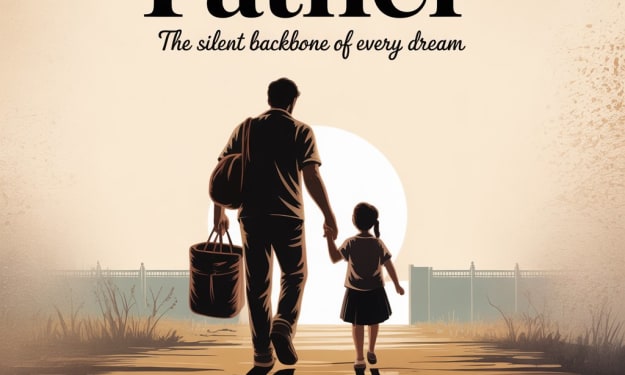
Father
The early morning sun peeked over the edge of the small village rooftops, casting long golden shadows across the narrow mud path. In one of the quieter corners of the village, Ravi adjusted the old, fraying strap of his bicycle and looked back at the sleeping house. A small handprint was still visible on his shirt from his son’s sleepy hug last night. He smiled faintly, brushed the dust off his trousers, and pedaled toward the city.
By Muhammad Wisal9 months ago in Families


Comments
There are no comments for this story
Be the first to respond and start the conversation.