

I never knew my grandfather. He was killed in the war when my mother was but a child. There survive no photographs of him, no physical evidence that he ever existed. My mother’s only enduring memory of him was a man in a uniform, who kisses her crying mother, then kisses her, then walks out of the front door of their home and never returns. She only told me this when the dementia had all but consumed her mind, and she no longer recognised me as her son. Her own mother never spoke about him, her grief at having lost her husband absolute, and she confessed in me, a stranger to her now, that she had always resented her for it.
When my mother passed away, that same house was left to me in her will. I had no intentions of keeping the old place – What could I possibly do with a house far too small for myself, my wife, and our three children? – so I began the onerous task of sorting through three generations worth of my family’s history: mine, my mother’s, and her mother’s, the contents of which was destined for either my garage, a local charity shop, or the dump.
It was there that I stumbled upon the cardboard box, buried at the back of the basement. It was wide but not deep, and the single word: “Roger” was written across it in faded blue marker pen. That was my grandfather’s name, Roger. Curious, as one might be when confronted by such a box as that, I carried it into the centre of the basement and set it down beneath the single bare lightbulb which hung from the ceiling, and opened it to reveal the contents: a navy blue suit jacket, folded lovingly into position and left here what must have been decades previously.
I placed my hand on the harsh wool and drew my fingers across it. The empty material was uncomfortably symbolic, a perfect illustration of the absence of a father figure in my life. My own father walked out the front door never to return when I was a child, too; if it had been for something as noble as fighting for his country, I would have been able to forgive him.
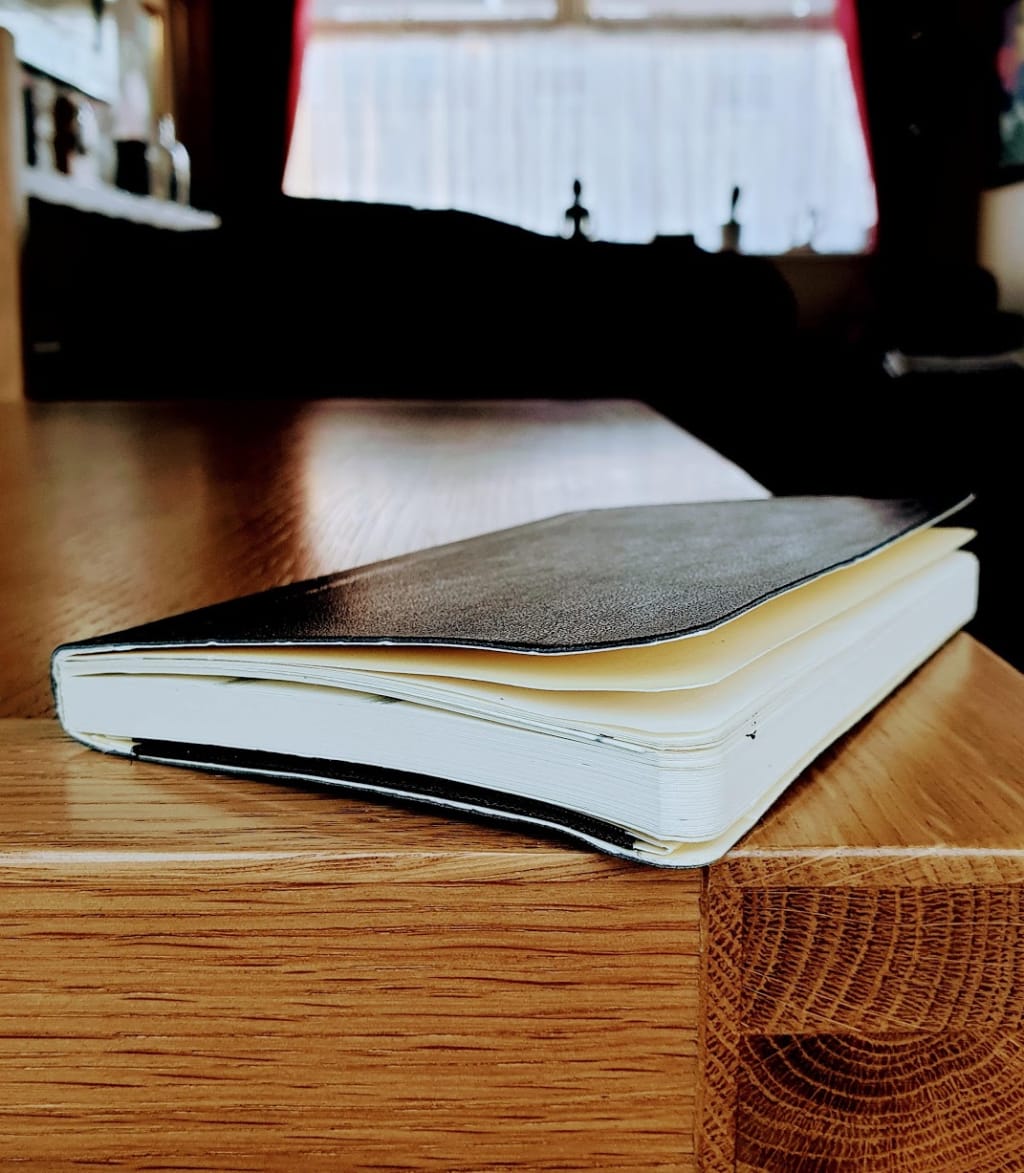
As I ran my hand across the jacket, lost for a moment in an old and well-rehearsed bitterness, I felt something in the breast pocket. Careful not to disturb the sanctity of the folded lines, I slipped my hand between the material and retrieved a small notebook. It was bound in black leather, its age apparent by the worn corners and the creases down the once pristine spine. I opened it, and written on the inside cover in a familiar hand – familiar in that it looked identical to my own – was the sentence: “Property of Roger Harding”. Property of my grandfather.
I sat down on the cold concrete floor and crossed my legs like a schoolboy, and began to read.
My grandfather was a poet.
The notebook was filled with his work. The first dozen-or-so pages were taken up by scribbled notes, a series of disjointed ideas and half-finished prose, placed into couplets which did not quite rhyme and verses which had no end. It was as if peering into the mind of an artist at work, words and phrases scattered like jigsaw pieces across the thick white paper.
These pages culminated in what was his first completed poem, dated as September 1936. It was a short piece of writing, with the simple title: “Lake”.
How the light cascades across the surface,
A mirror reflecting the touch of God himself.
Undisturbed by man’s heavy hand,
Nature at its purest, unbound and autonomous.
I am an intruder, watching from a distance,
Fearful to breathe for fear of breaking this delicate calm.
I deserve not to witness such beauty as is before me,
A world which refuses to acknowledge my existence.
The water breaks, one of its creatures braving the unknown,
Catching no more than a glimpse of what lies beyond its domain.
Seek not this place, little fish, for it shall do not but disappoint,
Remain below, where it is safe, where you are not alone.
I had never considered myself one for poetry. In fact, I could not recall ever reading a poem start to finish since leaving high school. Yet there was a beauty to my grandfather’s words. And not just in the prose itself, which even I could determine was a perfectly passable first attempt, but in the fact that this single piece of writing acknowledged his existence, acknowledged that he had lived before that single memory my mother had of him.
What manner of man must he have been, to have written something such as this?
The phrase I concluded on was: a gentle soul.
I lost the entire afternoon to that basement, neglecting the work I had gone there to complete. The notebook continued from the first poem in a similar fashion, that being a selection of ideas and failed attempts before having a full piece committed to paper. They were all in a similar vein, thoughts and observations about the beauty of nature and wildlife: a trio of young deer played gleefully about a sun drenched clearing; two rabbits peaked from a burrow into a heavy storm, cuddled together from the cold; a single yellow flower bloomed in the side of a rockface, a testament to nature’s unique potential. I still have no idea where he lived at the time he documented these sights, or whether they were purely figments of his imagination, yet with each passing line I felt an urge swell inside of me to drive into the middle of nowhere, to be in the wilderness by myself.
Alone, but for my grandfather’s words.
It was not a thick notebook, and soon I could feel the right side of it becoming thinner in my hands. I was disappointed, then, each time I found a page which was only half-full or, forbid, completely empty, as it came with a profound sensation of loss for what might have been written in the blank space.
Eventually I arrived at the final entry. Even before I read it, though, it struck me as unusual. Unlike the others, there was no practice prose written on the preceding pages which I could use to follow his trail of thought, almost as if it had been written without need for deliberation. And it was not about the beauty of nature, either, I realised. The title read: “For Alice”.
My daughter, the time has come too soon,
Too soon to watch you grow,
Too soon to see the woman I know you will become while I am away.
The moment I met you, I swore I would never leave your side,
That I would move the heavens and the earth to protect you,
That not a day would pass in which you did not know unwavering love and devotion.
I break that promise now, and it breaks my heart to do so,
For in the morning I leave you here and go to war,
To a place I have never been, to a fight I did not begin but know I must not ignore.
But remember, my dear, sweet Alice, that I do not forget you,
Not your smile, not your laughter, not your voice, not your name.
I carry them with me now and always, a shining beacon which guides me home to you.
I just pray you do not forget me while I am gone,
Because to know your love is to know what true love is,
And my greatest, only fear is losing that which I cherish most in this world.
My daughter, the light of my life, the time has come too soon.
I could not help but cry at his words, this man who was on the brink of being lost to time, of being forgotten by those he gave his life to protect, whose name my own children, his great grandchildren, did not know. His one fear had come to pass, and my mother had forgotten him save that single, heart-breaking memory of a man leaving. How devastated he would have been to know this, to have known that he would be no more than that.
If only she had read these words herself, had been able to hold on to this love which poured out from the page for her. Perhaps it would have filled that void left behind by his death.
I sold the house later that month for twenty thousand dollars, far more than I ever expected to get for it. A young couple bought it with the intention of building a family of their own there, and I must say I was glad to know that its rooms would be filled with the sounds of love and joy which have eluded it for so long.
We were able to pay off our own mortgage with what we got, and put the rest aside for when the boys are grown up. Much of the contents did in the end go to either the local charity shop or the dump, but not the box with the name “Roger” written across it. I kept that, this single reminder that a man named Roger Harding ever existed.
I read his poems to the boys some nights before they go to sleep, and they now know his name as well.
I hope he would take solace in the fact his memory will endure.
I just wish my mother had remembered him the way I do now.
About the Creator
Ian M. Williamson
My first book titled "In the Name of the Reich" is out now in paperback and eBook.
I recently started writing poetry to stay creative.
Find me at: www.ianmwilliamson.co.uk
Liverpool, United Kingdom.
Keep reading
More stories from Ian M. Williamson and writers in Families and other communities.
Wise~Guys
— Look Behind what's in Front of You ~ Make Good Choices — Hey, So how you Doin'..! Made~Men — Mobster Movies romanticise a distinctive, elegant appearance, impeccable attire style, along with the 'Families' expressive lingo. Making their 'Bones' gave them Panache — with vintage fedoras, tailored pin-striped suits, mirror-polished wing-tip shoes adorned with tassels; with their 'Gun Moll' gorgeous dates on their arms.
By Jay Kantor20 days ago in Families
Bettijo Hirschi
Introduction Bettijo Hirschi is a multi‑talented creative professional from the United States. She works as a designer, art director, photographer, writer, and event planner. Bettijo has built a long career in creative work and media. People know her for her artistic skills, her work in magazines and television, and her lifestyle blog. She is also known in recent news because of changes in her personal life.
By Farhan Sayed6 days ago in Families
The Devil's Cut
“Comrade, finally you’re awake.” The voice was smooth, sensual. A flickering incandescent bar was all that lit the white, sterile room. All Vladimir remembered was everything going black. He tried to move his arms and found them strapped to the gurney.
By Matthew J. Fromm7 days ago in Fiction



Comments
There are no comments for this story
Be the first to respond and start the conversation.