
Hands In Her Hair
by Tanner Reanne Blackton
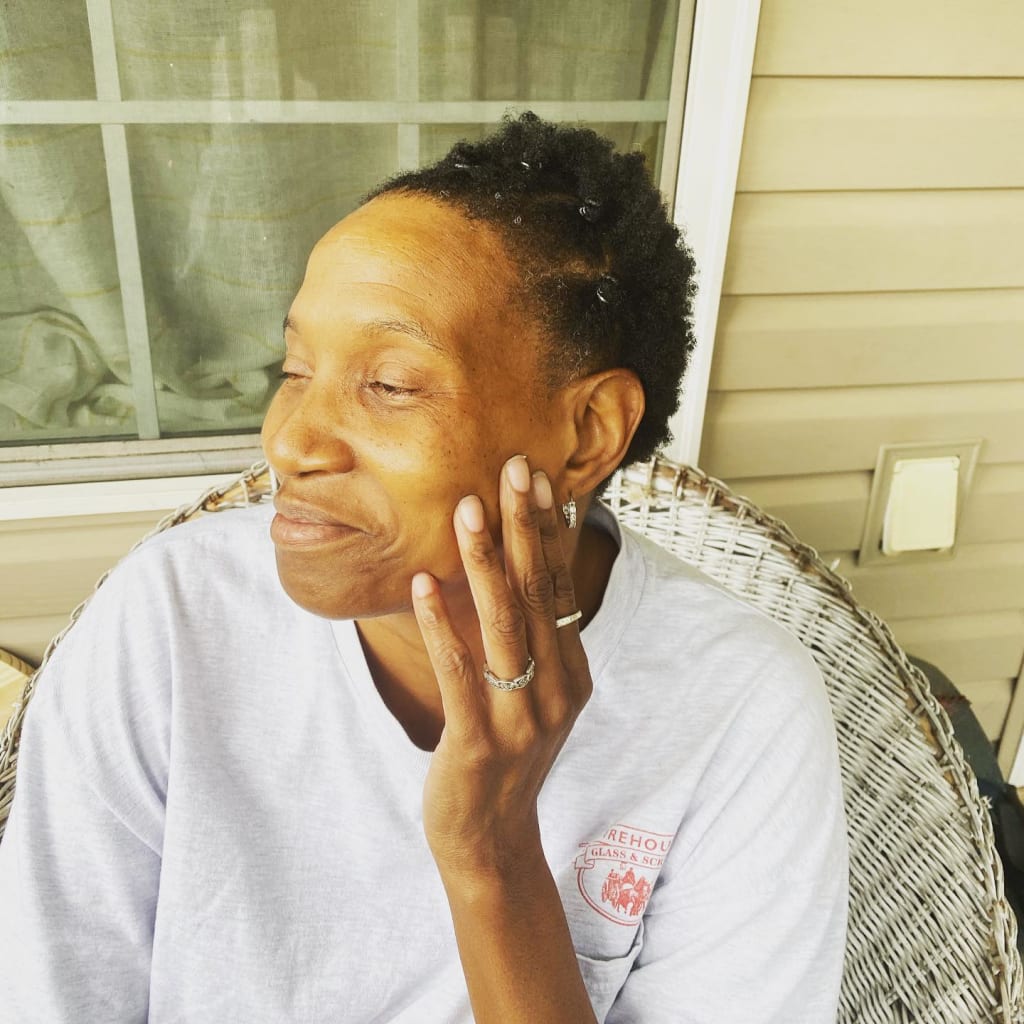
Twice a week, we bring out the arsenal. I put one of my large throw pillows on the ground and I gingerly help my mother lower herself to sit between my knees as I perch on the edge of the couch. Getting up and down off the floor is not as easy as it once was for her. The coffee table is laden with bottles of coconut oil, grape seed oil, detangling cream, a Denman brush, a rat tail comb, leave-in conditioner, a spray bottle full of warm water, and two glasses of Coke. It is a routine I was once daunted by, yet now I eagerly await.
This is the story of how I learned to do my mother’s hair.
Now, looking at the two of us side-by-side, there is no family resemblance. Besides the height difference (she has the taller frame of a former basketball player, I have a shorter, more solid build these days), her raven hair, dark brown eyes, and chestnut skin could not be more different than my mousy brown hair, blue eyes, and pale-as-cream skin. She, a gorgeous black woman; and I, her white daughter.
My mother was 54 years old before she saw the natural texture of her hair for the first time. Being from a generation that believed that naturally textured hair is ugly, unruly, unsightly, she has treated her hair with chemical relaxers since she was a child. Hot combs, smelly concoctions, countless hours of sitting under hairnets and heat lamps had left her exhausted and ready to let go.
Struggling with illness that affects her fine and gross motor functions as well as her memory, her hair had become more of a cause of stress than a celebration of her beauty, handed down for generations and generations. She was tired and resigned to wearing a bandana to cover what she felt was her shame.
One day, without saying a word, she handed me a pair of scissors. I held them in one hand and her hand in the other. Her hand slightly trembled as she nodded at me. It was time for a change.
We washed her hair, concentrating on rehydrating and restoring the health of her scalp first. Then, with a towel around her shoulders, I set upon the task of detangling. The solution to all her problems became obvious: when detangled, her hair had a clear delineation between her natural, untreated texture, and the straightened, chemically relaxed hair. We both took a deep breath, steeled our nerves, and I began to snip through her hair, exposing the tiny, corkscrew-like curls we both had never seen before.
The tether to years of suppressing her natural hair, a symbol of her heritage, her place in a long line of black royalty, slowly began to loosen until the last strands of forcibly straightened hair hit the ground. She was just as shocked as I to see her headful of these tiny reminders of the beauty she was gifted at birth.
Setting the scissors aside, I paused to drink in the significance of the role they just played in liberating my mother. Two blades with handles. That is all they were, yet to us in that moment, they were a clean break, a means to separate years of suppression from renewed pride and a willingness to celebrate instead of hide.
At first, I was scared to hurt her. Though I am very good at handling my own hair, which is very fine and straight as a board, her teeny spirals seemed oddly delicate. I was staring at a field of newly bloomed wildflowers that had been hiding under dense overgrowth. If I were too rough, in my mind, I would only add to the pain she already endured day in and day out. This needed to be a special experience. So, very carefully, I began to apply coconut oil throughout her curls, taking special care to separate and stretch them to show off the length of her hair.
With the first hurdle behind me, I threw myself into researching textured hair. Hours of videos on YouTube, phone calls with friends of mine with gorgeous natural hair, countless articles online, and even a conversation with a random lady in a parking lot on the way to my car with a large bag full of products especially for black hair. I had to be sure I knew what I was doing.
So far, we have tried twists, where I have sectioned small portions of her hair all over and twisted two strands together. We have tried cornrows. Bantu knots. French and Dutch braids. Even letting her hair breathe and leaving it free. All my trials have not been successful, but each and every moment spent with her has been a gift.
As a child, I saw her as a rock. An immovable, infallible force that would weather anything. I did not see the nights she cried in bed. The hastily wiped tears when I came in a room. The hours of sleep lost. The time spent with her elbows resting on her knees and her hands in her hair, cradling her weary head. As an adult, I realize now that she is human, with the same fears and weaknesses we all possess.
While I work on her hair, we talk about these things. We talk about her childhood memories. God. My ambitions. Family members who have passed on. Favorite meals, trips, and even the failures we have faced.
All the while, as she relaxes, her body leans into me, her shoulders lower, and she breathes sighs of contentedness.
With each of the sighs that she breathes out, I breathe in the smell of coconut and grape seed. I choke back tears because I remember being in this exact, yet reversed position when I was a little girl, and she was scared out of her wits she was going to do the wrong things with my soft, fine strands.
Now the years of strife and toil, though ever-present in both of our memories, seem to fade and ebb away slowly. Now the hands in her hair are mine. It is my only hope that with each motion, my love for her is transferred through touch. Right through the brain that has started to betray her body, and into her heart, which has the same volume as the ocean and just as much life.
About the Creator
Keep reading
More stories from writers in Families and other communities.
Wise~Guys
— Look Behind what's in Front of You ~ Make Good Choices — Hey, So how you Doin'..! Made~Men — Mobster Movies romanticise a distinctive, elegant appearance, impeccable attire style, along with the 'Families' expressive lingo. Making their 'Bones' gave them Panache — with vintage fedoras, tailored pin-striped suits, mirror-polished wing-tip shoes adorned with tassels; with their 'Gun Moll' gorgeous dates on their arms.
By Jay Kantor22 days ago in Families
Thoughts on Vocal and the way the world is
"Death cannot stop true love, only delay it." – Wesley in The Princess Bride. I decided to come back to Vocal on a very cold and dark night at the end of December. I had been, and still am, convalescing from a horrible staph infection that had gone misdiagnosed for months. This, paired with the increasing challenges of being healthy, making the best choices for my co-parented child, being a wife, and being a director at a new job, was a lot to manage.
By Jazzy 4 days ago in Confessions



Comments
There are no comments for this story
Be the first to respond and start the conversation.