
Gas vs. Induction Hobs: Which One Fits Your Kitchen Better?
When it comes to choosing the best kitchen appliance for you, there is a lot of uncertainty between gas and induction hobs. Every hob has advantages, and the final decision is based on your preferences, kitchen design, and cooking methods.
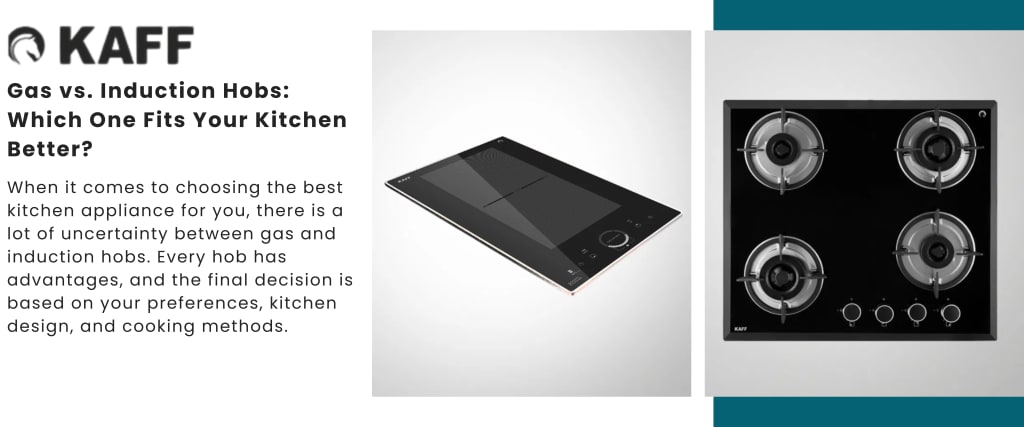
Gas Hobs:
Gas cooking has been the standard in kitchens for years. Many home cooks still prefer gas stoves for their cooking needs. They provide instant heat control, which is why they are favoured by many professional chefs and home cooks alike. The knob lets you control the temperature, making it suitable for recipes that require temperature changes.
Advantages of Gas Hobs:
Instant Heat Control: By turning the knob, you may quickly raise or lower the temperature on these hobs. Many cooking methods require this exact control.
Versatility: Gas stoves can handle any type of cookware, including cast-iron and non-stick pans.
Familiarity: For many people, cooking with gas is familiar. If you’ve used a hob gas stove for years, the switch to gas hobs will be seamless.
Cost: In general, gas hobs cost less than induction hobs.
Cons of Gas Hobs:
Cleaning: Gas hobs can be difficult to clean. The burners and grates can get greasy and food splatters, requiring more effort to maintain.
Energy Efficiency: Gas hobs are less energy-efficient than induction hobs because a portion of the heat is lost in the process of heating the cookware.
Safety Concerns: Since induction hobs do not have an open flame and only heat the pan, they are safer to use, especially in households with children or pets.
Induction Hobs:
Induction built in hobs are a modern option for home kitchens. Instead of using fire or heating sources, it warms the cooking utensils. The heat is generated by an electric current that flows via a coil beneath the hob surface, heating the pan. Making induction cooking more efficient and safe than gas cooking.
Advantages of Induction Hobs:
- Energy Efficiency: They are quite efficient since they heat the cookware directly. This results in less energy waste and faster cooking time.
- Induction hobs provide precise temperature control, just as gas hobs.
- Precise Temperature Control: Just like gas hobs, induction hobs offer control over the cooking temperature. You can set your desired heat level with a single tap of a button, making it easy to adjust temperatures while cooking.
- Safety: They do not have an open flame, they are safer to use, especially in households with children or pets.
- Easy to Clean: Induction hobs have a smooth, flat surface that is easy to clean. Spills typically don’t stick onto the surface, making cleanup easy.
- Design: Induction hobs tend to have a modern look.
Cons of Induction Hobs:
- Cookware Compatibility: Induction hobs require cookware that is magnetic, such as stainless steel or cast iron. Non-magnetic pots and pans won’t work on an induction hob, so you have to invest in newer cookware.
- Initial Cost: Induction hobs are generally more expensive than gas hobs, both in terms of purchase price and installation costs.
- Power Supply: Induction hobs need a stable electrical connection. If your kitchen’s electrical system is not up to mark, you may need to upgrade it to suit an induction hob.
Gas vs. Induction Hobs
Heat Source
- Gas Hobs- Open Flame
- Induction Hobs- Electromagnetic Field
Energy Efficiency
- Gas Hobs- Less Efficient
- Induction Hobs- Highly Efficient
Heat Control
- Gas Hobs- Instant And Adjustable
- Induction Hobs- Precise With Digital Control
Cookware Capability
- Gas Hobs- Works With Cookware
- Induction Hobs- Require Magnetic Cookware
Cleaning
- Gas Hobs- Hard To Clean
- Induction Hobs- Easy To Clean
Safety
- Gas Hobs- Risk Of Flames
- Induction Hobs- Safer For Families
Cost
- Gas Hobs- Lower Initial Cost
- Induction Hobs- Higher Initial Cost
Which One Fits Your Kitchen Better?
Your demands and requirements will determine whether you choose a four-burner gas stove or an induction hob. If you prefer traditional cooking methods, want quick heat control and don't mind cleaning, a gas stove is the best option.
A four-burner gas stove can provide more cooking space, making it perfect for large meals or multitasking in the kitchen. On the other hand, if you’re looking for energy efficiency, ease of cleaning, and a modern aesthetic, then an induction hob could be the right choice. Induction hobs are great for individuals who wish to cook quickly, with precise temperature control and the safety of a flame-free cooktop.
Individuals seeking convenience may also benefit from a four-burner gas stove with auto ignition. It has the typical cooking benefits of a gas stove while offering the convenience of easy ignition.
It essentially comes down to your cooking style, budget, and personal tastes; each type of hob has advantages and downsides. Whether you choose an induction or gas stove, make sure it meets your cooking needs in your kitchen. Brands like Kaff offer a lot of products to choose from.
About the Creator
Keep reading
More stories from writers in Families and other communities.
Wise~Guys
— Look Behind what's in Front of You ~ Make Good Choices — Hey, So how you Doin'..! Made~Men — Mobster Movies romanticise a distinctive, elegant appearance, impeccable attire style, along with the 'Families' expressive lingo. Making their 'Bones' gave them Panache — with vintage fedoras, tailored pin-striped suits, mirror-polished wing-tip shoes adorned with tassels; with their 'Gun Moll' gorgeous dates on their arms.
By Jay Kantor24 days ago in Families
The Punishment of Greed
The Punishment of Greed Once upon a time, in a small village, there lived a farmer with his two sons, Ahmed and Muhammad. Ahmed was clever and cunning, always thinking of ways to get more for himself, while Muhammad was innocent, simple-hearted, and somewhat naive. The farmer owned three valuable things: a cow, a fruit-bearing tree, and a blanket.
By Sudais Zakwana day ago in Families
The Path to Salvation
The late autumn evening air filled the monk's lungs, but it wasn't the season that chilled his bones. The heavy-handed presence of evil he had sensed upon entering the woods surrounding this mountain village had not bothered to conceal itself from him.
By Made in DNA3 days ago in Fiction




Comments
There are no comments for this story
Be the first to respond and start the conversation.