

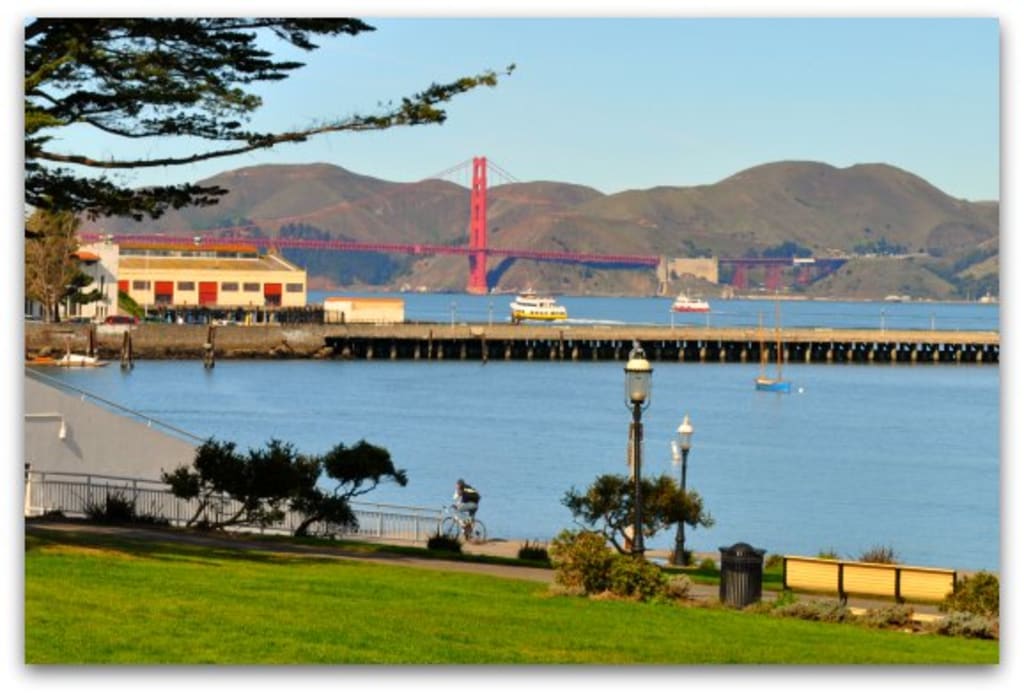
In San Francisco, my parents rented a large flat on Funston Avenue, bordering Park Presidio Boulevard. The only furniture we had were our dining table and chairs, and beds, they pulled out of storage. What might have been a beautiful and comfortable flat had it been furnished and decorated properly, was cold, physically, and for me, emotionally.
Mom took a job at a military hospital on Lake Street, not far from the flat, leaving Dad and me to fend for ourselves for dinner, as usually happened. Dad heated cans of new potatoes and spinach in a pot of boiling water while he fried a London Broil steak and onions. Sometimes instead we ate Campbell's Pork and Beans.
At first I spent my time in the flat comforting myself by listening to the radio, and enjoying favorite songs, like the Lovin' Spoonful's "You Didn't Have to Be So Nice," the Four Tops "Sugar Pie Honey Bunch," "You Were on My Mind" by We Five, and "Hold Me, Thrill Me, Kiss Me" by Mel Carter. I loved so many more great songs, as well.
I still stung from our abrupt move away from Los Angeles and my friend Robyn. My anger morphed into depression, which was worsened when I started Presidio Junior High for the last six weeks of eighth grade.
Presidio Junior High's three miserable stories span the block on 30th Avenue from Geary Boulevard to Clement Street. Most kids never have to begin attending a new school when there are only six weeks left in the school year. I can tell you from experience, it is like magnifying the discomfort of adjusting at the beginning, or even in the middle of, a year, by at least a hundred. Especially in junior high school.
I entered home room to find it packed to the gills with rowdy eighth graders presided over by an extremely obese man. I managed to find a desk at the back. No particular introduction was made; the teacher just asked my name and checked the roll sheet. He had to call the office, then pencil it in.
The two classes I remember are history and drama. History met in a classroom on the third floor. Like most everything else about the school, I remember it as gray and heavy.
The teacher was a dowdy, dumpy, middle-aged woman, who wore loose dresses and her gray hair in a braid down her back. At a desk a row over and two seats in front sat the skinniest girl I had ever seen. Bored with class, I spent my time in fascinated wondering about her and how sharp her shoulder blades were. She would become my oldest friend.
One day when I was getting over a cold, I had a coughing fit, and hacked my way out of the room. She followed me out and asked me, "How long have you been smoking?" Real concerned, wasn't she? So, she was not only uninspiring and unattractive as a teacher, but rude and insulting as a person.
The in-girls who lived in or near the posh Sea Cliff area, took an interest in me. I had no interest in joining that petty clique of plaid wool-skirted, superficial snobs. I don't know why they were attracted to me -- my clothes were old, and because of my sapped energy from depression, I made no effort to enhance my appearance. The only reason left is that they found me physically attractive.
Dona, however, yearned to be accepted by the in-crowd. They all passed through elementary school and junior high together -- Dona had stamina and endless hope, but little else going for her that appealed to them. She was ultra-skinny, as I mentioned, and tall, with stick-straight, thin, mousy brown hair. Her big, beautiful blue eyes could not make up for her gauntness. The loose calico cotton dresses made by her grandmother hung straight down, as Dona had no breasts to give them volume. She did not stand out as a student. She spoke with a slight lisp. Her family was definitely not wealthy.
In the many years in between then and now, Dona has often told me how much she appreciated my befriending her. It assuaged her loneliness and allowed her to feel a little confident for the first time. Our experiences together exposed her to wonders she never had known of. She found me after I left San Francisco without telling anyone where I moved to. She has been a loyal friend to me for 56 years.
Dona lived with her divorced dad, little brother, and grandmother in a small, odd, apartment carved out of a corner in a building on 15th Avenue. The carpeted lobby smelled like natural gas. In my memory, the apartment consisted of one large, rounded room and a bathroom, the family's beds and a tiny kitchen along the walls.
Dona's grandmother was a pale, meek, sweet, lady with a protruding stomach and wisps of thin gray hair. She wore the kind of apron that fit over her shoulders over the same type of calico dresses she made for Dona. I doubt if she ever went anywhere.
Dona's dad worked as a machinist, and so did very different kind of work from my civil engineer father. Dad had much more leeway to make his own schedule, was far better paid, and was highly educated. I only met Dona's dad once that year, and briefly -- just enough to get an impression that he was very different from my dad.
Dona showed me a portrait of herself as a baby. What a contrast! In the picture she looked well-nourished and rosy.
Dona's Dad and grandmother kept close tabs on her. Soon, this proved problematic when she wanted to join the other friend I made at Presidio for our treks downtown and to Fisherman's Wharf.
The other girl in our trio was Debbie. In contrast to Dona, Debbie maintained no ambitions to fit in with the in-crowd. She lived with her parents and two older brothers in her mom's parents' ground floor flat on 12th Avenue. The kids' beds were crammed into the tiny front room. Like Dona, and me, she owned few clothes. She invariably wore casual slacks with a long-sleeved shirt tucked into them. She was not nearly as skinny as Dona, but still skinny. She wore her straight blond hair down.
I met Debbie while eating my lunch on a cement bench that sided the walls of a long, dreary play area. We ate our sandwiches and fruit, and passively observed the other kids. It interested my two compatriots to see how Mom scored my oranges to make them easy to peel.
After school, Debbie and I usually walked Dona home, sometimes stopping at a five and dime on Geary Boulevard to browse. I often bought Dona a little trinket; I felt bad that she had no money.
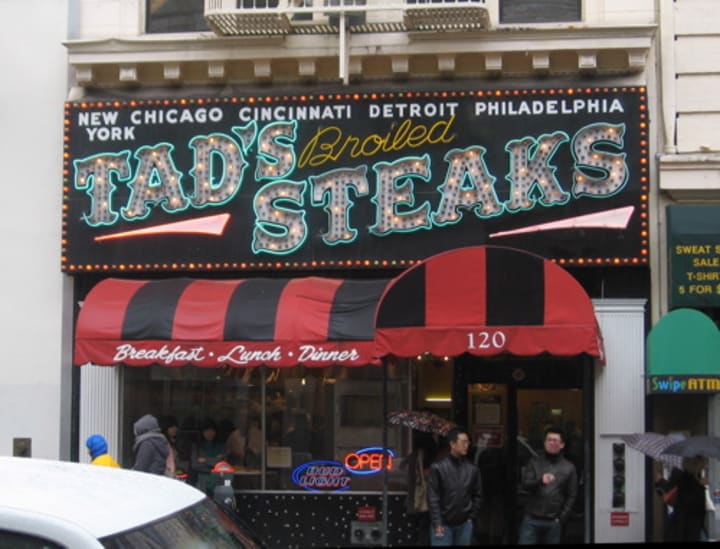
On weekends, the three of us, or just Debbie and I if Dona couldn't go, headed to the Geary bus to go downtown. Once there, we walked down to Market Street, stopping to stuff ourselves with humungous steaks, baked potatoes, and salad at Tad's Steakhouse. Dad always handed me a twenty dollar bill and said, "Have fun," before I left. This I used to treat my friends.
We often browsed in the many book and gift shops along Powell Street, then made our way to Woolworth's and Emporium on Market Street.
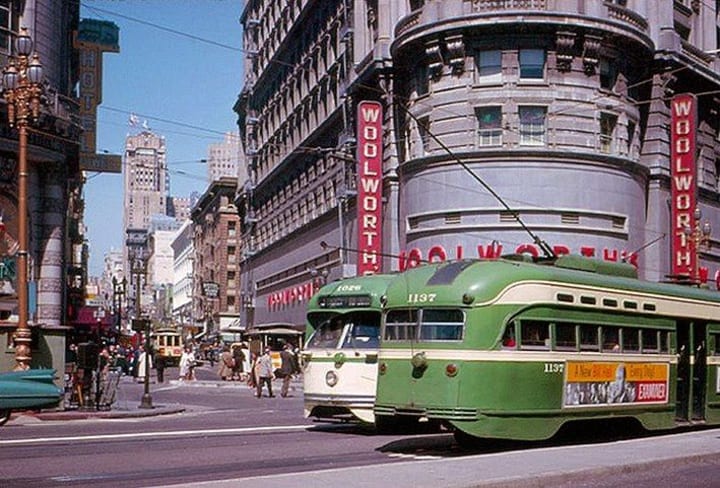
Woolworth's five and dime was humungous! We three spent so much time in there, peering down at the items arranged on tables that we could feel the security guards watching us. Rarely, we ordered hot fudge sundaes or hot dogs from their spinning racks at the lunch counter.
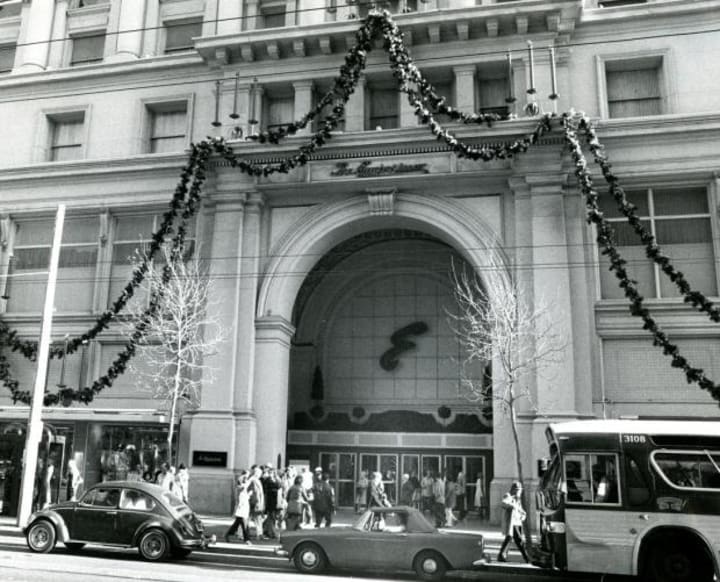
In the Emporium, we scoured the bargain basement for clothes. The basement was, like Woolworth's, filled with square wooden tables piled high with yard goods, towels and linens, and all manner of items marked down.
One day from my stall in the women's room, I asked Debbie how she managed not to get pee on herself while using the thin paper seat covers. "You tear the little tabs, so the inner part sticks down into the toilet!" She could have added, "Duh!," but didn't. Every time I pull one of those flimsy covers up and out of the dispenser, I think of that incident!
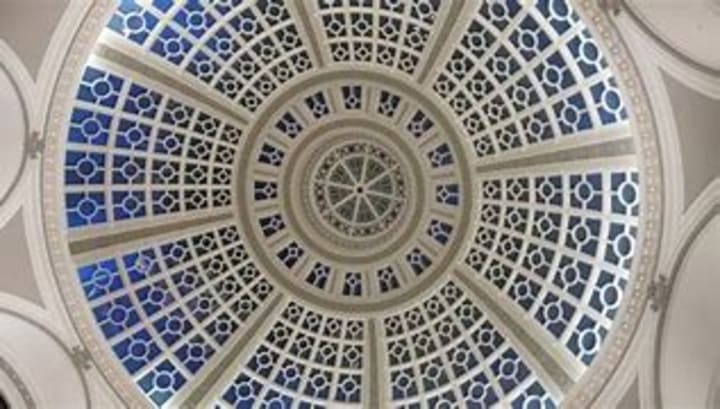
The old Emporium was a grand old building. Its most awe-inspiring and magnificent feature was the domed ceiling. Below the ceiling stood glass cases and racks displaying perfumes, cosmetics, purses and wallets, watches, jewelry, clothing, and other items. Once Debbie, Dona, and I sprayed just about every tester of perfume on ourselves (I liked White Shoulders, a scent I grew to have a real distaste for), we spent many hours gazing up, down, and sideways in the Emporium.
The pleasures of browsing segued into hopping on the Powell and Hyde cable car at the roundtable at the bottom of Powell Street. We became adept at doing this, and enjoyed standing along the side of the car instead of sitting on the wooden bench, where we held on to the cold, shiny brass poles.
The cable car proceeded up Powell Street along the mild grade to Sutter Street before it reached the steepness of Nob Hill. At the top of the hill, we passed the iconic Fairmount and Mark Hopkins Hotels. At Washington Street, the route cut over to Hyde Street. The final stretch down to the roundtable at Beech Street was so steep, it both thrilled and terrified us as we wondered whether the mechanical grip in the trench below the street was going to let go and cause us to careen helplessly down the mountain!
For those of you who wonder what I'm talking about, let me give you a little lesson on how cable cars work. The cars themselves have no engine. Instead, they are pulled along on strong steel cables under the tracks. The long cables run on down to a powerhouse that turn them around a wheel. Each line has its own cable. The gripman, or woman, maneuvers long levers that control how the cables are gripped by plier-like mechanisms. This is called "taking or dropping the rope."
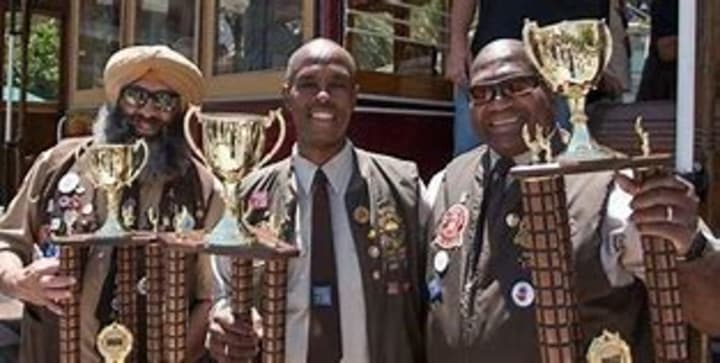
The other main job of the gripman is to ring the bell when the car is stopping, starting, coming to an intersection or needs to warn someone of its approach, or often, just for fun! You may have heard the old Judy Garland song from the movie Meet Me In St. Louis, that goes, "Clang, clang, clang went the trolley, Ding, ding, ding went the bell..."
There are two main bell systems on a cable car, the conductor's bell and the gripman's bell. The conductor stands at the back of the car to collect fares, give directions, operate the brakes, and advise the gripman when to go, stop, reverse, or warn him if there is a problem. His bell is smaller and quieter, and is located on the ceilings of the inside compartment and the outside compartment, where the gripman is.
The gripman's large, brass, and very loud bell sits atop the car.
Gripmen and women often elaborate on patterns. In fact, annual contests allow them to show off their bell ringing skills and improvisations!
Upon arrival at the Hyde Street turntable, we hopped of the cable car and trudged to Fisherman's Wharf. There we bought a crab from one of the large, steaming vats along the sidewalk. To accompany the crab, we chose a big round of San Francisco Sourdough and butter.
Once back in Aquatic Park, we sat on the grassy slope to feast. Oh man, there is nothing like eating fresh Dungeness crab and San Francisco Sourdough slathered with butter in the sun (or fog) while the wind blows your hair around and causes you to chase your napkins!
Happily stuffed, we walked back toward Fisherman's Wharf and headed for Cost Plus Imports. Housed in a 4,000 square foot warehouse on Taylor Street, it was the one and only Cost Plus World Market at that time.
Debbie, Dona, and I spent hours in there! Nowhere else could you find objects from so many countries, many of which were affordable, even for three thirteen-year-old girls. I especially loved the tiny Japanese cups and bowls, chopsticks, woven mats and rugs, wonderful handmade ceramic beads, tiny dyed dried flowers, enameled-metal teapots, wooden boxes inlaid with abalone, flowing exotic dresses, Indian tops...well, you get my drift. In other words, there was not much I did not love in that huge warehouse. I once bought a brass cow bell from India I wore on a leather thong around my neck during my pseudo-hippie days!
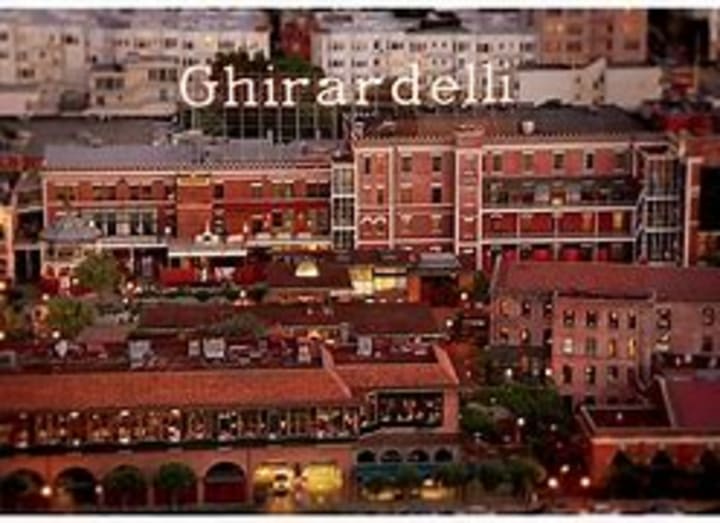
Sometimes we explored Ghirardelli Square. The Ghirardelli Square is a large, brick complex of shops and restaurants on the other side of Aquatic Park from Fisherman's wharf. It started as a chocolate factory, and we bought chunks of chocolate, which at that time you couldn't find in supermarkets.
Oh, man, did the air smell good! The aroma of the smoke from the steakhouse was potent and made our mouths water.
Eventually the time would come when we had to get Dona home, so we made our way back to the cable car turntable, up the Hyde Street Hill, to Geary Boulevard, where we caught the bus. By that time Fisherman's Wharf was foggy and cold.
On days when Dona was not allowed to come with us, Debbie and I had a different experience. When we walked along Market Street, Debbie flirted with sailors! Her doing so made me extremely uncomfortable.
In later years, I wondered if she might have been sexually molested by her older brother, and through that caused to cope in a way that many molested girls do: to feel hyper-sexualized at a young age.
The reason I wondered this, apart from her behavior with sailors, was that this brother was an adult and was in the military. Sometimes on his leaves we encountered him, and he made me uncomfortable with his lewd remarks and come ons. If he were that inappropriate with me, I wondered if he were not much more inappropriate with Debbie.
I never felt I could ask her about it. In those days, sexual abuse was not typically talked about, or even acknowledged. As adults, we drifted apart.
A funny incident happened in a park one day. I sat leaning against a tree. A little dog came running toward me. I told him what a cute little pooch he wa, and was all ready to pet him when he peed on me!
So, I had quite a lot of fun, despite my depression and anger, while living in San Francisco for those three months. In the summer, Mom took a job as camp nurse at Kennolyn Camp, a well-known camp in the Santa Cruz Mountains where rich people sent their kids. This was my parents solution to not knowing what to do with me, in part. I'm sure their concerns about my sexuality continued to plague them. And, I guess Dad had not found this time to meet his hopes, so my parents were looking to move somewhere else.
I rather resented my parents' motivation, bringing up my feelings from Los Angeles. I felt I had little in common with the campers, who came mainly from wealthy families. But that is a whole other story, which I will continue in my next post. Join me!
About the Creator
Caroni Lombard
As a child my family moved often. In my story, I share that experience; what it was like and how we coped.
But my story is not just for those who share my experience of growing up in a highly mobile family. It's for anyone who's human.
Keep reading
More stories from Caroni Lombard and writers in Families and other communities.
Wise~Guys
— Look Behind what's in Front of You ~ Make Good Choices — Hey, So how you Doin'..! Made~Men — Mobster Movies romanticise a distinctive, elegant appearance, impeccable attire style, along with the 'Families' expressive lingo. Making their 'Bones' gave them Panache — with vintage fedoras, tailored pin-striped suits, mirror-polished wing-tip shoes adorned with tassels; with their 'Gun Moll' gorgeous dates on their arms.
By Jay Kantor17 days ago in Families



Comments
There are no comments for this story
Be the first to respond and start the conversation.