
Finding Dad
Memory of things that happened and also of those that never did

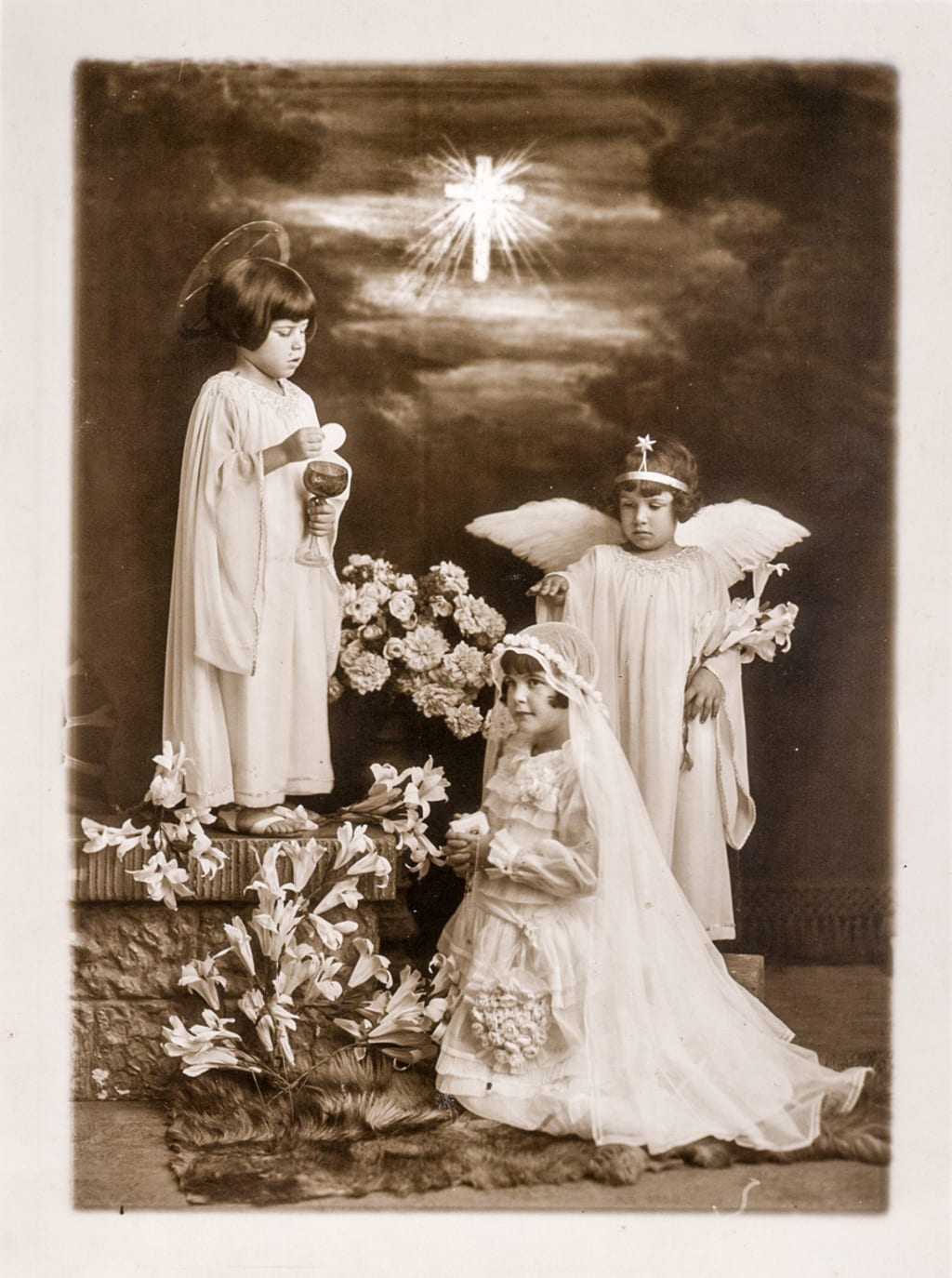
Who is my father? Who is this handsome old man looking at me through the cell phone screen, this cute young man with a ridiculous moustache, this blond little kid in an ancient sepia picture with angel wings in some type of pageant, this boy dancing with this girl, couldn’t be older than 15 but they were actually 23 and 25?
As I looked at the screen in this paragraph, my father was 95 years old, I lived in Oklahoma City, and he lived in Sao Paulo, Brazil. I don’t think he can answer this question now, neither do I. He is all those people both synchronically and diachronically - at the same time and in some sequence. One or more threads. As prolific people who are a little different age, life looks like several hanks of yarn with which a litter of kittens played for hours. It’s pretty awesome and also pretty chaotic.
Finding the threads and following them, maybe even rolling them back into hanks is not unlike my fathers’ beloved puzzles. During my almost sixty years, several people shared memories about my father, including himself. I have my own memories. They are all disorganized. Some are so old that I only have parts of peoples’ bodies, the ones directly visible to a tiny person: legs, maybe their middle and hands reaching down to me. Many of my memories, I know, are not factual. My parents didn’t run away on horseback because his family tried to separate them: Anita and Giuseppe Garibaldi did. His family did try to obstruct their marriage, though. I remember things that I couldn’t have heard or even overheard. Yet, when I checked with those who could remember, they were true.
Family pictures are a huge source of fact-fiction intertwining: children watch the same picture over and over again and a story slowly forms around it. Years later, it’s hard to separate what is fact and what the mind filled with symbolic material from elsewhere.
My father is “a little different” and for years I thought he didn’t like me very much. It took decades for me to connect the dots and two thoughtful psychiatrists who challenged all my previous diagnoses. Both, independently, said the same thing: there are clearly neurological abnormalities that we don’t have the tools to identify but they look like some atypical epilepsy. The second thing both agreed on is that I am probably somewhere in the autistic spectrum. As I thought about my father’s rituals to handle social niceties, always a bit off, or his difficulty dealing with his kids emotional challenges and especially outbursts, his horror of bureaucracy and institutional games and his acute reactions to my mother’s our our physical suffering, which could look like a psychotic episode, it all made sense.
Like a detective, I look for dad. My clues are memories - false, real, mine or shared -, stories told to me by other people, old photographs but now, mostly, the things that make me see him as I look at myself.
A while ago a friend of mine decided to run for office as city representative in São Paulo. His number was 18181. “Look, it’s an anagram!”. Nobody cared. I felt a little awkward as I insisted on sharing this fun fact. Last year, Lena turned 66 years old on June the 6th, her birthday. “That means you have six Satans to claim from your account”. It took too much explanation as nobody saw the fun in the 66 on 6 of the 6 (so 6666). Did I use to be fond of anagrams? I don’t remember but I know my dad is the anagram man, like mom is the neologism woman. I do both, at least now.
For as long as I can remember, my dad complained about his memory. We even had a ridiculous episode in which I went to the neurologist appointment with his head MRI because he was at the same time obsessed with the idea that he had Alzheimer’s syndrome and terrified to have it confirmed. So I proposed this arrangement: I would go in his place. If there were signs of the disease, I would say nothing. If there were no signs, I would report it. I know, it doesn’t matter, it made sense to us then and we met the best neurologist I’ve known. Dad’s brain was pristine. After the fear was dismissed, he kept going for tests and no, he has no memory problem. So what does he have? Most probably, he’s hyper-focused. He doesn’t have certain memories because he never paid enough attention to the fact, or something else was much more relevant.
The first time I got spooked by my memory was when I was in grad school and picked up a book in the pile of “books to read”. It was Foucault’s “The Order of Things: An Archaeology of the Human Sciences”. It was a used book. At the time, I bought several books in used book stores. As I started to read it, I noticed that the previous owner had made several annotations with a tiny handwriting in pencil. The more I read the person’s annotations, the more I realized that person’s thought process was extremely similar to mine. And there’s more: their handwriting looked astonishingly like mine. The book was mine, I had read it and I had annotated it. That was scary.
After that I became more aware that my memory was much worse than anybody I know. I couldn’t recall faces or names but I have the concept of the person. That created weird situations. “Don’t you remember me? I’m Henry, I own the book stand at the Philosophy department…” No, I didn’t remember. “We talked about Heiddeger..” And then the whole history of my interaction with Henry came back to me, full with details about his thoughts and shared anecdotes.
I realized I could retain very little about places, streets and roads. It was so bad that it looked like a condition my friend developed when he barely survived a motorcycle accident and had a brain hematoma: “jamais-vu”, the opposite of “deja-vu”.
At a certain point I had my second head MRI done and the result was… nothing. The neurologist said that it was a condition, not that unknown and there was no cure because it was not a disease. He told me to collect photos and buy a GPS. That made sense: I can easily find my way with a map or if the city is organized in numbered squares, like Brasilia, New York or Gainesville, FL.
My dad’s memory non-problem is different from mine but maybe, just maybe, we share the fact that we don’t consolidate memories because we are hyper-focused.
Dad can’t resist solving problems. We had several encyclopedias and thousands of books at home and his go-to source was the Britannica. If he didn’t find it there, he would pick up his keys and drive to the university and wouldn’t rest until he solved the problem. Any problem, it didn’t matter, as long as it tickled his problem-solving brain. I am irritatingly exactly like him.
In other aspects we are completely different. I’m no help there. But I have siblings and there are clues there. Lena is a perfectionist. The result of her artwork is beautiful but she can be irritatingly perfectionist. She will be absorbed in crafting something for hours, days, months, a lifetime, I don’t know. They share that: they are both creative and perfectionists.
Dad’s students published an article about a teaching device he developed to explain polarized light petrographic microscopy. I remember him with the “hat magnifying glass” picking up cellophane circles that he had made with a paper perforator and pasting them over glass circular surfaces. The whole apparatus took a long time to make and when it was done, it was a thing of beauty.
He made a scale topographic map with sheets of thin but dense cardboard that he cut with a razor. I don’t know how long it took but, again, it was a thing of beauty.
I see his conflict avoidance on all my siblings. I’m the oddball, the aggressive, confrontational and slightly menacing kid that grew up to be an aggressive, confrontational and slightly menacing adult. Or so I thought until I read the dreadful letter that his father sent to my grandma (my mother’s mother). In that letter, that monster of a man describe my father as a confrontational and difficult boy, who defied the order of things with his silence or his words. His silence, according to that man, was worse.
Dad collected things, especially rocks, for obvious reasons. Lena collected pectens. When she left home, I inherited the little plastic box with her pectens and kept collecting more and more pectens, my favorite seashells.
Mom explained to me that dad hated carrots and pumpkin because his monster of a mother forced him to eat them. She would force-feed them to him while his older sister held his hands behind his back and pinched his nose until he had to open his mouth to breath. Did anybody describe to me this torture session? Did I overhear it? Or did I imagine it? I don’t know. It’s so real that I can see it happening as an old movie on the screen of my mind.
He was never mean to his mother but I was. In the first opportunity I had, I elbowed her liver. I was only five years old and I remember the feeling of hate that she inspired in me. She did either pinch or poke me, or at least that was my explanation for her deserved punishment.
There are things I don’t understand about him and I guess that’s good.
Right now, I know he is stuck inside his head, on the other side of the world, far from me, during the COVID19 pandemic. And what I do know, for reasons I ignore, is that we must open a door to let him out.
About the Creator
Marilia Coutinho
Marilia is a multi-disciplinary scholar who publishes on health, politics and culture. Her background include biology, biochemistry, ecology and sociology. She also writes memoir pieces about her unusual life and fiction pieces based on it.
Keep reading
More stories from Marilia Coutinho and writers in Families and other communities.
The boat, treasures, and the beach
The red and white boat that dad shouldn’t have bought, according to mom, had a purpose: adventures at a semi-desert beach at the São Paulo Northern coastline. I believe that, at the time, Juquehy was a division of the city of São Sebastião.
By Marilia Coutinho5 years ago in Families
Dua To Make Someone Fall In Love With You
Dua To Make Someone Fall In Love With You – A Powerful Prayer for Love and Connection Love is one of the most beautiful emotions that Allah has placed in human hearts. It creates happiness, emotional comfort, and a deep sense of connection between two people. When someone truly cares for another person but struggles to express their feelings or gain their attention, it can become emotionally challenging.
By Karm Aalign Muslim - Dua For Love Back - Wazifa For Love Back - Dua to Make Someone Love youabout 21 hours ago in Families
A Transparent Look at Vocal Challenges and Top Stories
Almost three years ago, we shared a resource article that served as a place for people to suggest new challenge prompts. We thought it would be a good idea to refresh that thread, and take the opportunity to answer a few common questions about top stories, how challenges are judged and how submissions are reviewed.
By Vocal Curation Teama day ago in Resources


Comments
There are no comments for this story
Be the first to respond and start the conversation.