

They were all gone. Her parents, her little brother, and everyone else had been taken and she had been left. Out of 245 passengers plus the crew, she was the only one who had survived the plane crash. It seemed incredible, impossible, or—simply—fate. Merlin believed in fate, but was it fate that she should survive the crash into the ocean, only to die on a deserted island? Could that possibly be fate, or merely cruel circumstance?
At the age of twelve, after reading her father’s book of Nietzsche and having many conversations with him, she had formulated her belief that what was to be would be. “To love what is necessary” (“Amore fati”) seemed like a perfect way to live. Five years later she still believed it, but also that every decision a human makes has led them to where they are. Destiny was fate working itself out through time and events, and she had something to do with those events. Or did she? That was the eternal question. If she changed her mind, was that fated? Could she have refused to get on the plane with her family?
But now, sitting on the sand with the surf licking at her heels and looking out across the ocean at nothing—absolutely nothing—she wondered if she had been wrong about all that. Over everything else, she had believed that to the good fate was good. But now, fate seemed rather like a madman.
It had all happened so fast. They were flying along just fine and then suddenly the plane was diving, with little time for the stewardesses to help people get ready. It was only chance that, after slipping into her flotation device, she had forgotten to fasten her seatbelt, because she had turned to help her little brother fasten his and put on his preserver. Her father was busy in front helping her mother. And then they hit the water, and her lack of restraint made all the difference as the plane came apart, and the water rushed in, and she floated upward while they dropped down, down into the murky darkness. With hands outstretched to her brother, she saw his silent shriek of terror, and then nothing.
She swam in place on the surface and looked for anyone, but not one head bobbed up. Not until later. For a moment she thought about giving up, simply taking a mouthful of water, and sinking. But then she saw the island. Fate seemed to rear its head again, and she was a good swimmer.
That night was the worst night of her life. The hardest part was not remembering what had happened. Besides the immense loss, Merlin had nothing but the clothes on her back, consisting of jeans, a long-sleeved pullover, and tennies. She found a cave by the water that was high enough to be above the incoming tide and spent the night there. The next morning she saw a few bodies bobbing in the surf and one washed up on shore. They had unfastened their belts too late. The grim task of searching the bodies, if she wanted to survive, awaited her. She might need what was in their pockets, as well as the debris that she saw washing up on shore and in the inlets here and there. She put it off all day, while she searched the island, walking all the way to the opposite shore in about twenty minutes. Coconut trees were everywhere but they were tall and slender and she had no idea how she would get to them. Then she spotted something scurrying in the rocks near the cave. There were crabs here and they were big. If she could catch them and cook them, they would sustain her. Otherwise…
“What I do makes a difference,” Merlin said to herself, as she waded out to the bodies.
She had thought that she knew what effort was, but she had never struggled in her life the way she did for the next two days, to get the bodies far enough up on shore so that she could pile rocks on them, and to go through the bags and suitcases that she found. It was ninety percent emotional and ten percent physical struggle. Afterwards, she surveyed the stuff she had piled together and it looked like barely enough with which to survive, but maybe just enough for a short stay. The cigarette lighter was a prize, and the pocket knife, as well as the plastic bottle of alcohol. And the little whistle on its long chain might be good for something. She placed it around her neck.
The one thing that was a treasure to her lay by itself: a little, leather-covered, black book. She had found it in a briefcase, and she knew whose case it was immediately, not only by her father’s initials but because she was well acquainted with it. Merlin was a “Daddy’s girl” –named by him because of his love for that old story and because he liked magic—and she knew almost everything about him. A knife stabbed into her heart then because it was almost as if he had collaborated with fate and sent this up to her as his last parting gift. His last bit of wisdom because she knew that his journal was inside. The well-made briefcase was water-tight and had floated to the surface; everything was perfectly dry. In the back pages of the journal she found the money which he had placed there just before they left for Tahiti: twenty-thousand dollars for their trip expenses. Her dad’s philosophy was to always have more than enough for emergencies, and he preferred cash. “Cash speaks to everyone,” he would say.
A slight sob escaped from her lips as she held the money, recalling that moment in his bedroom when she watched him place it in the book. “I never go anywhere without this book,” he had said. “One day, I’ll let you read it.” That day had come, she thought, as she wiped her eyes. “Oh, Daddy!”
The crab was good eating. She had speared it with a sharpened piece of bamboo and roasted it above a small fire. She had used a few bamboo leaves and twigs for the fire, but it had been difficult to get it going. Because she knew that alcohol burned, she had finally poured a few drops on the twigs. The lighter would have to hold out for however long she was here, and so she needed something that would instantly light and catch other things on fire. There were two items like that: the money and her dad’s journal. She knew what her father would say to the idea of burning money, especially the only money she had with which to get home if someone found her. Yet, to burn her father’s journal was unthinkable. Merlin thought for a long time about this problem, and then she opened the journal and started reading. She read a little every day; it was too painful to keep it up for long at one sitting. She would read and think about what her father had written, while she hunted crab or little fish that had gotten trapped in the inlets, or simply walked around the little island’s shoreline, gazing off across the sea. At night, she would make a little fire using one or two of the pages of the journal, starting from the beginning with those she had already read. She knew that the words were hers forever. The paper was of good quality and burned very well, and long enough to ignite the twigs. She would roast her crab or small fish just above the fire on a spit. She did not need fire for warmth.
On her seventh day, as she was nearing the end of the book and the sun was approaching the horizon, she put down the journal. Reading was difficult now, although the light shined directly in through the high arch of the cave opening. She had already finished her dinner and there was nothing left to do but watch the stars in the west before falling asleep. Merlin thought about what she had just read. She had thought that she understood her father, but now she saw that she had never comprehended the problems he had gone through and his effort to understand life—especially his part in it. In truth, he had shown her only a small part of himself. At first, she felt cheated all those years, and yet she had always loved and respected who he was and he had always loved her. Meanwhile, he had had many doubts. Frederick Nietzsche was there in his writings, and so much more. He had begun to believe that fate was more than the great man had guessed, although he had seemed to fret around the edges of the truth. There was divine guidance for those who sought it, and men were not stuck with whatever happened.
In the first few days, Merlin had more than once come to the point that she thought was the end of her. She could go no farther; the pain was simply too great, the loss too insurmountable, her future prospects too bleak. And then she would think of her parents in their watery grave out there in the ocean and ask herself what they would want. How did her father see her responding to these things? And she would get up and go on.
Now, as she wondered what would happen to her and as she faced her life’s greatest trial, she picked up the book again and read her father’s last words, as if he had been writing directly to her.
"When you accept fate, it does become your destiny, but when you fight what seems to be your fate, you may sometimes create your destiny. Fight, so that you may live, for there is nothing else that may truly be called living. "
“Oh, Daddy!” Merlin cried out to the echoing cave. “You fought, I see it now. You fought for years. You fought for me, and Timmy, and Mother. And you did not lose. You did not lose. I am here because of you. And I will fight!”
She jumped up now and ran out of the cave, felt the soft, cool sand under her feet, because she had taken off her shoes, and saw the stars like dust above her, the ocean waves falling with the sound of drumbeats on the shore. “I will fight!” she shouted to the elements around her. “I will never give up!”
And then she saw the lights, not far off shore, that moved up and down the island, as if looking for something—or someone. “They’re looking for me.” She verbalized her realization. “They’re looking for me!” But they would not see her in the dark. She remembered the whistle. Her hand impulsively went to it, shoved it between her lips, and she blew as hard as she could. She did not stop blowing until she saw the boat on the surf, headed toward shore.
Later, much later at the airport, a reporter asked her how she had survived. Merlin held up her father’s journal—the little black book that had not left her hands since she had left the island, except to shower and dress into the clothes they had given her. The last twenty pages were still in the book. “This is how,” she said.
About the Creator
roger Crane
A retired English teacher, Roger writes for the love of writing and creation, populating real or imaginary worlds with characters who reflect on us, helping us to appreciate the act of living. Roger loves writing spontaneously on prompts.
Keep reading
More stories from roger Crane and writers in Families and other communities.
Gupta
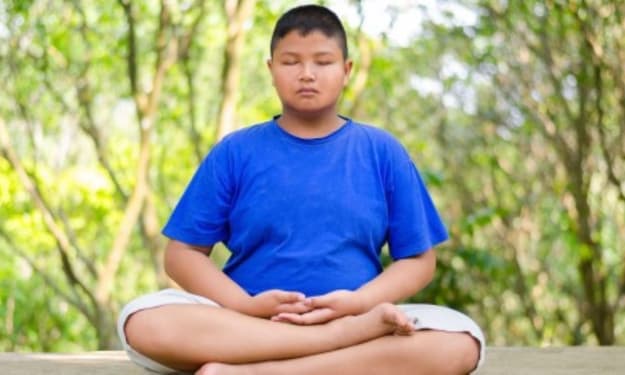
Gupta Gupta sat cross-legged on the boulder, his hands resting on his lap, and he thought. At least, that is what he appeared to be doing, with his eyes closed. It was a very large, smooth boulder that he sat on, and Gupta looked like any ordinary boy about ten years old. However, he was not an ordinary boy, and a great sense of peace seemed to emanate from him. I don’t know how else to describe it.
By roger Crane5 years ago in Futurism
Wise~Guys
— Look Behind what's in Front of You ~ Make Good Choices — Hey, So how you Doin'..! Made~Men — Mobster Movies romanticise a distinctive, elegant appearance, impeccable attire style, along with the 'Families' expressive lingo. Making their 'Bones' gave them Panache — with vintage fedoras, tailored pin-striped suits, mirror-polished wing-tip shoes adorned with tassels; with their 'Gun Moll' gorgeous dates on their arms.
By Jay Kantor23 days ago in Families
Men who eat nuts tend to have better quality sperm
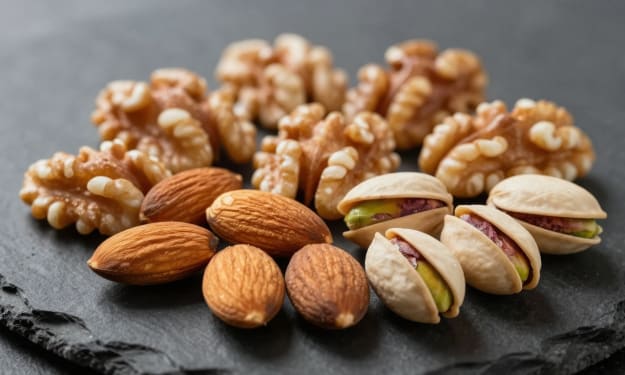
Peak Potency: How a Daily Nut Habit Elevates Male Sperm Quality Male fertility rates have dropped in recent years. Many couples struggle to conceive, and men often overlook their role in this challenge. Your diet can make a big difference here. Nuts stand out as a simple fix. They pack antioxidants and healthy fats that support better sperm quality. Think of them as fuel for your reproductive system. Studies show men who eat nuts regularly see real gains in sperm health. If you're planning a family or just want peak vitality, adding nuts could be your smart move.
By Story silver book 7 days ago in Families
Autonomy Is The Real Privilege
Good morning, freedom-seekers! Today we’re gonna be looking at autonomy. A strange word, I know; one many would probably look at blankly and run away from on sight. We’re gonna figure out what it actually means, consider how it’s achieved, and decipher just how deeply most of us are tangled up in dependence without realising it.
By That ‘Freedom’ Guy4 days ago in Humans


Comments
There are no comments for this story
Be the first to respond and start the conversation.