
Crumbs of Courage
A refugee baker's journey told through the recipes he leaves behind.

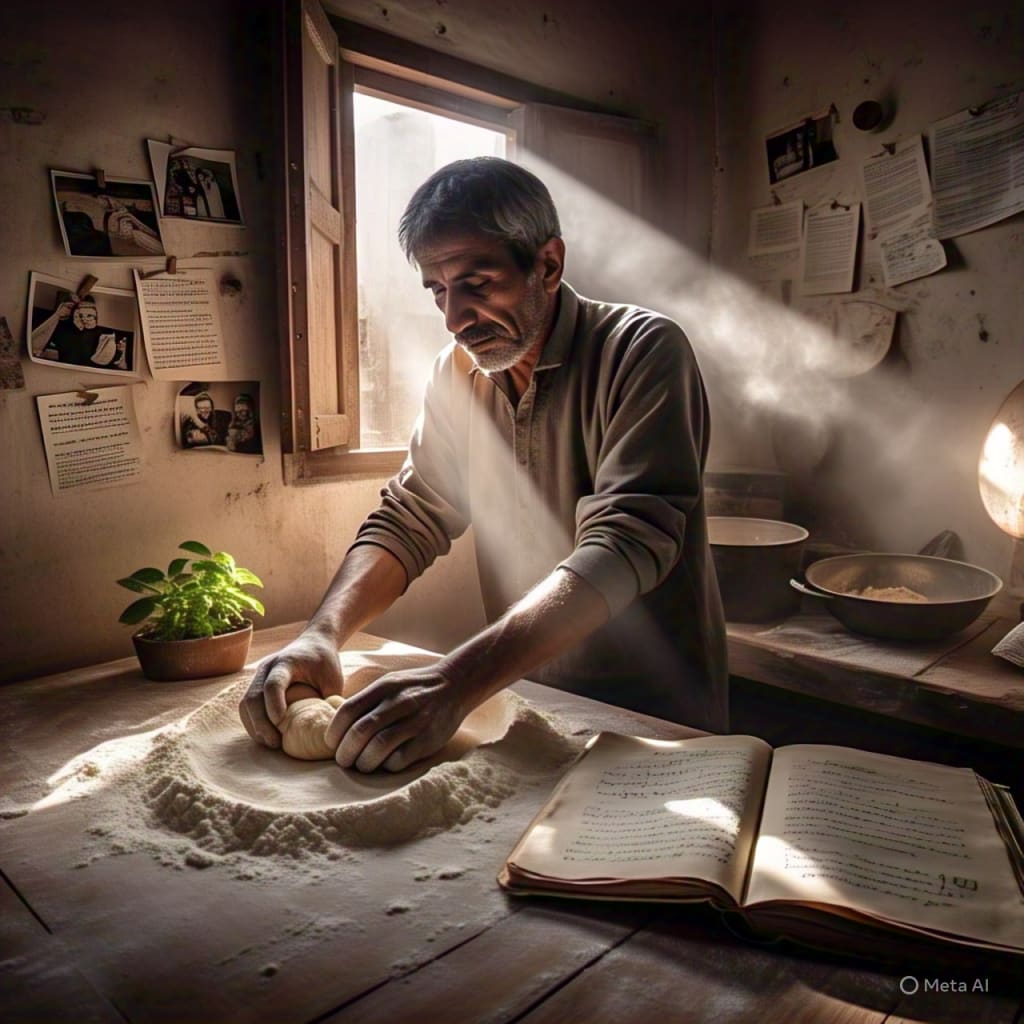
The first time Amir baked bread in the new country, his hands trembled.
Not from the cold—though the small, tiled kitchen in the shelter was icy that morning—but from memory. The flour on his fingers reminded him of home: of sunlit mornings, of his wife humming as she rolled dough, of the faint smell of cumin and rosewater drifting through open windows.
Now, everything smelled like sterilized metal and worry.
Back in Aleppo, Amir had owned a small but beloved bakery named Khobz wa Salaam—Bread and Peace. His baklava was legendary. Locals said his hands were guided by angels, that his sweet dough could mend broken hearts.
Then the war came.
Missiles replaced music. He buried his wife beneath rubble and fled with nothing but a tin box of recipe cards, most smudged by blood or soot. His son, barely nine, held his hand as they crossed borders, nights filled with hunger, silence, and fear.
When they finally reached Europe, the camp was crowded and gray, but it offered a roof, food, and school for his boy. That should’ve been enough.
But something was missing.
It wasn’t until the camp coordinator mentioned a community kitchen project that Amir offered, hesitantly, to bake.
That first morning, he shaped the dough carefully, hands remembering what the heart had tried to forget. He baked small, soft flatbreads—khubz taboon—brushed with oil and scattered with thyme.
He placed them on a tray, heart pounding.
When the other refugees tasted them, something shifted.
Eyes widened. A woman began to cry. A teenage boy whispered, “This tastes like my grandmother’s house.” People lined up not just for bread, but for something they had forgotten they craved: connection.
Word spread.
The shelter gave him a corner of the kitchen and old ingredients nobody wanted. He worked magic with them—cardamom buns, date cookies, fragrant rice-stuffed flatbreads. Every bite told a story. Every spice whispered of a lost city, a loved one, a street that no longer existed.
And then, one day, he began writing again.
He took out his old recipe cards, rewritten now in three languages—Arabic, English, and French. On each card, beneath the ingredients, he added a story.
A memory.
“My wife, Leila, made this when I asked her to marry me.”
“My son laughed so hard, he dropped the whole tray of these.”
“My bakery was bombed the day after I made these for the town festival.”
People didn’t just eat. They read. And wept. And hugged him. And stayed.
Months passed. His son began smiling again. Local volunteers noticed. One of them, an elderly French chef named Bernard, asked Amir to teach a weekly class.
At first, Amir refused. He didn’t want to speak. But Bernard insisted: “People need to taste your story.”
The class became a sensation.
Every Thursday, Amir taught a new dish and shared the memory behind it. Students weren’t just refugees—they were locals, too: curious, kind, hungry to understand.
One girl asked, “How do you bake when you feel broken?”
Amir paused, then said, “I bake because I’m broken. The dough listens better than most people.”
They wrote that on the chalkboard and never erased it.
Soon, Amir’s recipes were compiled into a small, illustrated book titled Crumbs of Courage. Each chapter was a dish, each dish a moment of his life. The last page had no recipe—just a photograph of Amir and his son planting mint in a clay pot by their shelter window.
“Fresh things can grow,” the caption read. “Even in foreign soil.”
Years later, his son would run a café called Khobz wa Salaam in a sunlit corner of the city. Tourists came for the baklava, but stayed for the walls—covered in Amir’s recipes, written in his careful script, each signed with a simple line: “Made with memory.”
By then, Amir no longer trembled when he baked.
He stood tall in the kitchen, his apron dusty, his heart light.
For in every crumb he left behind, there lived a quiet kind of courage. The kind that survives bombs, borders, and language barriers. The kind that says: “I am still here. And I am still feeding hope.”
About the Creator
Syed Kashif
Storyteller driven by emotion, imagination, and impact. I write thought-provoking fiction and real-life tales that connect deeply—from cultural roots to futuristic visions. Join me in exploring untold stories, one word at a time.
Keep reading
More stories from Syed Kashif and writers in Families and other communities.



Comments
There are no comments for this story
Be the first to respond and start the conversation.