
“Just take what you want,” I say loudly to my sister in the other room. “I don’t want any of it.”
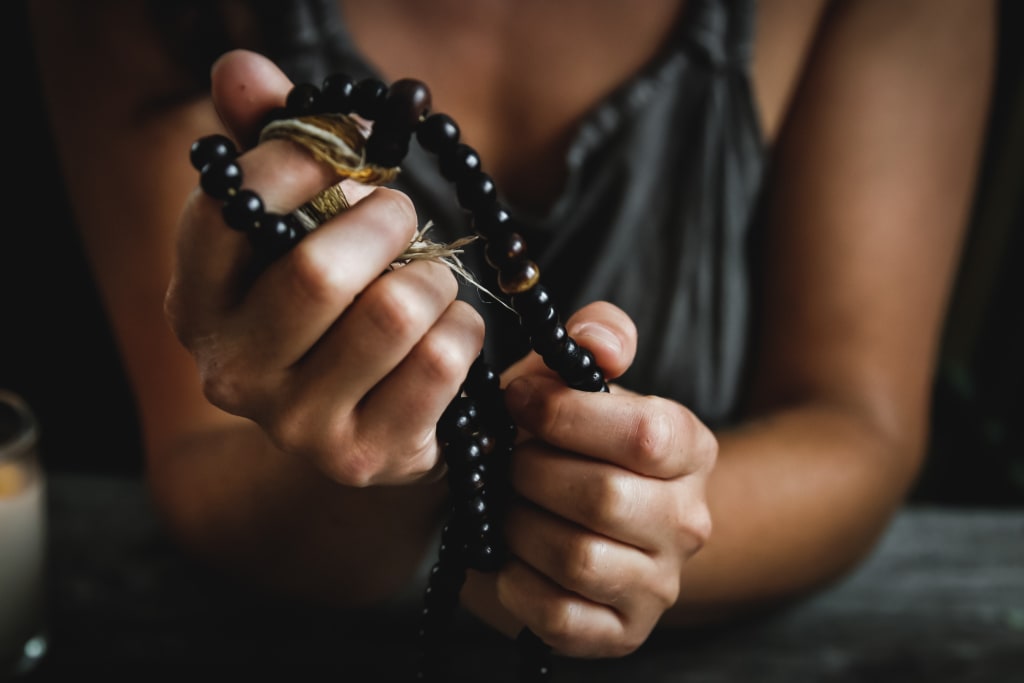
I sink down into my father’s old armchair, instantly swallowed by masses of hard fabric and foam that are used to a much larger frame than my own. My eyes scan the room by habit. There’s nothing here to catch my eye-- I know the layout of my father’s bedroom by heart. And still, I find myself staring at objects I’ve already memorized, in both shape and placement within the space. It’s a welcome distraction, really. I note the piles of laundry that have been neatly folded, stacked on top of the dresser but not put away. His too-big bed fills the space almost obnoxiously, making the room look even smaller. Light streams from the window, shining mainly on his nightstand that’s been settled in the right-hand corner of the room for as long as I can remember. My eyes shift to the prayer beads nestled neatly on top of the nightstand, the harsh glint of the afternoon light bouncing off of each bead. Instinctively, I reach out to touch the beads, running my fingers over the smooth spheres as my grandfather did, as my father does. Or did, until yesterday. The brown beads feel cold to the touch, despite the sun beating down upon them. They, too, feel my father’s absence. Here, he is everywhere, but nowhere to be found. His scent fills the air, as if he is right around the corner, waiting to be noticed. But he doesn’t appear. He can’t, for that matter, because he dropped to the ground last night and never got up. A mysterious final act for a mysterious man, I suppose.
I listen to my little sister shuffle around the kitchen aimlessly, stacking pots and pans into keep or throw piles. I imagine she’s gone through the contents of the cupboards by now, which are more likely than not filled with huge bags of white rice and tiny packets of saffron, and boxes of tea that were bought ambitiously, as if they could be consumed within just one lifetime. Maybe I should help. For now, I continue to stay rooted to the spot, comforted by my brief spell of isolation. Except I am not really alone-- I am surrounded by the presence of my father still, wherever I go.
Mindlessly, indulgently, I continue to play with the prayer beads. The tips of my fingers brush the plain, smooth black cover of a small notebook that they rest on. I’ve seen this book before many times before on my father’s nightstand. It’s well-crafted, but unassuming. Never have I opened it, or thought about what lies within it. It belonged to him, and him alone. It was a part of him that I accepted, without asking questions. Today, though, that doesn’t feel like enough. I want more. I stroke the spine of the notebook in trepidation, wondering if I should step across the threshold and open it. Am I disrespecting the memory of my own father, whose last breath has barely left his body? What kind of daughter am I, to attack a parent’s belongings so ruthlessly?
My musings do little to quell the signals my body is sending to my brain, and in spite of myself I find my hands reaching towards the book’s cover. Quickly, before I can stop myself, I force the notebook open to its first page. Within it, I see my father’s spidery handwriting in a script I can’t understand, in his native language that feels foreign to me. I flip through page after page of billowy script, yearning to know what was so important it merited being immortalized on paper. Turning to yet another page, I notice its weight feels heavier, and I find myself staring at a smiling picture of my father, but not as I knew him. He is a teenager, grinning towards the camera with a twinkle in his eye that even decades later, never left. He sits in the desert sand, legs crossed one on top of the other. His brown skin is the darkest I’ve ever seen it, and I doubt he’s ever been subject to a Canadian winter at this point in his life.
Slowly, I continue to thumb through more pages, consuming more bits and pieces of my father’s past life, memories that feel private but also helped shape the blood that courses through my own veins. I see, for the first time, life through his eyes. And yet, as quickly as I subject myself to it, it disappears. Snapshots of mountains and mosques fade, and instead I find myself transported to my childhood, to the land of suburbia and familiarity. Gone are any traces of my father. I scan through the photos, searching for his face, but instead, I find pictures of my first bath, my little’s sister’s birth, my dance recital in elementary school. I see the dried glue, yellowed and seeping out of the edges of my sister’s high school graduation portrait, then a shot of my own university graduation, smiling not unlike my father did all those years before. There, the pictures end. There aren’t any more moments for him to record now, to document in his little book of memories. There’s so much that will be missed, that he will miss. The notebook, too, has reached its final chapter alongside the end of my father’s.
My sister shrieks from the other room. I jump at the sound, clutching the book to my chest as if I were a guilty child, finally caught in the act.
“What is it, Shadi?” I yell, matching the volume of her outburst.
“Come here!” She manages, and so I trudge towards the kitchen, back to reality.
The house is messier than I’ve ever seen it, and I wonder how long I’ve really been cooped up in my father’s room. Every drawer is unhinged, and cushions are strewn wildly along the floor. An open bag of rice has spilled, and ten pounds worth of long, white, delicate grains cover the floor more extensively than any carpet I’ve seen. Shadi looks even more dishevelled. She shakes violently, unnervingly. She wrings her hands together, and her face is twisted with an unnerving combination of grief and glee. She tugs on my sleeve, like she did when she was small and looking for attention.
“What?” I snap, more shocked than annoyed.
“Remember how Dad didn’t believe in banks?” Shadi squeaks. I nod quickly, remembering his constant distrust of any banking institution. I didn’t use a debit card until I was 18.
“Well, I was taking apart the couch and I found these--” Shadi whips out several bunches of twenties, thick and packed together with old rubber bands.
“That was five thousand, alone. Then, I kept looking, and I found five grand in the bathroom, three in the cupboards, one in the rice, believe it or not, and six thousand more behind all the picture frames.”
My eyes widen, as I mentally add up the huge sum in my head. “Then,” I say, slowly, as if my mind can’t comprehend what I am about to say-- “Shadi, that’s twenty thousand dollars.”
She nods vigorously, as if I am slow to catch up.
“I know! I guess he really didn’t believe in banks!”
I can’t help it. I laugh. I laugh, until my laughter turns to tears. Suddenly, I feel a weight in my hand. I realize that I’m still holding the prayer beads, tucked in between the palm of my hand and my father’s black notebook. I clutch them a little tighter. This time, for the first time, I feel the beads steadily growing warmer, pulsing in my palm.
“Keep it,” I find myself saying. “I have everything I want.”
About the Creator
Keep reading
More stories from writers in Families and other communities.
Wise~Guys
— Look Behind what's in Front of You ~ Make Good Choices — Hey, So how you Doin'..! Made~Men — Mobster Movies romanticise a distinctive, elegant appearance, impeccable attire style, along with the 'Families' expressive lingo. Making their 'Bones' gave them Panache — with vintage fedoras, tailored pin-striped suits, mirror-polished wing-tip shoes adorned with tassels; with their 'Gun Moll' gorgeous dates on their arms.
By Jay Kantor25 days ago in Families



Comments
There are no comments for this story
Be the first to respond and start the conversation.