
Buried in Silence: The Children of Gaza
A true story of survival, loss, and the fading innocence of war-torn lives
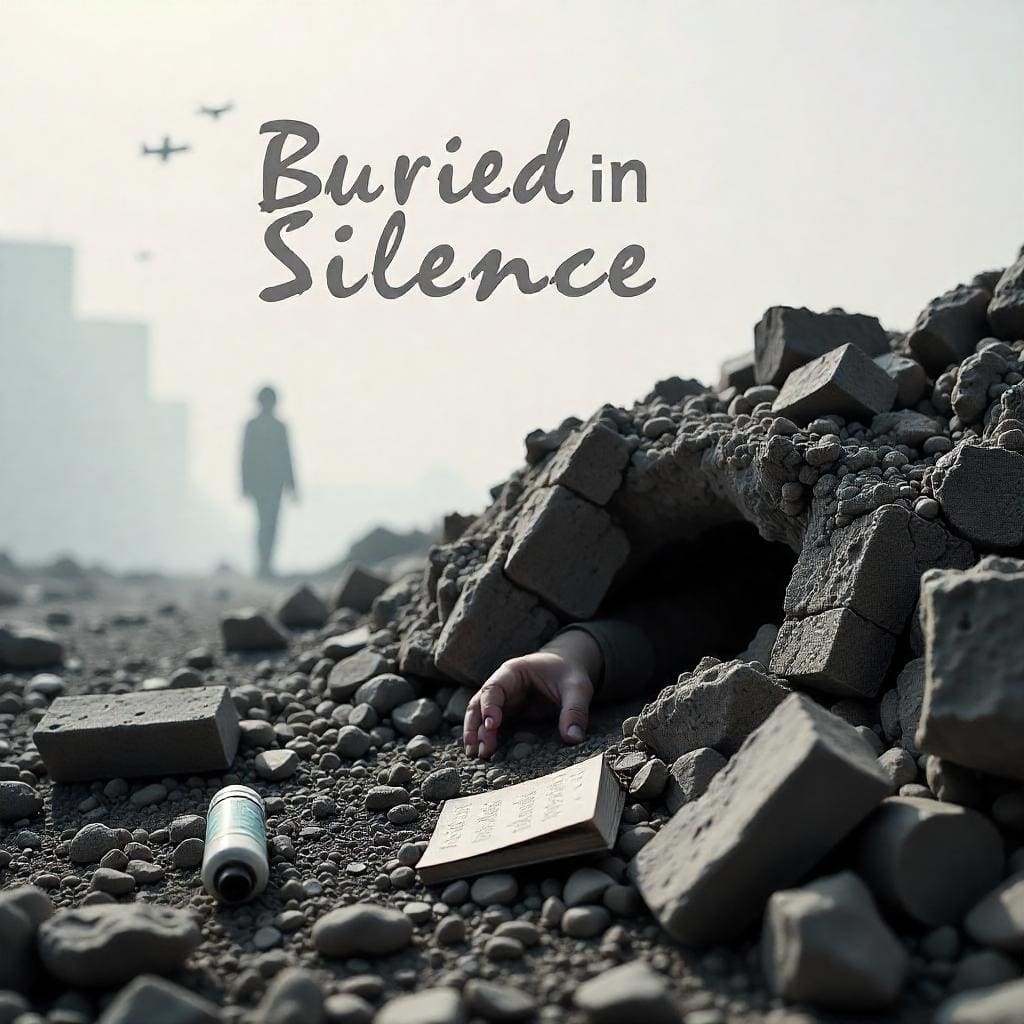
My name is Reem. I am ten years old. At least, I think I still am. We haven’t celebrated a birthday since the war started. Time doesn’t move the way it used to. Days blur into nights, and each one feels like the last day on Earth.
Before the war, we lived in a small house near the Al-Shati refugee camp. It wasn’t perfect—our walls were cracked, our rooms too small—but it was ours. Baba had painted a garden of olive trees on the outside wall for Mama. She missed her village and its endless fields. “They smell like peace,” she used to say.
My younger brother, Omar, and I would sit outside and pretend we were picking olives from those painted trees. Sometimes, we would take turns being farmers. I’d carry an old basket, and Omar would climb imaginary branches. We’d laugh when Baba joined us, pretending to fall off the wall. Mama would clap from the window. But that was before everything turned to ash.
The Day the Sky Broke
I remember that morning too clearly. The air felt wrong—heavy and still, like the world had stopped breathing. Mama looked at the clouds and said softly, “It might rain today.” Baba stared at the sky and whispered, “Not rain. Fire.” The bombs came suddenly. No warning. Just a loud roar—and then the sky fell.
The first explosion hit our neighbor’s home. The sound was so loud it felt like the earth had cracked open. I didn’t hear the blast at first. I heard Mama scream. She pulled Omar and me into the kitchen, pushing us under the table as the walls trembled and dust filled the air. I closed my eyes and held my breath. I remember Mama’s heartbeat. I could feel it against my cheek—fast and loud. When I opened my eyes, our ceiling was gone. Above us, the sky was black, burning, and full of smoke.
Running From Shadows
We left that night. There was nothing left of our home. Only rubble, fire, and silence where laughter used to live.
For days, we ran—shelter to shelter, mosque to school, always one step ahead of death. At a UN school, we thought we were safe. We slept next to strangers who became like family. But safety was a short-lived dream. On the second night, the school was bombed. The explosion tore through classrooms and lives. I saw a boy lying under a desk, a blue backpack still strapped to his shoulders. He was probably younger than Omar. His eyes were open, staring at the ceiling as if waiting for someone to come. I never knew his name, but I see him every night when I try to sleep.
Now, we live in what was once a mosque. The dome collapsed weeks ago. We sleep under shattered glass, broken stone, and twisted iron. Mama says it’s “safer here.” But even she flinches when drones hum above us. Baba left six days ago to find food. He hasn’t come back. Mama doesn’t say it, but I see it in her eyes—she knows he’s not coming.
Hunger is a Quiet Killer
There is no water. No clean food. The taps are dry, the sea is poisoned, and the markets are gone.
Omar cried yesterday—his stomach hurt too much. He begged for bread. Just a bite. Mama tore her scarf into strips, soaked one in salt water, and told him to suck on it. “It will help you forget,” she said. But he vomited minutes later. I held him as he cried, and Mama looked away. We hear rumors that aid trucks are coming. People run with empty cans and sacks. But they come back either empty—or bleeding. Some don’t return at all.
I once heard someone on a broken radio say, “54,000 children in Gaza are at risk of dying from hunger.” I don’t know what that number means. But I know I’ve never seen so many tiny graves, so many covered bodies. Every day, death feels closer.
A Doll Named Amal
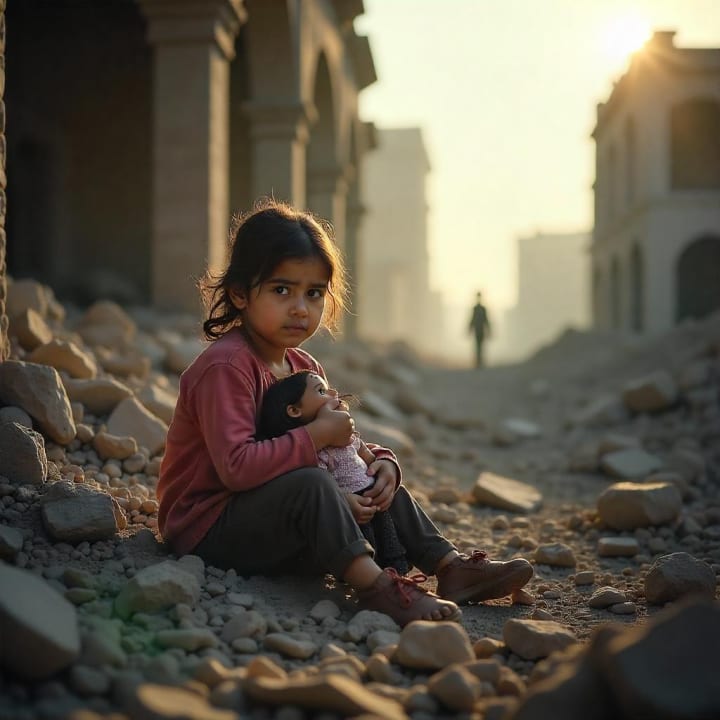
One morning, while picking through rubble for wood, I found a doll. Her dress was torn. One arm was missing. Her face was covered in dust. I named her Amal. It means “hope.” She never cries, but I pretend she does. At night, I hold her and whisper stories about a world where trees grow tall, where bread is warm, and where the rain falls softly—without fire or fear.
Mama used to brush my hair while singing an old lullaby. Now, she just stares at the door, waiting for Baba. She doesn’t speak much anymore. Her eyes are always red. Her hands tremble. I think she hums to stop herself from screaming. My hair is tangled now. We haven’t seen soap in weeks. But when I hold Amal, I pretend I’m clean. I pretend I’m safe.
Will Anyone Listen?
This morning, a boy came running through the rubble. “Forty-eight hours,” he shouted. “They say we only have forty-eight hours before thousands of children die!” The adults cried. I didn’t understand. I still don’t. What happens after forty-eight hours? Will someone come? Will they finally care? The world talks about borders, politics, militias, and governments. But we—children—talk about bread. About water. About which wall is strongest to sleep under. We wonder which building will fall next.
Omar’s Dream
Last night, Omar drew a house in the dirt. He used a stick to sketch a roof, two windows, and a sun with a smiling face. He even added a tree beside it. “I’ll live there one day,” he said, brushing away a fly. I nodded. I didn’t tell him that his cough sounded worse. I didn’t mention that he hadn’t eaten in two days. But his voice—something in it made me believe. Just for a second. Maybe we will live. Maybe we’ll plant real olive trees one day.
A Letter to the World
If someone finds this, please remember us. Not just as numbers. Not just as headlines. But as people. I am Reem. I am ten years old. I used to laugh. I used to go to school. I had dreams of becoming a teacher. I loved purple crayons and honey bread. I still hold a doll named Amal. We are the children of Gaza. We are buried under broken buildings and silent skies. But we are not forgotten.
Not if you remember us.
Not if you hear our silence.
Not if you care.
Author’s Note: A Cry Across Borders
This story is not just fiction—it is reality with a heartbeat. Reem may be a character, but her pain is carried by thousands of real children in Gaza whose voices have been silenced by bombs, blockades, and international indifference. We live in a world where satellites can see a grain of sand, but somehow cannot see starving children dying in plain sight. Where human rights are shouted in conferences but silenced in action. This is not just Gaza’s tragedy. This is humanity’s failure.
I am not a politician. I am not asking for sides. I am asking for humanity. For food. For water. For safety. For childhoods.
Please, speak up. Share. Protest. Write. Pressure your leaders. Open your hearts. The children of Gaza need more than prayers. They need justice.
Frequently Asked Questions (FAQ) – Questions That Should Haunt Us All
Q1: Why should I care about what’s happening in Gaza?
Because suffering anywhere is a wound on humanity everywhere. If you can ignore starving children and broken families, ask yourself: what have we become?
Q2: Isn’t this just another war? Don’t people die in all wars?
No. This is not “just another war.” This is a systematic erasure of an entire people’s identity, infrastructure, and future. Over 14,000 children have already been killed. This is not collateral damage. This is genocide.
Q3: Can my voice really make a difference?
Yes. Silence is complicity. History remembers those who stayed silent just as much as those who stood up. Call your leaders. Donate. Amplify real stories. Protest. Every ripple counts.
Q4: What about politics? Isn’t it too complicated to take a side?
This is not about sides. This is about saving lives. When a child is starving, do you ask about their politics before giving them bread?
Q5: What if the media is exaggerating?
When hospitals are bombed, aid is blocked, and mass graves are filled with children—what more proof do we need? Look beyond the headlines. Listen to survivors. Believe the suffering.
🙏 Final Thought
If you've made it this far, you have something powerful within you: empathy. Don't let it die in the noise of politics and propaganda. Let this story live beyond the page.
Let it move you. Let it haunt you.
And above all—let it awaken you.
About the Creator
Mian Nazir Shah
Storyteller fueling smiles and action with humor, heart, and fresh insights—exploring life’s quirks, AI wonders, and eco-awakenings in bite-size inspiration.
Keep reading
More stories from Mian Nazir Shah and writers in Families and other communities.
**Echoes of Wisdom: A Virtual Grandfather’s Legacy**
It started as an experiment. Nothing more than an innocent side project. Hamza, a tech-savvy yet emotionally detached young man, had always struggled with his family. Their constant lectures, unsolicited advice, and old-fashioned views made him feel suffocated. His grandfather, **Dada Abbu**, was the worst of them all—his wisdom was timeless, yet utterly incompatible with modern life. One evening, after another family gathering where Dada Abbu had**insisted** that Hamza must drink tea with cardamom to enhance his memory, Hamza stormed into his room and decided he had had enough. “This is it,” he muttered, opening his laptop. “If they won’t let me live in peace, I’ll create my own family.” And thus, the **Virtual Dada Abbu Project** was born.
By Mian Nazir Shah8 months ago in Families
Wise~Guys
— Look Behind what's in Front of You ~ Make Good Choices — Hey, So how you Doin'..! Made~Men — Mobster Movies romanticise a distinctive, elegant appearance, impeccable attire style, along with the 'Families' expressive lingo. Making their 'Bones' gave them Panache — with vintage fedoras, tailored pin-striped suits, mirror-polished wing-tip shoes adorned with tassels; with their 'Gun Moll' gorgeous dates on their arms.
By Jay Kantor19 days ago in Families




Comments (1)
This is so heartbreaking. It makes you realize how lucky we are. I can't imagine living through that. How do you think kids like Reem can ever feel safe again after experiencing something like this? And what can we do as a global community to prevent such tragedies?