
Breathe, Relax, Release: Your Guide to Easing Daily Tension
Stop the Spiral: How to Cut Tension Before It Controls You

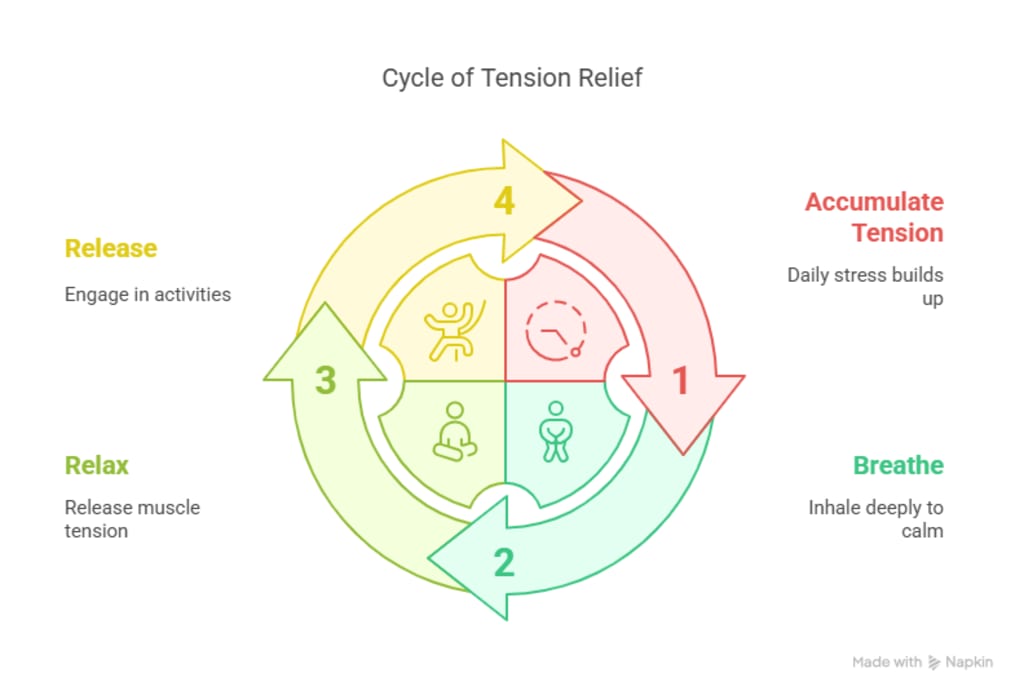
Breathe, Relax, Release: Your Guide to Easing Daily Tension
It starts small, doesn’t it? You wake up, check your phone, and before your feet even hit the floor, there's a flood of notifications. Emails, group chats, news alerts—everything demanding attention. You barely have time to sip your coffee before you're thrown into another whirlwind of a day.
Tension creeps in quietly. It shows up in the tightness of your shoulders, the clench in your jaw, the way your mind races at night when all you want is sleep. You brush it off, tell yourself it's normal. Everyone's stressed, right?
But here's the thing: just because something is common doesn't mean it's healthy.
For the longest time, I wore my stress like a badge of honor. Being busy felt like being important. I thought if I wasn't exhausted, I wasn’t doing enough. That mindset nearly broke me.
It wasn’t until I found myself crying over a forgotten grocery list that I realized something had to change. I wasn’t just tired—I was tense, inside and out. That’s when I stumbled across a phrase that stuck: Breathe, Relax, Release.
Simple words, but they’ve become my daily mantra. Let me walk you through how they changed everything.
Breathe
It seems obvious, right? We breathe all day. But how often do we really breathe?
When stress hits, our breath becomes shallow. We don't even notice it. But the way we breathe affects how we feel—physically, emotionally, and mentally. Deep, conscious breathing signals the body that it’s safe. It activates the parasympathetic nervous system, the one responsible for calm and restoration.
Now, whenever I feel that tightness creeping in, I stop and do this:
Inhale slowly through the nose for 4 counts.
Hold the breath for 4 counts.
Exhale gently through the mouth for 6 counts.
It takes less than a minute, but it works like a reset button.
Relax
This part is trickier. Relaxing isn’t just about lying on the couch—it’s about intentional unwinding. I had to learn what actually helped me relax. For some, it’s yoga. For others, music, journaling, walking in nature, or even cooking. For me, it’s a mix of all the above, depending on the day.
The key is to carve out time—even ten minutes—and protect it. That means no multitasking, no guilt. Just being present with something that doesn’t involve productivity. It felt selfish at first, but now I see it as essential maintenance.
Release
Here’s the hard part: letting go.
Letting go of perfection, unrealistic expectations, the need to please everyone, and the constant buzz of anxiety. I used to hold onto stress like it was a to-do list. But I’ve learned that most of it isn’t mine to carry.
I started practicing what I call “mental decluttering.” At the end of each day, I write down what’s bothering me. Then I ask, “Is this something I can control?” If yes, I make a plan. If not, I write, “I release this,” and move on. It sounds small, but it’s freeing.
Tension may be part of life, but it doesn’t have to run the show. You don’t need a week-long vacation to feel peace. You just need a few moments. A deep breath. A quiet pause. A choice to let go.
So if today feels heavy, try this:
Breathe. Relax. Release.
And remind yourself—you deserve to feel light again.
In our fast-paced world, daily tension can accumulate, leading to stress and discomfort. This guide aims to provide practical techniques and insights to help you breathe, relax, and release the tension that builds up in your body and mind. By incorporating these strategies into your daily routine, you can cultivate a sense of calm and well-being, allowing you to navigate life with greater ease.
Understanding Tension
Tension often manifests as physical tightness, mental stress, or emotional strain. It can be triggered by various factors, including work pressures, personal relationships, and even our own expectations. Recognizing the signs of tension is the first step toward managing it effectively.
Signs of Tension
Muscle tightness, especially in the neck, shoulders, and back
Headaches or migraines
Difficulty concentrating
Irritability or mood swings
Fatigue or low energy
Breathing Techniques
Breathing is a powerful tool for relaxation. By focusing on your breath, you can activate your body's relaxation response and reduce tension.
Deep Breathing
Find a comfortable position: Sit or lie down in a quiet space.
Inhale deeply: Breathe in through your nose for a count of four, allowing your abdomen to expand.
Hold your breath: Pause for a count of four.
Exhale slowly: Release your breath through your mouth for a count of six.
Repeat: Continue this cycle for several minutes, focusing on the sensation of your breath.
Box Breathing
Inhale: Breathe in for a count of four.
Hold: Hold your breath for a count of four.
Exhale: Breathe out for a count of four.
Hold: Hold your breath again for a count of four.
Repeat: Continue this pattern for a few minutes.
Relaxation Techniques
In addition to breathing exercises, incorporating relaxation techniques into your routine can help alleviate tension.
Progressive Muscle Relaxation
Tense and relax: Start at your toes, tense the muscles for five seconds, then relax them. Move up through your body, tensing and relaxing each muscle group.
Focus on sensations: Pay attention to how your body feels as you release tension.
Mindfulness Meditation
Find a quiet space: Sit comfortably and close your eyes.
Focus on your breath: Notice the rhythm of your breathing without trying to change it.
Acknowledge thoughts: If your mind wanders, gently bring your focus back to your breath.
Practice regularly: Aim for a few minutes each day to cultivate mindfulness.
Releasing Tension
Once you've identified and addressed your tension, it's essential to find ways to release it.
Physical Activity
Engaging in regular physical activity, such as walking, yoga, or dancing, can help release built-up tension and improve your mood.
Creative Outlets
Expressing yourself through art, music, or writing can be a therapeutic way to release emotions and reduce stress.
Connecting with Nature
Spending time outdoors can have a calming effect. Take a walk in a park, sit by a lake, or simply enjoy the fresh air to help ground yourself.
Conclusion
Easing daily tension is a journey that requires practice and patience. By incorporating breathing techniques, relaxation methods, and healthy outlets into your routine, you can cultivate a more peaceful and balanced life. Remember, it's essential to prioritize your well-being and take time for yourself amidst the chaos of daily life. Breathe, relax, and release—your body and mind will thank you.
About the Creator
Fazal Wahab
Researcher
Keep reading
More stories from Fazal Wahab and writers in Families and other communities.
Turning Sorrows Into Strength
Where Sorrows Fade: Learning to Let Go It was an old bench by the lake that knew her secrets. Mira sat there every evening, watching the light spill over the water like melted gold. The lake didn’t ask questions. It didn’t interrupt. It just shimmered, reflecting whatever sky it was given—cloudy or clear, stormy or calm.
By Fazal Wahab11 months ago in Motivation




Comments
There are no comments for this story
Be the first to respond and start the conversation.