
"Beneath the Mango Tree"
Subtitle: Some treasures are too sacred to lose — even when the land is gone

I was only six when my grandfather showed me the mango tree.
“It’s older than you, older than me,” he said with a wide smile, his thumb tracing the bark like it was skin. “Your father fell from this tree when he was a boy. Broke two teeth but didn’t stop climbing.”
I remember laughing. Not because it was funny — but because his stories made everything feel like part of a secret history that only he and I shared.
The tree stood in the corner of our family land, near the narrow irrigation ditch and the chicken coop that smelled terrible in the summer. But the mango tree? That place was sacred. It was where I sat during summer vacations with juice on my hands and dirt between my toes, while my grandfather told me stories of his youth, the war, the floods, and the first time he tasted Coca-Cola.
One afternoon, he brought out a small metal box. It was scratched, with a loose hinge, and jingled faintly when shaken.
“This,” he said, placing it in my lap, “is our treasure.”
I opened it slowly, expecting gold coins or something shiny.
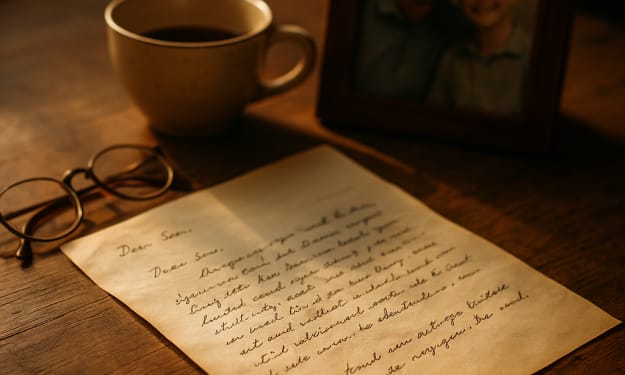
Instead, it held two old photographs, a rusted watch, and a letter folded so many times the paper had turned soft. Nothing valuable — unless you knew what it meant.
“That photo,” he said, pointing with his knuckle, “is the last picture of my mother before she died. And that letter… I wrote to your grandmother before we married. She almost said no.” He laughed like it still surprised him.
Then he knelt beside me and said something I would never forget.
“Promise me, son, if one day this land is gone — if the house is gone — you’ll take this box with you. Never let the treasure get lost.”
I promised.
---
Years passed. My grandfather grew thin and slower. The fields that once grew wheat were rented out. The mango tree stood strong, but everything else began to fade — especially after he left this world one winter morning, his hand in mine, a faint smile on his lips like he was dreaming.
The house fell silent after that. My mother would sit in the kitchen with the radio news playing softly, and my father kept busy with property talks — rumors that the land might be sold. My cousins visited less. I visited more.
I was sixteen when the day finally came.
“We have to sell it,” my father said one evening. “No one lives here anymore. It’s too far from the city, too much to maintain.”
I didn’t argue.
I didn’t cry.
Instead, I took a deep breath, waited for everyone to leave the next day, and walked alone to the mango tree.
The box was still there, buried under the stones behind its thick roots, wrapped in the plastic bag my grandfather had placed it in — “just in case.” I pulled it out, brushed the dust off, and sat under the tree for what felt like hours.
I read the letter, now so fragile it felt like holding breath. I looked at the pictures again. The watch no longer worked, but I wound it anyway — pretending time could be brought back.
And then I left, box pressed tightly to my chest.
---
The day the land was sold, I stood by the gate one last time, watching trucks and strangers come in. The mango tree was still there, tall and proud, but the air felt different — heavier somehow. My mind went back to all the summers I had spent there — running barefoot in the fields, chasing chickens, and hearing my grandfather’s voice telling me about the old days.
The next morning, I woke up early, took the box, and sat by my desk. I opened it again and started writing down the stories my grandfather had told me, the memories I had of that land and that tree. I wrote about the war stories, about the flood that almost washed everything away, about the simple joys of a cold glass of lemonade on a hot afternoon.
Writing helped me hold onto something that the land couldn’t keep. It was like planting new roots — this time inside my heart.
---
Now, the box sits safely in the top drawer of my writing desk. Sometimes, when life feels overwhelming, I take it out, open it, and feel the weight of those memories.
One day, my daughter asked me, “Why do you keep that old box?”
I looked at her and said, “Because it holds stories. And stories are the only way to visit people who are no longer here.”
Maybe one day, I’ll take her to the place where the mango tree once stood and bury a new treasure — one that she will promise never to lose.
Until then, the mango tree and its treasure live on in my stories, a reminder that some things, no matter how small or forgotten, are worth holding onto forever.
About the Creator
Keep reading
More stories from Ahmad Khan and writers in Families and other communities.
Christmas Abroad: Celebrating the Holidays Without Family
I moved to South Korea in 2017. I was twenty-two years old and excited to start my career as an English Second Language Teacher. With a Bachelor's degree and six hundred dollars in my bank account, I set off for Busan.
By Kera Hollow29 days ago in Families
Where Love Lives: A Slow Sunday Inside Our Family Home
There’s a quiet magic in ordinary mornings—the kind that doesn’t shout, but lingers in the corners of your heart long after the day has passed. For our family, Sunday mornings are like that: a gentle rhythm of laughter, familiar routines, and soft celebrations of simply being together. If you asked someone passing by our home at 9 a.m., they might mistake us for a movie scene—the scent of fresh coffee, the hum of soft music, and the comforting clatter of plates and cups filling the kitchen. But there’s nothing cinematic about what we do. It’s ordinary. And it’s ours.
By Divexa Exchange5 days ago in Families
Getting Serious About Comedy (Part I)
If I were asked to remark on my life and the childhood that paved some road leading me to this point, I would have to say something about all the funny people who surrounded me for the last 26,872 days (and counting). Somewhere along that road, I became a big fan of laughter and the comedy that spawns it – and, I mean not only my own laughter, but the laughter of others, some of which I have actually been responsible for inducing.
By John Oliver Smith5 days ago in Humor


Comments
There are no comments for this story
Be the first to respond and start the conversation.