
Barbara’s Son
Lessons on Wonder

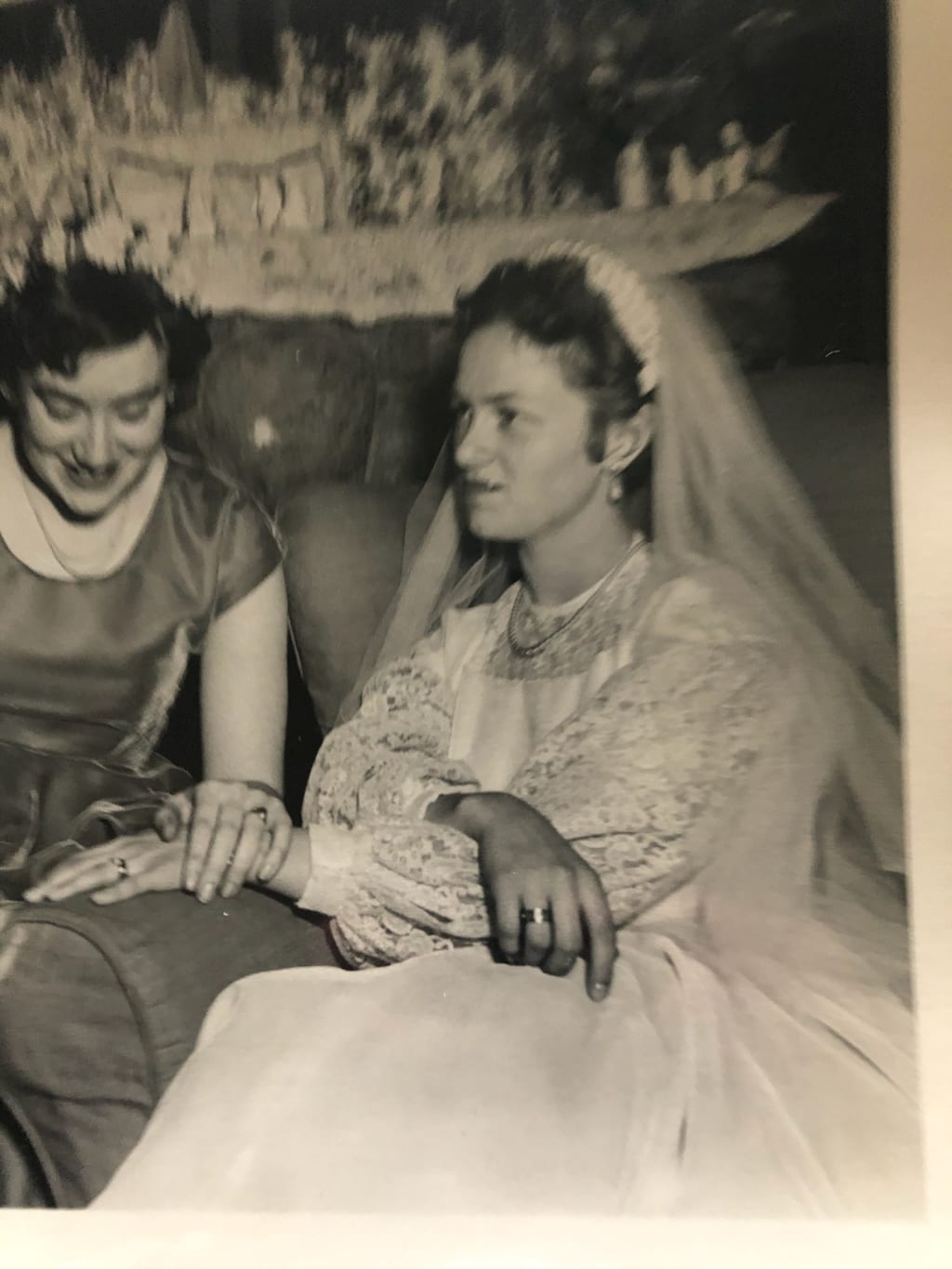
One summer night in 1966, my mom got a flat tire when driving to the airport to pick up my father. This was problematic for many reasons, not the least being that it was nearly midnight on a Saturday and my mom had six sleeping children in the car. Compounding matters was that my mom was dressed only in a nightgown and slippers for the 45-minute trip to the airport. “I probably didn’t think that decision through very well,” my mother allowed, years later.
My parents had no family in Indiana and one car, and they had just recently moved into their new home. It didn’t seem that big a deal for the plan to be, simply, pack the kids and go. Seat belt laws were less stringent in those days (i.e., non-existent) and the station wagon had lots of room in the back for pillows and blankets and sleeping kids.
As my mom steered the thumping car off the highway and onto the shoulder of Interstate 69, she woke up her oldest daughter, my sister Orene (12 years old) and told her she was going to have to watch the other kids while my mom flagged someone down. Miraculously the very first car my mom waved at turned out to be a friendly state trooper who immediately and efficiently attended to replacing the flat tire (though he had to displace several sleeping children when getting the spare out of the back.). After fifteen minutes, the trooper was finished, the car was restored, and my mom was back on the road again to pick up her husband. What could have turned into a catastrophe instead became an anecdote. “Dumb luck,” my mom said, many years later. “But sometimes you get that. I did remember to bring a coat the next time I drove in my nightgown, though.”
My mom had a knack for improvisation. She married my dad when she was 22 and by age 30 she had given birth to her sixth child. They hadn’t planned on having children and then had six in eight years. Go figure. Their first child was born nine months to the day of their wedding night and don’t think that that didn’t cause eyebrows to be raised by the family.
You’d think that having such a great charge to attend to would require intricate planning and almost military-like precision—Captain Von Trapp blowing the whistle and such—but my mom wasn’t having any of that. Everyone got fed, everyone went to school, but how it all happened, exactly, nobody was quite sure. The home existed in a state of constant chaos but it never felt frightening or pitched in hysteria. And it was a small home, too. Three bedrooms. Parents’ Room, Boys’ Room, Girls’ Room. But it never felt small to us.
When I was a boy there were two primary things I knew about my mom. One: she loved me. Two: she liked me. By far, the latter of these two facts was the most important to me. She seemed to delight in the things that were singular about me, my bashful ways, the joy I took in word play, even at a young age. She made me feel I was a unique entity all on my own, and not just the 3rd boy of three, or the fifth child of six. I’ve talked with my siblings about this later, and they all said the same thing: Mom liked them for them. How she managed to do this, how she could give individual attention to each kid is something I’ve never comprehended.
It’s also incomprehensible to me how much she did on her own. Shortly after my parents moved to Fort Wayne, my dad was squeezed out of his job at the engineering firm. Instead of having a regular career in his new hometown, my dad had to scramble for work. There was nothing else in Fort Wayne for a man of his background. He started taking temporary contract jobs across the country, in cities where the engineering market was stronger. Nine months in Philadelphia. Six months in Huntsville. A year and a half in Detroit. He would leave on Sunday afternoon, or early evening—I learned to hate Sundays—and then drive back on Friday to see us. He did this for the majority of his career, never again working in Fort Wayne.
That trip to the airport in 1966, the flat tire trip, was to get dad from his inaugural out-of-town job, in Philadelphia. Dad’s job in Philadelphia was also notable in that it was then that he first starting exhibiting symptoms of the acute mental illness that would become a part of his life. He had called my mom one evening and told her that he had been hearing voices in his head, and he didn’t know what to do.
“Okay,” my mom said, after a long pause. “Why don’t you come home?”
Dad saw a psychiatrist. He was given a diagnosis of mild schizophrenia. He was functional, and able to return to work. None of us kids knew any of this, just my mom. Her job, she told us later, was to keep things together. They soldiered on. We never really knew about my father’s condition until he had a psychotic break in 1975 and had to be institutionalized for four weeks.
After my youngest sister was officially enrolled in school, my mom went back to work. She had graduated with a degree in nursing in 1954, but had quit her first out-of-college job when she married my father. With all the kids in school she decided it was time to return to nursing.
She worked at St. Joseph Hospital in Fort Wayne. For years, I would come across former co-workers of hers who would nearly genuflect when I told them my last name. “Barbara’s son?” they would ask, in reverent tones. A woman I was in a play with at the Fort Wayne Civic Theatre was overwhelmed when she discovered my lineage. “Barbara was my mentor,” she said. This happened constantly. Three of my high school friends had moms who worked with her, and they always beamed when I met them. They seemed to forgive me for the shenanigans I got into with their kids then, when I was deep in my shenanigan phase.
One of my mom’s close friends was an African American nurse named Mary. One time Mary was upset about how her family was being treated and she talked about the rage she felt at this prejudice. In tears, Mary cried out that sometimes she hated white people.
My mom was quiet. Then she pointed out that she was white.
Oh, you’re not white, Mary dismissed. You’re Barbara.
Some people set the world on fire for you, and dazzle you with wonder and charisma. And others simply keep your world from falling apart. My mom was good at both.
When my little sister was sixteen, she was involved in a horrific car accident caused by a drunk driver and sustained a crushed femur and a significant brain stem injury. She was in a coma and it seemed likely that she wouldn’t survive the day. When I got to the hospital—I was the last to know—my mom grabbed me and hugged me tightly. “We’ve got each other, she said, staring at me. She didn’t stop searching my eyes until I nodded.
The accident happened on a Saturday night. All day Sunday we waited to hear the dreadful, inevitable news. The day was endless, but there was no change in her condition. As fate would have it, I was scheduled to drive to Bloomington, Indiana on Monday to pre-register for my first year of college at I.U with two friends. (Before computers, everyone had to physically register for their courses on site.) That night I told my parents that I would call my friends and let them know that I wasn’t going.
“No,” my mom said.
“But I have to.”
“Life goes on,” my mom said. And she was right. My sister recovered, due in large part to my mother’s ability to keep the world from falling apart.
About the Creator
Keep reading
More stories from Christopher Lincoln and writers in Families and other communities.
Slave to the Rhythm
At first, he would only go dancing with packs of people, usually co-workers at the restaurant after their shift ended, but after a few trips he felt confident enough to dance by himself. It was actually a relief to go solo, he soon discovered, for he didn’t like the ironic way most of the pack would dance, all clumped up on the floor, the straight cooks uneasily staring at the gay men in the club while conspicuously dancing with (and only with) the waitresses. He also didn’t like the way everyone deferred to the lone gay waiter who traveled with them, either, treating the poor guy like some cicerone who could explain the hidden codes and rules of the gay dance club that the straight people were cheerfully resigned to never decipher.
By Christopher Lincoln4 years ago in Fiction
Christmas Abroad: Celebrating the Holidays Without Family
I moved to South Korea in 2017. I was twenty-two years old and excited to start my career as an English Second Language Teacher. With a Bachelor's degree and six hundred dollars in my bank account, I set off for Busan.
By Kera Hollowabout a month ago in Families
The quiet sound of families breaking
There is a kind of silence that is louder than any noise. It is the silence of a child waking in the night and realizing their parent is gone. It is the silence of a kitchen table with one chair suddenly empty. It is the silence of a home that still looks the same, but no longer feels the same. Across the United States, thousands of families live inside that silence. Not because of war. Not because of disaster. Not because of death. But because of policy.
By Kaylee Souther4 days ago in Families



Comments
There are no comments for this story
Be the first to respond and start the conversation.