

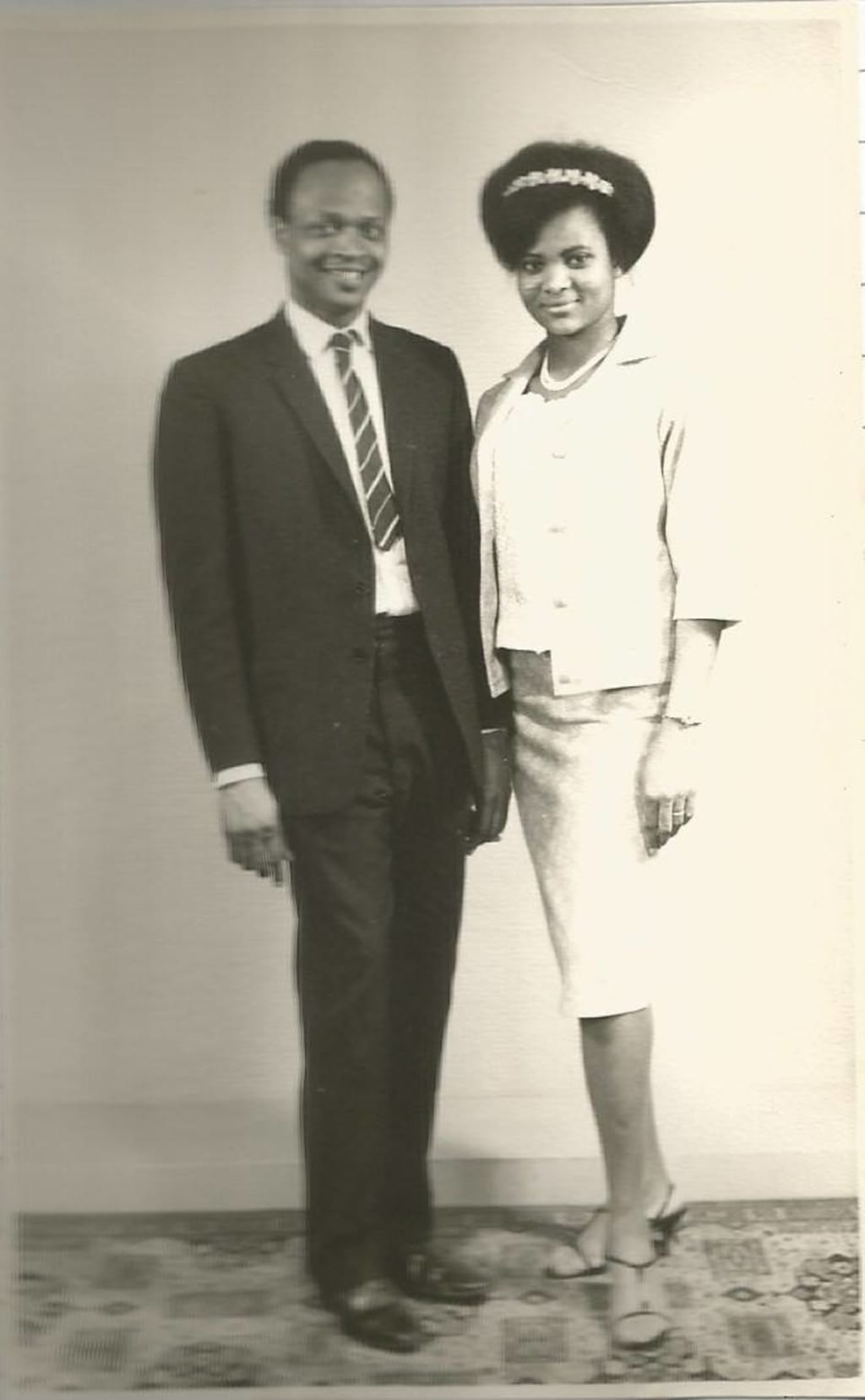
Chapter 1 – An immaculate conception
When my paternal granddad saw my mum joyfully singing in the church choir, he turned to my dad, who was sitting next to him, and announced: “That’s the woman you’re going to marry!”
My dad was shocked because the ‘woman’ was a small child of 11 and he was a grown man of 27.
My parents – Margaret Jatto and Clement Iziren – attended the same church in Otuo, a remote village in Edo State, southern Nigeria, during the 1950s. They didn’t know each other at all, but my granddad knew my mum.
After my granddad’s shock announcement, my dad turned to him and asked: “How long am I going to have to wait for her to grow up?”
Well, just seven years later, when my mum was 18, the two became one in London!
My parents met for the very first time in London, during the spring of 1964.
When my dad went to greet my mum at Heathrow airport, she was visibly pregnant.
“It wasn’t my fault,” she protested.
“Don’t worry,” my dad said, reassuringly. “This is the second immaculate conception!”
My dad knew of my mum’s pregnancy and insisted that she give birth to the child in London.
Two months after my mum arrived in London, the child was born. He was named Alex, after the then British Prime Minister Sir Alec Douglas Home, who travelled from Nigeria to London on the same plane as my mum, according to my dad a prolific and enthusiastic amateur researcher!
Just eleven months after Alex was born my parents had their first child together. It was another boy and my dad named him Reginald, which means leader of the army. The choice of name was a clear indication that my dad wanted my mum to have more children and Reggie was going to be their leader.
When Alex was a year old, he went to live with my maternal grandparents in Nigeria. He did not return to London until he was 20.
My parents were married. Neither were present at the wedding ceremony. As my mother has repeatedly told me in the past ‘we got married in accordance with our traditional laws and customs.’
Chapter 2 – The lady with a vision
For just over two years, after the departure of Alex to Nigeria my mum juggled bringing up Reggie with working very hard in the hospitality industry – specifically in the canteens of police stations. My mum’s hard work was beginning to pay off as by October 1966, she got a new full-time job in a police station which paid her more money than she had ever earned - £8 a week!
She was 20 at the time and now her ‘fabulous’ weekly pay packet left her feeling overjoyed. So, when she fell pregnant in February 1967 her joy turned to sorrow. Not only did my mum not want to give up her £8 a week job for a baby, but she also feared the baby would be another boy.
“What am I going to do in the midst of men?” she cried, after telling my dad she was pregnant.
“This is the baby girl you have been praying for,” my dad said, reassuringly.
“How do you know?” she demanded.
Unmoved by my dad’s faith in God, my mum made an appointment to see her doctor.
A few days before my mum was due to visit her doctor, she went to church as usual with my dad and Reggie.
During the service, a lady in a long white gown began prophesizing loudly from the pulpit.
You, lady at the back,” she shouted, pointing her finger at my mum.
“God has given you a baby girl and if you don’t accept this gift you will suffer.”
My mum was deep in thought, worrying about the future and so didn’t hear the lady’s prophecy.
The lady repeated it again and again.
Two women were sitting next to my mum and they each nudged her repeatedly.
“She’s talking to you,” said one.
“Get up,” said the other.
My mum struggled to her feet, shaking and with her hands outstretched.
“God has given you a baby girl and if you don’t accept this gift you will suffer,” the lady prophesized for the last time.
My mum cancelled her doctor’s appointment and after I was born, she had two more two sons.
Chapter 3 – Wapping
When the first of the two sons were born in 1970, we moved from a house we shared with two other families in Hackney, east London, to a three-bedroom council flat, in Franklin House, Wapping, east London.
My dad considered himself to be a ‘frank’ man and so he loved the name Franklin House. He loved it so much that he even named my brother Franklin!
Wapping was a quiet and deprived area, full of council flats, to many adults, but to many children it was a big adventure playground. I loved Wapping so much that by the time I was six I started roaming its streets with my friends, after school and especially during the school holidays. Sometimes we would end up in the park on the highway, near Shadwell. The park had a short gate which had steps that led to the Rotherhithe Tunnel. From the top of the steps, we could see cars whizzing by, in the tunnel. We loved to run down those steps, take a quick peak at the cars and then run back up the stairs again.
I experienced the dark as well as the fun side of Wapping. At the age of six I was sexually abused by two 11 and 13-year-old brothers. The abuse was not just touching, but full penetration that led to me contracting a sexually transmitted disease. My mum noticed it when she was bathing me one morning. She asked: “What is this?” I calmly told her what they did to me, and she went mad.
That day she repeatedly said: “I’m annoyed with you; I’m annoyed with you!” She got on the phone and for hours complained about me to a close family friend, who was married with six children. The next time when I visited the family, one of the children, who was a year older than me, said: “Adeline, I heard that you’ve been naughty……”
After the abuse I began to live a double life. When my parents were around, I was this young girl who loved reading and was keen to fulfil my dad’s dream for my life, which was to attend university and become a doctor. When they were not around, I began spending some of my ‘play times’ in bed with a seven-year-old boy and this led to another sexually transmitted disease. I also began indulging in another deviant past-time. While roaming the streets of Shadwell, with my friends, we stumbled across a big supermarket which had a slogan in big bold letters: It’s fresh, It’s clean, It’s Sainsbury’s. I had never seen or heard of Sainsbury’s before, but as soon as I stepped into it, I felt I was in paradise because it clearly lived up to its name, with lots of aisles filled with fresh smelling foods, unlike the shops my mum frequented, which typically stocked lots of dried fish. I walked around Sainsbury’s full of joy and then spotted an aisle full of big packets of sweets. Without even thinking I grabbed a bag of sweets and stuffed it under my jumper then began to walk out of Sainsbury’s with my arms folded. Before I even left the lengthy aisle, I heard a lady shout: “Put that back!” I turned around and it was the lady from Brownies, a girls’, club I attended every week. I was immediately banned from Brownies, but this humiliating experience didn’t put an end to my life of petty crime….
Chapter 4 – My mum’s last child
During my descent into teenage rebellion - 10 years early - my mum gave birth to her fifth and last child, in 1974. She was 28 at the time. I couldn’t wait to get to The Royal London Hospital to see the baby as my mum promised me it would be a girl.
But when I got there with my dad and two other brothers, she told me it was a boy and I burst into tears.
David was the name of the new baby, and I didn’t see him for very long after his birth, as he was whisked off to a small village in West Yorkshire, to live with a white middle-aged couple, who were registered foster carers. It was quite normal during the 60s, 70s and 80s, for Nigerian families to voluntarily foster all or a few of their children to couples living in the countryside, as they juggled full-time employment with the needs of family life. Franklin was fostered by a couple, in Great Yarmouth, in Norwich, from the age of two until the age of four. One night my dad dreamt that the teenage children of the foster carers tried to bury him in the sand, at the beach. A few days after the dream Franklin came back home for good and it transpired that my dad’s dream was spot on!
Chapter 5 – His finest hour!
During the boiling hot summer of 1976, my family moved from our three-bedroom council flat in Wapping to a four-bedroom house they bought in Balham, south London. In Wapping the rent was £6 a week and in Balham, the mortgage was £150 a month.
My mum continued to work full-time in hospitality for the police, but by now she was working at New Scotland Yard, the Metropolitan Police HQ, in Westminster. My dad headed the passport section at the Nigerian High Commission, located on London’s Fleet Street, famed at the time for being the home of the British newspaper industry. He had worked at the organisation, since the late 1960s, but initially, in a lower position.
In addition to their day jobs, my parents had a small side-line business selling a cleaning product called ‘Kimbo’ and my mum had many more side hustles, including buying and selling clothes, toys, Avon and jewellery.
My brothers and I loved living in Wapping so much that we didn’t want to move. As my mum’s white Peugeot 501 pulled up outside our new home on July 30, 1976 – dad’s 46th birthday – my brothers and I told her how we felt. Trying her best to make Balham seem as appealing as possible, she said: “You can play tennis or ride a horse in the park.” But we were unmoved by her words.
Now a proud homeowner, playing was the last thing on my dad’s mind, in the summer of 1976. He was very keen to prepare his three cockney children to cope with the academic demands of their new schools.
Drawing on his experience as a teacher in Nigeria, he turned our new dining room into a classroom and every day for six weeks, he taught us two subjects we had never heard of - times tables and the parts of speech (noun, verb etc). I was eight then and my brothers Franklin and Reggie were 5 and 11, respectively.
It was strange being taught by our dad, a lovable, but distant figure. He rarely interacted with us and when he did, it was usually to tell us to ‘take a book and read’ if we were watching too much TV or playing games led by my eldest brother Reggie. Reggie definitely lived up to the meaning of his name – leader of the army!
After six weeks of brilliant tuition from dad, my brothers and I were so good at times tables that we consistently scored 100% in tests at our new schools. The boiling hot summer of 1976 was my dad’s finest hour!
Chapter 6 – The bullies at school
During the summer of 1976, I decided to abandon my dad’s dream for me, which was to become a doctor, as I found my own dream. I wanted to become a newsreader. This dream was inspired by Angela Rippon, who became Britain’s first ever female newsreader, the previous year, in 1975.
I loved reading and within days of moving to Balham I entered a reading competition for 8 -12-year-olds at the local library. I read around six books in less than six weeks, as part of the competition.
That summer I combined reading with an old habit started in Wapping – shoplifting. I would help myself to sweets in local newsagents and then walk out.
At my new school I found myself the target of bullies. They would call me names that I had never heard of such as ‘African bulla’ and sometimes they would hit me, and I would hit them back. This often led to a full fight breaking out and ending only after the intervention of a teacher. Fighting and thieving were a habitual pattern in my life, but my parents saw me as a good girl who would grow up to be their ‘saviour’ by looking after them in their old age.
I got bolder as a shoplifter, graduating from the small newsagents to regularly helping myself to sweets and felt tip pens at the Balham branch of Woolworth. I also helped myself to felt tip pens in Boots the Chemist, a few shops away from Woolworth.
I remember trying to leave Boots with a big pack of felt tip pens, which I hid under my jumper, in August 1977. I folded my arms as I began to walk out of the store with them, but a store detective, as he described himself, stopped me and escorted me to a little room. Within minutes the police arrived. I was then bundled into a police car and driven to Tooting Police Station. I started crying and begged the Police to let me go. They repeatedly told me to shut up and even swore at me a few times. At the police station they quizzed me in a medium sized darkish room, and I was scared. Within half an hour I was back in the police car, and they drove me home. The police never told my parents what I had done. My arrest, two months before my 10th birthday led to an abrupt end to my life of petty crime, but I still kept getting into fights. The last one was in May 1979, a few weeks before I left primary school.
Chapter 7 – The new me
When I started secondary school, at Vauxhal Manor, (now Lilian Baylis) in September 1979, I vowed never to get into a fight again and throughout my period in secondary school I never did. By that time, I started secondary school, I had reinvented myself - in fact I started to become my real self. A few months into secondary school I completed a class assignment – my autobiography. I charted my whole life up until the age of 11 - the fighting the stealing and my eventual arrest at 9. My English teacher liked my autobiography so much that she showed it to the head of my year, who then showed it to the headmistress. The headmistress then wrote a one-page letter commending me on my ‘brilliant work’. I was thrilled and with the letter still in my hand I told a few of my classmates that I am going to become a writer when I grow up. To this, one of my classmates, replied: “Become a journalist instead, because writers don’t get paid very much!” The word ‘journalist’ was a big word to me at the time and one that I had never used, but it summed up exactly what I wanted to do. What’s more, being a journalist required you to have so many of the qualities I had displayed from a young age. I remember at around the age of four my dad regularly telling me that I was “too bold and too inquisitive” partly because I sometimes used to walk into the front room when he was hosting family friends and help myself to biscuits. Interestingly he never told me to stop being bold and inquisitive, but he did tell me to stop asking questions, which really irritated adults, especially my youngest brother’s foster mother. Whenever we visited him in Yorkshire, in her presence, I would always ask my mum “when is David going to come home?’ She hated that question and I suspect she hated me too. She had plans for David, including marriage, to one of her granddaughters – as he told us when he came back home permanently in the summer of 1980.
Chapter 8 – My teenage years
I I turned 13 in October 1980. I really enjoyed my teens because they were peaceful, happy and pure. I say pure because thankfully I didn’t experience sexual abuse, which had brought me so much shame as a six-year-old. As a teenager I enjoyed a fun after school life, which started in the early 1980s, when my friends and I would attend exciting events such as Capital Radio’s Junior Best Disco in Town for 10 – 16-year-olds. Bands such as Wham and Spandau Ballet performed at these events weeks before they became famous, after racing up the pop charts.
My teens were so happy that towards the end of them, I considered how I could happily live out the rest of my life. The answer came a few months after I turned 20, when a lady invited me to a bible discussion. I went along and eventually became a practising, Christian. “The answer to all life’s problems can be found in the pages of the bible,” Ronald Reagan once said. I agree with this statement from the former actor who was elected President of the USA, in 1980.
Although my teens were generally a very happy time, they were also a stressful time, as I spent four years instead of two years trying to pass A levels and my parents were going through a divorce.
My mum told me she wanted to divorce my dad way back in 1978 because they were incompatible. The divorce papers arrived in October of that year – on my 11th birthday to be specific. The divorce proceedings finally ended after 11 years in 1989, the year I finally started university. My dad didn’t want the divorce and so he did his best to persuade my mum to stay with him, but she refused. He hated the fact my mum, who he regarded as ‘his property’ was walking away from him and so he fought tooth and nail to keep the one that couldn’t – the house they bought together. My dad was so angry about the divorce that periodically he would say: “The whole of Britain would hear about this divorce!” This made me wonder what on earth he was planning to do! Divorce rates were soaring in the 80s and occasionally I would read horror stories in newspaper of disgruntled soon to be ex-husbands killing their wives or burning the family home down. I was always fond of my dad and demonstrated my fondness for him more than ever during my teens because I didn’t want him to do anything silly.
By 1987 my mum had bought a small three-bedroom terraced house in West Croydon, and I moved there with three of my four brothers, plus my maternal granddad who left Nigeria to come and live with us, in February of that year. Alex, the eldest who returned to the UK when he was 20, was living in a flat in Streatham. About a year after we moved into the terraced house, my mum decided to sell it to buy a bigger home, similar to the size of the home we grew up in, in Balham.
A few people came to view the terraced property, she was keen to sell, including a very tall well-built English man. He was around 6ft 4in and had to bend his head to get through the front door. My mum showed him around and then he asked her a few questions. When he left the house, I said: “Mum, that man looks like a millionaire, why would he want to buy our house?” I don’t know why, but I opened the front door, looked down the road and saw my dad running in the opposite direction of our home. I got my answer: the man was a private detective hired by my dad. My dad was awarded the family home by a court judge, who described my mum as a ‘remarkable woman’ before delivering this news. My dad sold the home and paid cash for a two-bedroom Georgian flat in Balham. “I am the only man in Britain to take a home from his wife and children,’ he once boasted, at a time when the growing divorce rates resulted in many men leaving the family home they bought and ending up in a bedsit.
Chapter 9 – My parents
The impact the divorce had on the health of my parents became evident quite quickly. In 1990, a year after the divorce was finally settled my mum fell ill and was forced to take early retirement before the end of that year. She was just 44.
When my dad celebrated his 60th birthday in 1990, he looked young, but frail. When I moved into his home in 1995, after leaving my first staff job in journalism at an Emap title, his neighbours were relieved. His inability to clean what looked like a tidy home led to cockroaches which they inherited. I gave the home a good clean before I moved in and kept it clean. Very quickly the cockroaches disappeared permanently.
The year after I moved in my dad had a stroke and I became his carer, with legal responsibility for him. While recovering in hospital it became evident that he had dementia. Sad though it may seem dementia was a blessing in disguise for my dad because he stopped talking about the number one issue that brought him so much pain – the divorce. He stopped talking about it because he could hardly remember it.
Periodically, he would say to me: “I have no wife, but I have a daughter.” This fact left him feeling quite content. Dementia in many ways brought out the best in my dad. He would regularly say ‘please’ and ‘thank you’, words he never uttered when he was ‘normal’.
My dad’s dementia was also a win win situation because he got someone to look after him in his old age and I got an opportunity to pursue a passion, which was to freelance for lots of different media outlets, after two years spent working for The Voice. The Guardian, The Daily Mirror and The Evening Standard are among the publications I started writing for regularly. Within two and a half years of combining my caring role with freelancing I won two journalism awards, including an online Work Foundation Award for features that I wrote for The Guardian’s website.
In October 2000, a few months after his 7oth birthday, my dad caught a cold, which he still had in January the next year. I enjoyed teasing my dad and one evening that month I asked him what kind of daddy he is, and he replied: “A good daddy.” Later that day he became mute, and his health worsened. Three days later on January 22, 2001, he died in St George’s Hospital, in Tooting, after suffering a heart attack. On Fathers’ Day, in June of that year, he was buried in Nigeria, after my brother Franklin remortgaged his home.
About the Creator
Adeline Iziren
I earn a living telling stories. I tell stories as a PR professional and journalist. I love telling stories that inspire, such as this one: https://metro.co.uk/2021/06/02/alex-lewis-losing-my-limbs-helped-to-save-my-relationship-14686169/
Keep reading
More stories from writers in Families and other communities.
Wise~Guys
— Look Behind what's in Front of You ~ Make Good Choices — Hey, So how you Doin'..! Made~Men — Mobster Movies romanticise a distinctive, elegant appearance, impeccable attire style, along with the 'Families' expressive lingo. Making their 'Bones' gave them Panache — with vintage fedoras, tailored pin-striped suits, mirror-polished wing-tip shoes adorned with tassels; with their 'Gun Moll' gorgeous dates on their arms.
By Jay Kantor29 days ago in Families
12 Birthday Party Activities for Kids That Don't Require a Pinterest PhD
You don't need to spend three weeks crafting elaborate decorations or refinance your house for a bouncy castle. The best birthday party activities for kids are the ones that actually work: low prep, high chaos, maximum fun.
By Ben Robertsonabout 8 hours ago in Families




Comments
There are no comments for this story
Be the first to respond and start the conversation.