
A lifetime of mother`s resentment
Tension in family relationships

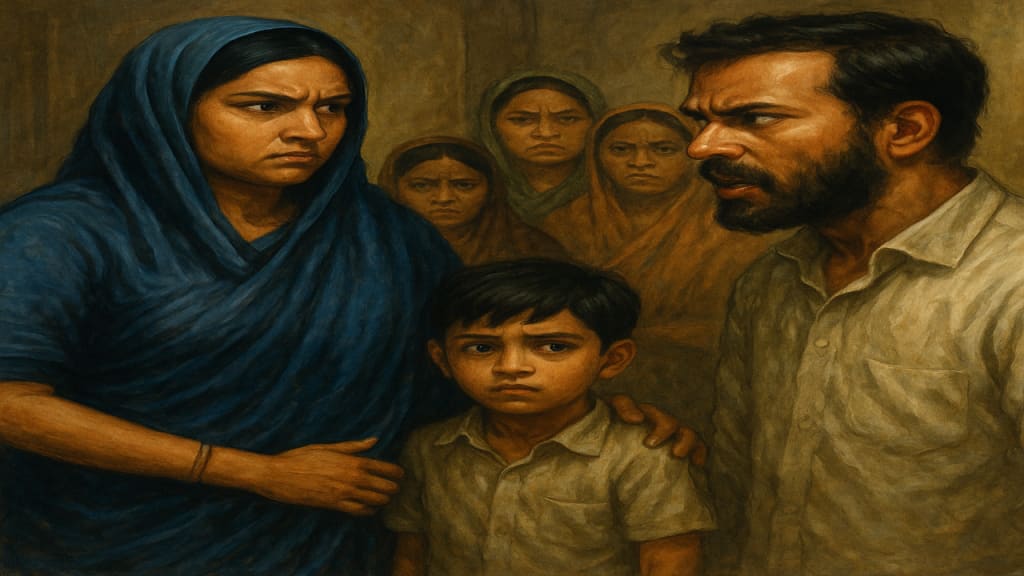
That day, Abba (Father) held a judgment for my Amma (Mother). Everyone had requested that he finalize the divorce. But Abba did not grant the divorce. Instead, during the judgment, he instructed Amma to leave the house and made it clear she should never return. Everyone present was very pleased.
Amma was furious. She left with the three of us—her children—and took shelter at her parental home. But the aunts (Amma's sisters-in-law) there did not want to accept us. Only our grandmother was alive then, and she gave us some space, although even she seemed slightly irritated. My name was not even mentioned in the whole process. I am Fardin Mihir, and I was nine years old at the time.
At Nana’s house, Amma stayed with us in Grandma’s room. Even though everyone else saw us as a burden, Grandma didn’t treat us too harshly. Everyone thought Abba would eventually send a divorce letter. But to everyone’s surprise, even after several months, he never did. Grandma pressured Abba relentlessly. But Abba always said he would rather live alone than marry again.
On the other hand, even Grandma from my mother’s side secretly sent a message to Abba requesting he send the divorce letter. She didn’t inform Amma of this. Grandma’s plan was to give the three of us up for adoption and get Amma married again. But since Abba never divorced her, that plan fell through. One of my uncles, Amma’s middle brother, also opposed the divorce.
I heard that Grandpa became bedridden about six months later. Grandma couldn’t handle the household alone and pressured Abba to remarry. Despite many attempts, he never remarried.
Back when we lived at Dada’s house (paternal grandparents’), both Grandpa and Grandma used to take all of Abba’s earnings. Whatever he earned from his salary or tutoring students, they kept it all. Even after we left, this continued. Abba was very meek and quiet. Being the only son, he was often emotionally blackmailed by them. After we moved to Nana’s, Grandma's household still ran on Abba’s money, and the rest was spent on his two sisters. Abba used to tutor students at home. Grandma knew exactly how many students he had and how much he earned. She kept a close watch to make sure not a single penny went to Amma.
We heard Abba would return home late at night. Our aunts kept contact with our neighbors at Nana’s house to monitor whether Abba ever came to see us or sent money. The two houses were in adjacent areas, so it wasn’t hard. But Abba never visited us or sent money. However, we heard he would sometimes stand quietly near our school to catch a glimpse of us.
Two painful years passed at Nana’s house. We lived as if we were burdens. Whatever was left over from others’ meals was given to us. Even when Amma was sick, no one bought her medicine. The aunts treated us terribly.
During this time, I completed my fifth-grade exams and got admitted to high school—but not in Abba’s school. Abba was a high school math teacher and had hoped I would study there. But Amma was still furious and didn’t want Abba to see us, so she enrolled me elsewhere.
Word reached Abba quickly that I wasn’t admitted to his school. My exam results weren’t very good either. Then, one evening, Abba suddenly showed up at Nana’s house. In the past two years, he hadn’t spoken to Amma even once, and Amma had destroyed her phone in anger. No new phone was bought, as no one would provide one at Nana’s house. Abba could have called someone else’s phone—but he didn’t.
That day, he came without bringing anything with him. His mood was fiery. I had never seen such anger in our usually quiet Abba.
Inside the house, my aunts were whispering, “He came after all this time! Didn’t even bring anything for the kids. What kind of father is this?”
Hearing all this hurt Amma deeply. It was true—he could’ve brought something for us. Abba wanted to speak with Amma, but she refused. Still, Abba wouldn’t leave without speaking to her. He waited for nearly three hours.
Finally, Amma spoke to him from behind a curtain. Abba’s first question was, “How are you?”
Amma didn’t respond. But his second question shocked everyone. A harsh truth came to light.
Abba gently said, “Come home. Both Ammi and Abba (his parents) are bedridden.”
Amma flatly refused, “Never! I will never return!”
Abba lost his temper, “What will you do staying here? Mihir’s results weren’t good. I knew you didn’t tutor him. You could’ve arranged a private tutor!”
“A tutor? Did you give me any money? Did you even ask how your wife and kids were doing?” Amma shouted.
“I’ve gone door to door, tutoring until midnight. I’ve sent you money with so much difficulty. I gave you two mobile phones in two years. But you never once called me. You didn’t even tutor Mihir a bit. Now you’re accusing me of not sending money?”
Amma was stunned. Abba had sent phones and money? We had no idea. Amma immediately asked, “Who did you give the phones and money to? If I had those, would I have struggled so much?”
Abba replied, “I gave everything to your middle brother—every month. I worked hard, even taught night batches, just to send you money. The mobile phones were given to him.”
My middle uncle wasn’t home that evening—he was at the market. But my aunt’s face turned pale hearing all this. My cousin sister quickly went to her room. It felt like they both knew the whole truth.
We were all stunned. We had suffered so much in those two years—without new clothes even for Eid—unaware that Abba had sent money. Two new phones had come into our uncle’s family, one used by the cousin, the other by my aunt. Phones meant for Amma.
They must have assumed Abba and Amma would never reconcile, and thus took advantage of the situation. But Amma didn’t wait a minute longer. She snatched the phones from them, got us ready within twenty minutes, and left with Abba.
Before leaving, she only spoke to Grandma. Not a word to anyone else. As we were leaving, we met our uncle returning. Amma confronted him:
“Return everything that’s mine, brother. Your betrayal has no bounds. If strangers from my in-laws had done this, I could’ve accepted it. But you, my own brother, betrayed me. Return all my belongings properly. I pray to Allah that I never have to see your face again!”
That very day, we returned to Dada’s house. Both grandparents were truly bedridden. Grandma had become sick from handling everything alone. Abba told Amma, “Hire a maid. She’ll come early to help. Amma takes sleeping pills now and can’t wake up early. The maid will be gone before she wakes.”
Amma angrily replied, “I won’t do any housework!”
Abba smiled, “If I’m home, I’ll care for both of them myself. Just help out a bit.”
But Grandma never stopped. If Abba brought groceries, she would interrogate how much he brought, and he always underreported—saying less than the actual amount—to avoid complaints. Even from her bed, she would try to monitor everything and scold Amma. The aunts gave her bad ideas. Yet, Amma never returned to her parental home. As Grandma’s condition worsened, her interference lessened. The aunts didn’t cause much trouble either, afraid Amma might stop caring for Grandma, in which case they would have to step in.
Despite everything, Amma never went back to her parental house, except once, when Grandma passed away. Amma could never forgive her in-laws, and later not even her own family. She used to tell us that betrayal from loved ones is the hardest to bear. She faced suffering from both ends.
Within two years of returning, both grandparents passed away. Maybe Grandma, bedridden like Amma once was, faced her own punishment. After they passed, Abba quickly divided property for his sisters, so they would not interfere with our family anymore.
Amma always considered the betrayal of her own brother to be the greatest pain of her life. A year and a half after we returned, that cousin sister of mine—the one who used Amma’s phone—got married. But her in-laws couldn’t get along, and four years later, she returned to her father’s house with two children. Amma used to say:
“I cursed your father a lot because of my brother’s betrayal. Maybe those curses didn’t touch your father—but they touched your uncle’s family. That’s why your cousin came back to her father’s house with her children, just like I did. This is Allah’s sign.”
Because of her anger, Amma never enrolled me in Abba’s school. I didn’t get good grades. That disappointment drove Abba to visit us, which revealed everything.
Though Amma later bonded with my aunts, she could never forgive her parental family.
About the Creator
Alomgir Hossain
When I was a child, I used to listen to fairy tales from my mother. When I grew up, I was very fond of reading books, so I used to go to the library and read different types of books. Short stories and novels were my favorite books.
Keep reading
More stories from Alomgir Hossain and writers in Families and other communities.
Mad Dashu
Among all the students in our school, there was no one who didn’t know Mad Dashu. Even someone who knew no one else would immediately recognize him. Once, a new gatekeeper joined the school—a rustic man, completely unfamiliar with town life. The moment he heard the name "Mad Dashu," he instinctively figured out who it was. Because from Dashu’s face, speech, and mannerisms, one could clearly tell that he was, well… a little touched in the head.
By Alomgir Hossain11 months ago in Families



Comments
There are no comments for this story
Be the first to respond and start the conversation.