
A Book of Ages
A foreword that reflects on one author's life and lineage

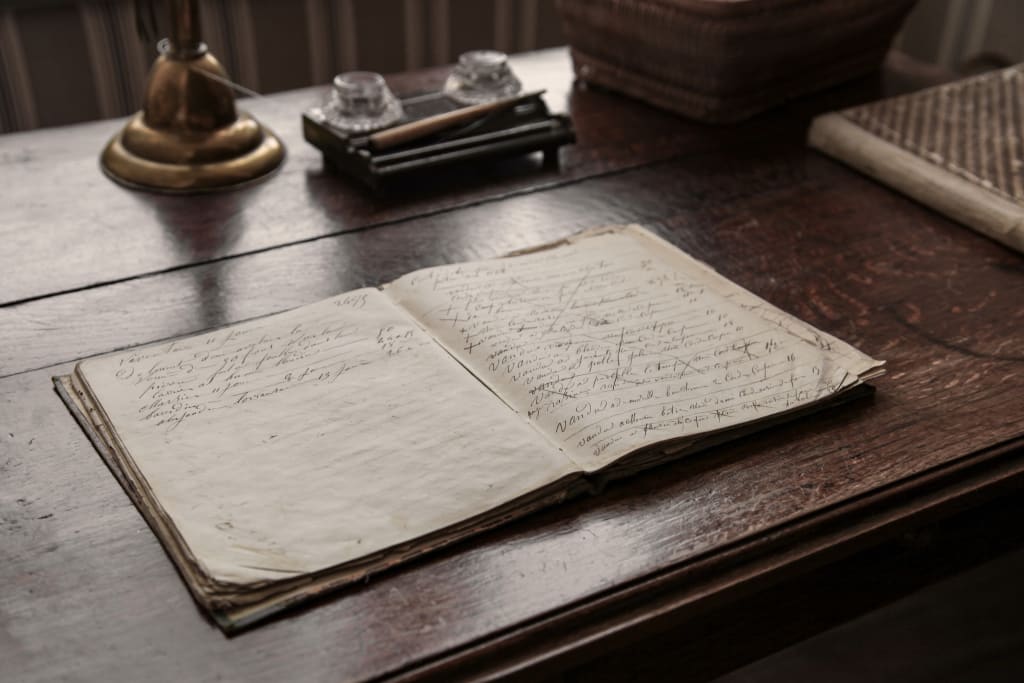
I wasn’t sure if I wanted to publish this book at first, but after a lot of thinking, I decided that it can help people. It can make a difference. On top of that, it can fill a hole that has been missing in my life for ten years. Let me explain.
This book is a collection of journal pages that has been passed down through every single generation in my family for the past two hundred years or so. In the 1800s, one of my forebears came up with a way to link her life to those of future generations. She wrote a couple of paragraphs about her life on the first page of a black leather journal. The last paragraph she wrote came with a directive: Future generations were to read her entry, then add an entry about their own lives, using strictly one page in the journal. The idea was to have a journal that would eventually encompass different generations of the same family line, unifying the lineage in one physical relic.
After she wrote her entry, she gave the journal to her son. She told her son to open it when he was ready to pass it on to his children. He was to read his mother’s page, then add a page of his own before passing the journal on to his kin, each of whom would add their own pages when their time came. The journal only contains around forty pages, but it’s already halfway full. We have been fortunate enough to have plenty of families from each generation become part of this tradition.
It is a beautiful concept, and one that I am lucky enough to be a part of. As I write this foreword, I am looking at the heirloom. The leather is tattered in places, but somehow still holds some of its sheen. The bottom corner of the front cover curls up like a rescue dog’s crooked ear, and the pages are yellowed with age. The little black journal radiates character and history. I have to be careful when opening it. Hearing the stretching moans and creaks of the old leather as I open it reminds me of my grandfather getting up from his favorite armchair after a long nap.
Every single entry in the book is beautiful in its own way, although some of the entries are illegible -- handwriting standards have really changed over time. The entries I was able to read gave me beautiful insights into my ancestors’ lives. For example, some of my forebears used their page to reflect on their happiest moments in life. Like my aforementioned grandfather, who remembered winning twenty-thousand dollars in the lotto and using that money to change his life. One of my great-aunts wrote about being the first woman to receive a scholarship at her university. Others wrote about small moments from their childhoods that stuck with them for whatever reason. My aunt, for example, recalled her best friend helping her get bubble-gum unstuck from her hair when she was eight or nine. That one made me smile. I won’t spoil any more of the entries; each one is a treat to read.
I cried just as much as I laughed reading through the journal. It hurt when I learned that so many of my ancestors suffered from so much heartbreak. The pages are dotted with reflections on feelings of loss and regret scattered between those of joy and nostalgia. One thing is certain; I had never felt such a strong connection to my family before I read that little black journal. I felt closer than ever to those I care about in my life, which is why I was in anguish when it came my turn to write an entry.
As you may have gathered, I should be passing the journal on to my kin now, to continue the legacy as those before me have done. I always thought my ancestors were lucky that they all had children to whom they could bequeath the journal. I wish I could say the same about myself. Ten years ago, my only daughter committed suicide. She lost her battle with depression, and my life has been a challenge ever since. The pain of losing her has found a permanent place in the pit of my stomach. Over the years, I have learned ways to better cope with it, but it does not get easier.
Earlier this year, when I realized that it was my time to write in the journal, the initial excitement at the prospect was immediately dwarfed by guilt and shame. I have nobody to pass the journal down to. My wonderful daughter is no longer with me. Where multiple generations of my family were able to continue this beautiful tradition, I have failed.
My idea to publish the journal was a silver lining. I realized that I could do something that could help those who are in a similar dark place to my daughter. I could do my part to help veer them away from a path akin to the one my daughter chose. That is why all of the proceeds from this publication, as well as my book advance, will be going directly to various mental health awareness programs (listed in the acknowledgements a few pages ahead) to aid suicide prevention initiatives. Furthermore, I hope that you can relate to some of my family’s nostalgia, melancholy, joy, regrets, etc., over the past two hundred years, and I hope that this book can serve as a way for you to bolster the bond you have with those you love.
As I finish this foreword, I’m running my wrinkled fingers down the smooth face of this beloved relic, adding my fingerprints to the collection of those who came before me. A fun experiment has become an iconic tradition for me and my family. Sometimes, I still feel guilty about my decision to publish. These entries were never intended to be read by anybody outside of the family. But knowing that this book might do some good in the world gives me solace. Though I am sad that the tradition ends with me, I find comfort in the thought that my family’s two-hundred-year bond will be immortalized with this publication.
About the Creator
Christmas Abroad: Celebrating the Holidays Without Family
I moved to South Korea in 2017. I was twenty-two years old and excited to start my career as an English Second Language Teacher. With a Bachelor's degree and six hundred dollars in my bank account, I set off for Busan.
By Kera Hollowabout a month ago in Families


Comments
There are no comments for this story
Be the first to respond and start the conversation.