
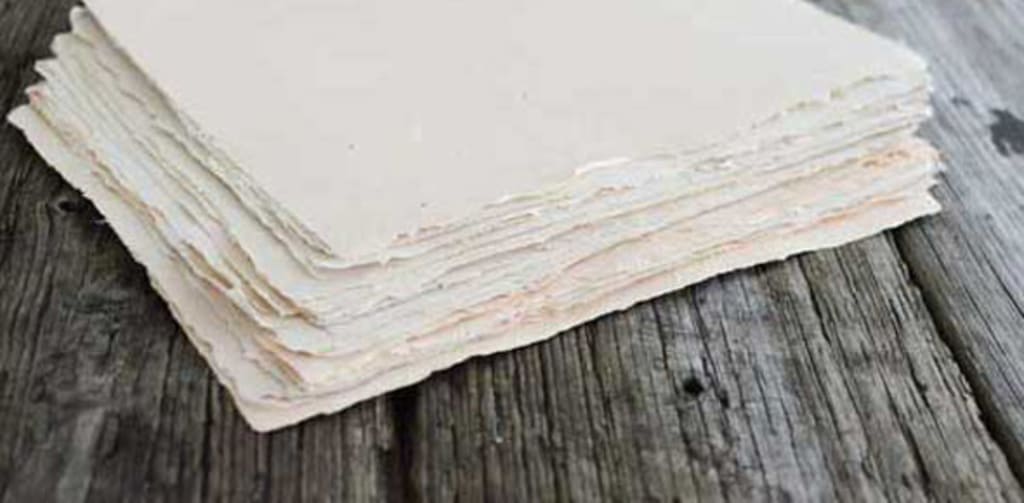
It begins with a blank page.
Mind forms idea,
hand wields pen,
ink dries into a mark,
It will last just so long as the paper.
Marks are easy:
draw in the sand with a stick,
paint pictures on a wall
with berries and blood and soot.
Art is its own glory,
written language a revelation:
But they would be nothing
without the base which holds them,
the stratum that surrounds and sustains them,
the medium that passes them
through time, across space
to new eyes in new lands,
new minds in new ages.
Paper. All is in the paper.
God made the world: but where did He put it?
I didn't know you were a poet, Granpa. I found this poem in this book, black leather cover and thick, heavy pages that crinkle and creak when they turn. Only thing in this apartment worth looking at.
Granpa Will died two months ago, December, 1901. Two months for word to reach me, a week to come to San Francisco, an hour to search.
No safe, strongbox, bank book, deposit box key. Just this notebook, which I picked up and looked through hoping there would be an honest-to-God treasure map. Half the book filled with poems, the other half blank; I am writing this account on those blank pages. Granpa Will won't need them, after all, God rest him.
No map.
No sign of the money.
I know he had it ten years ago, because he offered half to me, his only living relative and heir. He'd got it for selling his stake in the gold mine he'd found during the California Rush. $20,000.
But all I see here is an old man's things: not a rich man's things. And this book with his words in it – now some of my words, too.
Some of the pages he wrote on? They're not in English. Looks like Chinese.
I guess that doesn't surprise me.
I have taken much.
I have taken life from father and mother.
food from the soil,
drink from the rivers and streams.
Meat from the living
creatures who share this world.
I have taken love. Friendship.
I have taken the lives of my fellow men,
so they would not take mine.
I have taken from deep inside the Earth,
broken the Earth's bones
to draw out the shining golden marrow.
I have taken much.
Perhaps I made much of what I have taken –
but still, I took it.
And after I made it:
still mine. Still taken.
Now I will give.
I will create, not a reflection
of my desires or my will,
but a space, a blank,
for another.
An uncarved block.
Fertile ground that seeds may be planted in.
I will not destroy what I have made,
I will not unmake
in exchange for my making.
I will create balance.
To the world that gave me room to grow,
I will give back room,
create empty space,
a blank slate.
I will make paper
so that another may write.
He was a man of his word, I'll give him that.
I discovered why Granpa Will was so interested in paper. He had a shop, a papermaking and book-binding shop, right on the edge of Chinatown. Blank Paper, it's called. Proprietor, William Blank.
More than likely, that's where the money went. He built the place out of my gold. Well, still his gold, then. But I know who has it now.
I saw her in the shop when I went by, yesterday.
The same woman. The same China doll that turned Granpa's head ten years ago, when he offered me that money. I refused it then, because when he offered me half of the sheaf of new-minted gold certificates, I couldn't think of anything but the other half of that money. Only half for me, his own blood, and he was giving the rest – to her. That Chinese witch. I cursed her, and him, stormed out. Didn't even say goodbye.
That was the last time I saw my grandfather.
Those were the last words he heard me say.
I went inside today. She came out from the back to wait on me. She knew me, right away, even after ten years. She hadn't changed: smooth face, white robes, hair wound up and held with chopsticks.
Still pretty as sunrise over a calm lake.
She looked at me, and tears started in her eyes.
That just made me madder.
“Why aren't you wearing black?” I growled.
She spoke softly, with some accent but every word clear. “In China we wear white. To mourn.”
“You're not in China any more!” I spat. “You're his widow, aren't you? American widows wear black.”
She shook her head. “I not American widow. We had Chinese wedding, but cannot marry American.”
I jumped on that. “If you're not his widow – then this shop belongs to me.”
Her jaw tightened. “Shop not Will's. Mine from first husband, Chinese husband, Li Wei.”
I scoffed. “You can't own anything, not in America. Probably not even in China.”
She looked daggers at me through the tears. “Store belong my son. Li Huan born here, he is American.” She leaned closer. “Your grandfather made sure. Men wanted to take store when Li Wei died. Will stopped them.”
I was stunned. “You have a son? Was he – is he –” I couldn't say it. Is he my blood – even if a half-Chinese bastard? Is he a Blank?
She straightened up, and despite being a foot shorter, she looked down on me. “Li Huan!” she called. “Come!”
A young Chinese man emerged. Maybe sixteen, tall, youth-slender. Not a Blank: Granpa Will was still out at the mine when this boy was born.
“Can I help you?” he asked me, politely. English good as mine.
I had to scrape together enough anger to clench my teeth. “You the owner?”
“That's right, though my mother here, she's the expert.” He smiled at her – then noticed her expression, and frowned.
“Where'd you get that name, Blank Paper?” I asked. That still heated my temper. I used it.
“It was my stepfather's name. William Blank. He worked here with my mother.”
His mother said something in Chinese. The boy's eyes grew wide, flashed to me. I nodded. “My name's Victor Blank. Will Blank was my grandfather.” I looked around. “I guess he more than worked here, didn't he? Since his name's on the shingle?”
He blinked. “He was my jifu. My stepfather. He raised me. We honor him. That is why we kept the name.”
And that boy stood up straight, and bowed. To me.
It brushed away my temper like a broom sweeping dust.
That boy loved my Granpa. So did his mother: I saw the tears on her cheeks. Will Blank was my grandfather, my blood, and here they were mourning him. Honoring him. And what was I doing?
Looking for goddamn money.
I turned to go.
“Wait!” she said. “Your granpa's money. He want it go to you.”
I turned back. Not for the money, not really. I turned back because if he left something to me, Granpa had thought kindly of me. Even after what I'd done.
I shouldn't have done what I did. He'd loved her. Took care of her, of her boy. Not many men would have done that with any woman, let alone a Chinese woman. But he did it, and they honored him.
It made me proud.
It made me feel even more like a heel for what I'd done. Made me wish I'd been a better man. Or at least come back sooner, while Granpa Will was alive. Maybe I could have known him better.
I knew right then what I wanted. Not the damn money. I wanted to know my Granpa. I wanted to honor him, the way this woman and this boy did.
But I still heard myself ask, “Do you know where the money is?”
She looked at me for a long minute and then nodded. “I help him make the place, put money there.”
There was an emptiness in my gut that wanted filling. A voice told me what would fill it: everything I could buy with that money.
There was another emptiness in my heart, where my Granpa should have been. He'd been my only family. He was gone, and there was no replacing him, no way to fill that void. I knew the money wouldn't help with that, not at all.
But I still heard myself ask: “Where is it?”
She wiped tears from her eyes, and gave me a narrow look. “You find poems?”
I nodded slow. “Some of them are in Chinese. You do those?”
She smiled. She looked proud. “All poems Will's. I help him learn to write poem. And write Chinese. He very good.”
I frowned. “Are you saying the money is, what, it's in the poems?”
She laughed. “Yes, money in poems. You look.”
I went back to Granpa Will's apartment.
I looked through his leatherbound book: all that heavy, smooth paper, half filled with poems, half blank. I had scrawled over some of the blank pages, and when I looked at them, my crabbed handwriting on Granpa Will's beautiful paper – I was ashamed, again, of what I'd done. I turned back to the beginning, to Granpa Will's poems.
That's when I found it. I had turned past the flyleaf the first time, but now I found it. What my Granpa left me.
For my grandson
Victor Blank
This book and all that it contains
Half of the pages have my thoughts
Half are blank
All are yours. Do with them what you will.
I started crying. I kept turning the pages, not reading, just skipping my eyes over the words. I wished I could read the Chinese. My Granpa wrote that, too.
One page had Chinese and English, interwoven, a line of characters, a line of English under, then more characters.
My treasure,
it said.
My Xiao! My love!
It went on, but that was enough. That one wasn't for me. It was a love poem, that my Granpa wrote. For his Chinese wife.
She should have this. I cut a line with my penknife, as near the binding as I could, and carefully tried to tear it out.
The paper was heavy: at first it wouldn't come. I didn't want to pull too hard. I scored the other side – it had another poem, all Chinese – and then pulled…
The page came out ragged. And – there was something inside it.
The page was double-thick, and between the layers, there was something –
Carefully, I peeled away the paper with my fingernail.
Two $100 gold certificates, one in the top half of the page, one in the bottom.
Hands shaking, I turned back a page. I felt the stiffness, heard the crinkle. One hundred pages, the first half filled with poems, the second half blank paper, waiting for me.
I found it, Granpa. The money you left. Your gift, for me. Money in poems. Money in paper.
Can I get the money out? How?
Rip up Granpa Will's words? Destroy his poems, just to get my hands on some cash?
Hell no.
But there's $20,000 in that book. Do I just leave it there?
That's when I thought of it. And I have never felt a smile on my face, before or since, that felt half as good.
How do you get out treasure that is buried under poetry? That is buried inside of blank paper?
You go see a papermaker.
I suspect the only way to get the money out is to destroy the paper. To destroy Granpa Will's poems. But maybe his wife – my step-grandmother – would make new copies for me. And tell me what the Chinese ones say. Maybe she can teach me – I'll pay her handsomely – how to make some new paper, to replace what we'll have to tear up to get the money.
Blank paper.
A fresh start.
About the Creator
Theoden Humphrey
Writer, Reader, Teacher
Website: theodenhumphrey.com
Podcast: Learning by Literary Audio Files
Books: The Adventures of Damnation Kane, Vol. I & II
Keep reading
More stories from writers in Families and other communities.
Wise~Guys
— Look Behind what's in Front of You ~ Make Good Choices — Hey, So how you Doin'..! Made~Men — Mobster Movies romanticise a distinctive, elegant appearance, impeccable attire style, along with the 'Families' expressive lingo. Making their 'Bones' gave them Panache — with vintage fedoras, tailored pin-striped suits, mirror-polished wing-tip shoes adorned with tassels; with their 'Gun Moll' gorgeous dates on their arms.
By Jay Kantor22 days ago in Families



Comments
There are no comments for this story
Be the first to respond and start the conversation.