
Zodiac Signs and Feng Shui (1)
The Culture of the Zodiac

At the beginning of the New Year, I wish everyone good fortune and blessings in the Year of the Horse.
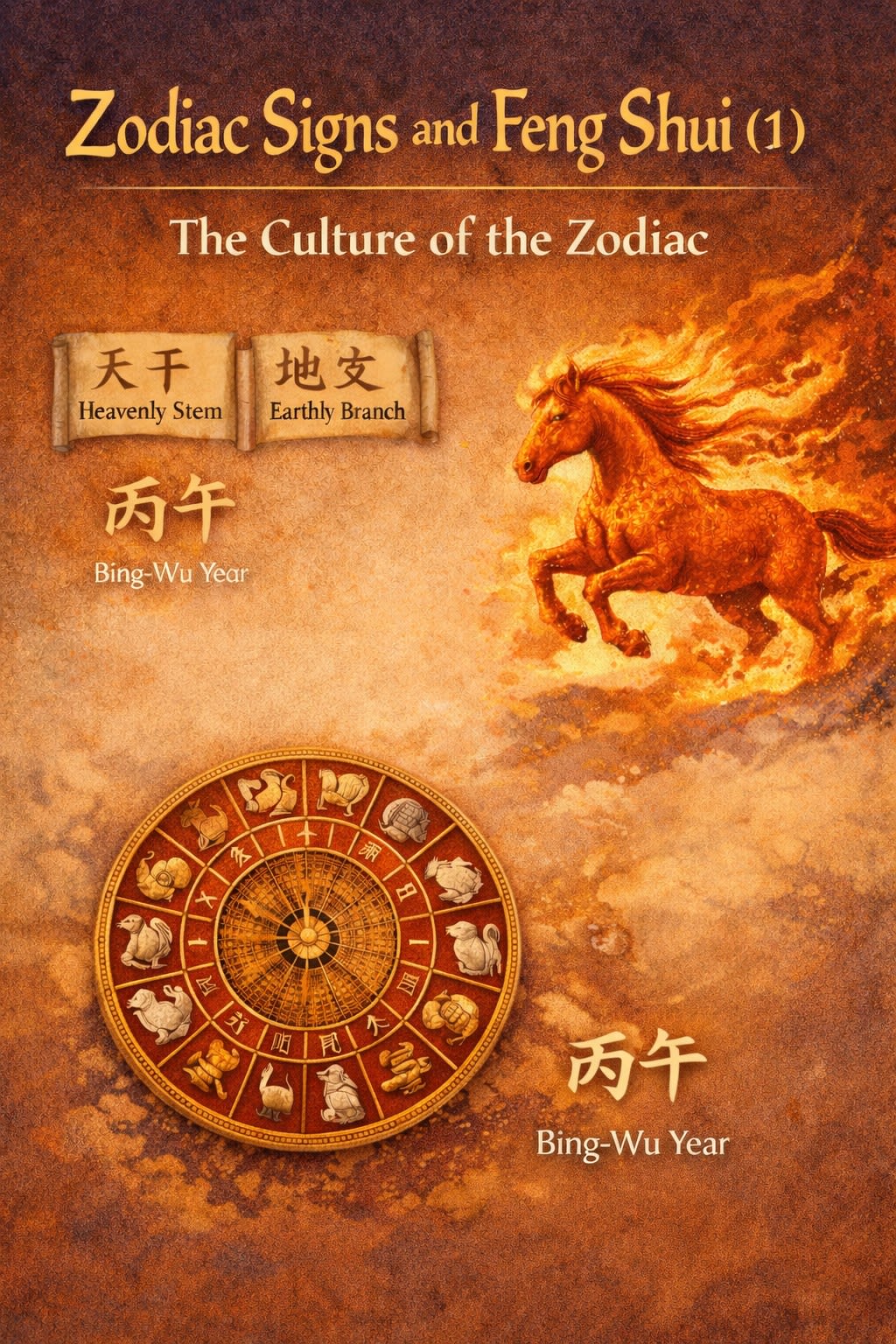
2026 is the Chinese lunar Year of the Horse. In professional Chinese Feng Shui terminology, it is known as the Bing-Wu year (丙午). The zodiac name “Horse” is the common name for the second character, “Wu” (午), and it is one of the twelve signs in the traditional Chinese zodiac system.
Each Chinese lunar year is expressed through a pair of Chinese characters, known as the Heavenly Stem and Earthly Branch. This system defines each year as a specific combination of cosmic energy and Earthly energy, forming the energetic foundation that shapes the year.
In the Bing-Wu (丙午) year, “Bing” (丙) represents a type of Fire energy associated with cosmic or heavenly forces, while “Wu” (午) represents a type of Fire energy associated with the Earth. Therefore, 2026 is a year in which Fire energy is particularly strong and active.
At the beginning of each new lunar year, many Feng Shui practitioners publish zodiac-based personal guides. These guides often tell readers which zodiac signs will be fortunate in the coming year and which may face challenges.
However, if we pause and reflect, an important question arises: how reliable are these guides?
There are currently about 8 billion people on Earth, and only twelve zodiac signs. That means, on average, around 660 million people share the same zodiac sign. If these zodiac-based guides were truly accurate, they would imply that all 660 million people sharing the same sign experience the same fortune in 2026.
But does that really make sense? For example, if you and your coworker share the same zodiac sign—whether Horse or Dog—can we reasonably assume that both of you will experience the same destiny and life outcomes throughout 2026?
Is this really possible?
If not, why does a wave of zodiac-based Feng Shui enthusiasm emerge at the beginning of every zodiac year? And how do Chinese Feng Shui practitioners actually write zodiac-based Feng Shui guides?
In this article, I will address the first question.
As discussed earlier, more than 660 million people share the same zodiac sign on Earth. It is therefore impossible for all of them to experience the same fortune in 2026. If we reflect on past zodiac years and recall the many positive or negative Feng Shui predictions published online, how many of those predictions truly manifested in our own lives?
Most zodiac-based Feng Shui forecasts found online are highly generalized. Yet every year, they remain a widely discussed topic at the beginning of the Chinese New Year. Why is this the case?
The reason lies in history and culture. Zodiac-based forecasting is a long-standing folk tradition in China. Over time, it transformed what was originally a complex and rigorous system of personal destiny analysis into a form of popular culture that is easy for the general public to understand and participate in. As a result, it became a shared seasonal custom, allowing people to engage with the New Year in a joyful and meaningful way.
The theoretical foundation of the zodiac system can be traced back to the Han dynasty (202 BCE–8 CE), particularly to scholars such as Jing Fang (京房). Jing Fang and his contemporaries developed a profound and highly sophisticated Five Elements theory. However, for most ordinary people in ancient times—who lacked formal education—these theories were highly abstract and difficult to comprehend directly.
The zodiac system offered an elegant solution. By using the twelve zodiac signs to represent twelve types of Earthly energy, complex Five Elements principles were translated into a symbolic and accessible system. Through memorizing the relationships among the zodiac signs, people were able to grasp basic patterns of energy interaction without advanced theoretical knowledge. Over time, this approach gave rise to simplified zodiac-based Feng Shui interpretations.
For example, in 2026, people born under the Sheep sign are often said to have favorable fortune. According to the Five Elements relationships within the Earthly Branches (which form the basis of the zodiac system), the Sheep represents Earth energy, while the Horse represents Fire energy. These two energies form a harmonious combination (六合), merging into Fire. Based on this logic, many online Feng Shui practitioners conclude that the Sheep sign will experience good fortune in 2026. This interpretation is grounded in the Five Elements definitions of the Earthly Branches.
From a social and psychological perspective, people naturally seek a positive beginning to the New Year. Hearing such optimistic interpretations brings joy and reassurance, functioning as a form of positive psychological suggestion. This helps explain why zodiac culture has endured throughout Chinese history and why it continues to spread globally today. The desire for hope, happiness, and a better future is universal, and zodiac culture offers a symbolic and emotionally resonant way to express that desire.
This does not mean zodiac culture is meaningless, but rather that its role is cultural and symbolic rather than precise personal prediction.
However, from a professional Feng Shui perspective, this simplified zodiac-based approach is clearly imprecise. While Chinese Feng Shui practitioners also discuss zodiac signs, their analyses are far more complex and often difficult for the general public to understand. So what exactly do professional Feng Shui practitioners examine when they discuss zodiac signs? I will introduce this in the next article.
About the Creator
Lidong Yu
I am a Chinese Feng Shui consultant and educator, raised and trained in China. My work draws on classical Feng Shui traditions to help people better understand the relationship between themselves, their environments, and time through Qi.
The Value of Respect
On a cold winter morning, the school hallways were still quiet when Bashir arrived, as he always did before sunrise. He unlocked the gates, swept the corridors, wiped the classroom windows, and cleaned the floors before the students came rushing in.
By Waleed khanabout 3 hours ago in Education
How Problem-Solving Shapes the Success of Modern Entrepreneurs
Entrepreneurship today is defined by constant change and relentless challenges. Business leaders are no longer operating in stable, predictable environments; instead, they face shifting markets, evolving customer expectations, and rapid technological advancements. In this environment, problem-solving has become the cornerstone of entrepreneurial success. The ability to identify issues, analyze them critically, and create practical solutions separates thriving ventures from those that struggle to survive. Entrepreneurs who develop strong problem-solving skills are better equipped to innovate, make strategic decisions, and guide their businesses toward sustainable growth.
By Greg Warnock2 days ago in Education



Comments
There are no comments for this story
Be the first to respond and start the conversation.