
Bagua Feng Shui Series (5)
Why Did Mrs. Li Lose Money in September 1988?


In earlier blogs, I emphasized a key idea: Feng Shui concerns the movement of Qi (vital life energy) through time and space — and how this energy shapes our lives, opportunities, and even our destiny.
In Feng Shui, time and space operate as one system. Space holds Qi — the energy around us — and time sets that energy in motion and transformation. The two are inseparable. This concept is also deeply rooted in classical Chinese philosophy, especially the I Ching (Book of Changes). Traditional Chinese thought teaches that the world never stands still; everything is alive, dynamic, and continuously transforming.
If you have already studied Bagua and its divination foundations, this idea may sound familiar. If not, here is the core takeaway:
- Qi operates in time and space as one unified system (时空一体).
With this principle in mind, the Feng Shui case below will become easier to understand — and much more fascinating.
Case Background Review
In my last blog, I introduced Mr. Li’s home. Two key conditions defined its Feng Shui structure:
First, his house is classified as a Gen House. It sits on Trigram Gen in the northeast and faces southwest according to the Later Heaven Bagua chart.
However, the front door is located at Trigram Xun in the southeast (see Figure 1).
This creates two different energy types in one home:
- The house belongs to the West Four House Group
- The front door belongs to the East Four House Group
In classical Feng Shui, this is a mismatch. The Qi entering from the door (East Group) conflicts with the internal Qi of the house (West Group).
However — and this is important — a conflict does not automatically bring misfortune.
Qi is dynamic. As long as the house’s internal Qi and the door’s entering Qi remain in subtle balance, the household can stay stable and peaceful. Balance can exist even within tension — but it is fragile. A small disturbance may shift everything.
When the Balance Breaks
Things change when a third type of Qi enters this delicate system.
If an external force strengthens the internal conflict, real-world consequences may follow.
This brings us to the second key factor in Feng Shui: time.
In September 1988, two powerful time-energies met head-on, creating a sharp energetic clash — and that was when Mrs. Li experienced a major financial loss.
So why that year? And why that month?
Understanding the Time–Qi Collision
1988 was the Year of the Dragon.
In Feng Shui, the Dragon is a cultural symbol representing a type of Earth Qi known as Chen (辰). Chen is positioned in the southeast on the Feng Shui compass — the exact direction of the Li family’s front door.
Thus, the annual Chen-Earth Qi arrived directly at the door, stimulating and activating its already sensitive energy field.
Then September arrived, bringing another type of Earth Qi: Xu (戌).
On the Feng Shui compass, Xu sits in the northwest, directly opposite Chen (see Figure 2).
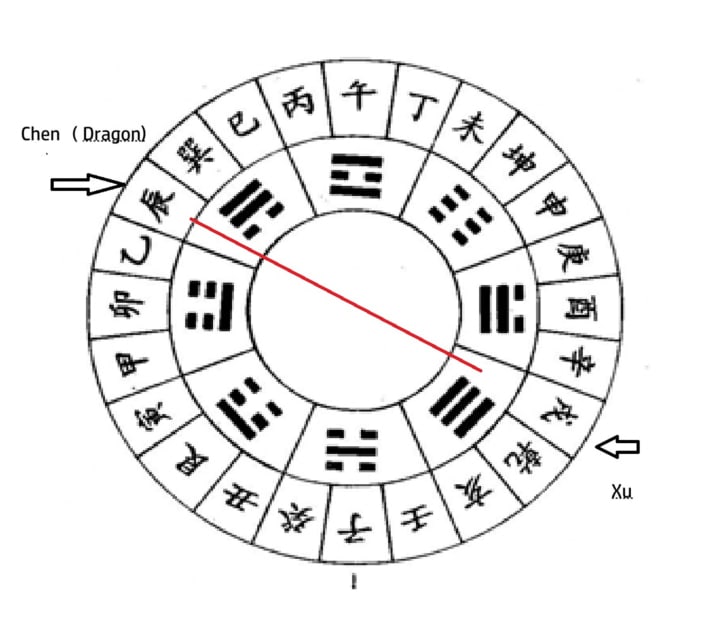
So we have:
- Year Qi: Chen (辰) — Southeast
- Month Qi: Xu (戌) — Northwest
Chen and Xu oppose each other. When these two Earth energies meet, classical Feng Shui describes it as Earth clashing with Earth — two forces pushing against each other, destabilizing whatever lies between them.
Since the house already had a Qi conflict at its front door, this annual-and-monthly clash acted like a spark falling on dry grass. A fragile balance broke, creating an unfavorable Qi field for the household — and leading to Mrs. Li’s significant financial loss.
The Deeper Feng Shui Lesson
This case touches on deeper layers of classical Feng Shui. If some concepts feel unfamiliar, do not worry — you do not need to grasp every symbol immediately. The key ideas are simple:
- Qi is never still — it flows, changes, interacts
- When time-Qi activates a hidden space-Qi conflict, real-world events can unfold
This is why the foundational text of Feng Shui is the Book of Changes. Both the Book of Changes and authentic Chinese Feng Shui teach us:
Change is constant — and it shapes our destiny.
Feng Shui is not superstition. It is the study of how life unfolds when vital energies in time and space interact — sometimes harmoniously, sometimes in conflict. When we learn to read these patterns, we can better understand our environment, prepare for energetic cycles — to make the most of auspicious periods and act cautiously during unfavorable ones, so we can reduce potential negative impact.
About the Creator
Lidong Yu
I am a Chinese Feng Shui consultant and educator, raised and trained in China. My work draws on classical Feng Shui traditions to help people better understand the relationship between themselves, their environments, and time through Qi.
Why Mississippi Small Businesses Are Finally Taking Their Websites Seriously
For many years, having a website in Mississippi was more about appearance than performance. It was something businesses created simply so they could say they had an online presence. A basic page with a phone number, a short description, and maybe a photo was often considered enough.
By Jhones Benn3 days ago in Education
The First Rainbow Baby
Pitter-patter, pitter-patter. The rain fell in rhythmic splatters, slowly slowing, but still constant. Mira rolled onto her side pulling the blanket tight against her ears, but still she could hear chitter-chatter and scurrying feet of the creatures that refused to sleep in the lower decks.
By A. J. Schoenfeld3 days ago in Fiction




Comments
There are no comments for this story
Be the first to respond and start the conversation.