
You Know Nothing About Economics
But there is no shame in that


Did you know that the government can never run out of money, taxes don't fund its spending, the national debt isn't a debt, and printing money doesn't cause inflation? Probably not, because your parents, teachers, politicians, and favorite journalists have always told you the opposite.
For most of my life, I didn't know either. I have two PhDs, and if one of them were in economics, it wouldn't have helped. The only people who know how government finances work are central bankers (who won't tell you), traders with hands-on experience of the failure of economic norms, and those who stumble across their work (which I explain below).
Everyone else, from New York Times economists to the leaders of both major parties, reinforce common falsehoods, which may be why the economy is brutal and crashes every ten years. Some of these experts lie, others don't want to rock the boat or jeopardize their careers, but most don't have a clue.
That is why, if there is a conspiracy to stop us learning "why the government can never go broke," for example, so that we don't ask for nice things like public healthcare, climate action, and a basic income, it is almost effortless. Most people automatically treat the government like a big household that is subject to the same financial rules as themselves—balance income with spending, save for a rainy day, and avoid debt.
As responsible adults, that is our lived experience—the hard truth of budget living that accompanies adulthood—and it continues to guide every financial decision we make. When analogized to the government, disagreement appears infantile to us "adults in the room" who assiduously calculate how to pay for government programs with taxes and cuts.
What eventually caused me to stop basing my beliefs on assumptions, hearsay, and intuition were questions like "where does money come from?" And, how did the trillions of dollars that exist today actually get here? My intuition had only supported the ridiculous notion that money is an eternal object that circulates in the economy and cannot be created or destroyed.
In my examination of what seemed like a scholarly question, I discovered what may be the greatest cause of suffering in the developed world— politicians who falsely declare that a government "cannot afford" something or has "reached its debt ceiling" are creating opposition to social spending that would save lives and could save the planet we live on.
The remainder of this article will provide you with the knowledge to reject their misinformation and, I hope, facilitate the greatest societal change of the 21st century.
Where Does Money Come From?
Take the United States as an example. Every U.S. dollar in existence was created by the U.S. government (or by banks with government licenses), and this exclusive right to create the dollar is enshrined in the U.S. Constitution. It is even called a Federal Reserve Note to tell you it was created by the government's bank.

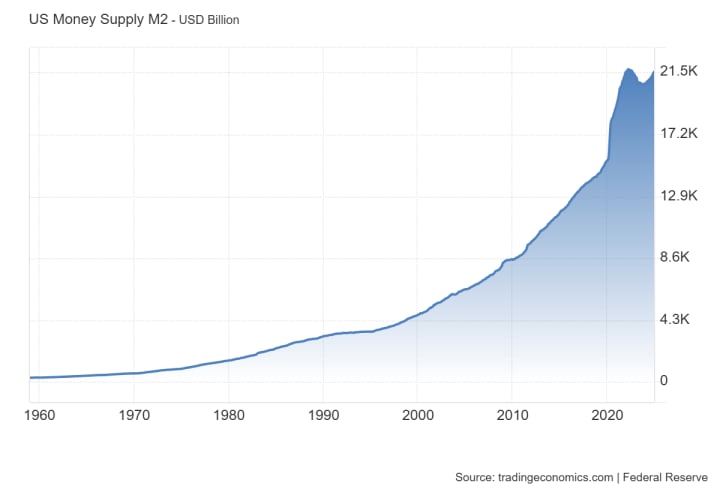
The first dollar was created in 1792 and trillions have been created since then. In fact, there are twice as many dollars in existence today compared to ten years ago (see graph). Although much of the new money is bank credit, the rest is created when the government passes spending bills.
Most national governments are currency issuers, including the U.K., Australia, and Canada, although some are not (e.g., European Union states such as Greece). Localities such as U.S. states also do not create currency and require some form of income.
This power to issue currency means that every statement from a politician, economist, or media personality about the government "running out of money" or being "unable to pay its bills" is a lie.
The Government Can Never Go Broke
In a rare and unreported admission, the Federal Reserve confirmed that the U.S. government issues the dollar and can never run out.
As the sole manufacturer of dollars, whose debt is denominated in dollars, the U.S. government can never become insolvent, i.e., unable to pay its bills. — Federal Reserve Bank of St. Louis
Alan Greenspan also said the following under oath in front of Congress (see video for context).
There is nothing to prevent the federal government from creating as much money as it wants and paying it to somebody. — Alan Greenspan (Federal Reserve chairman, 1987–2006)
Another Fed chairman, Ben Bernanke, said something similar when he described how the government bailed out the banks after the 2008 financial crisis (see video below). As I said in the introduction, central bankers know how it works. They just almost never tell you.
Taxes Do Not Fund Spending
In the previous video, Bernanke explained that tax money was not used to bail out the banks, and, logically, a currency-issuing government does not need taxes to fund itself.
On a practical level, economists who have studied the operations of the central bank know this to be true.
The proceeds from taxation and bond sales are technically incapable of financing government spending [...] modern governments actually finance all of their spending through the direct creation of high-powered money. — Professor Stephanie Kelton
It makes no practical sense for governments to wait until they have accumulated enough in taxes. Or did you think the Treasury was waiting for your grandmother's taxes to arrive before they could buy a warship?
Rather, they create money as they spend. As Bernanke explained, the government makes a payment by instructing the Federal Reserve to increase the number of dollars in a bank account. This happens by keystrokes on a computer. It doesn't even need to be printed.
Taxes Are Deleted
There is a veiled admission from the Federal Reserve about the fate of our taxes. Essentially, they acknowledge in footnote 1 here that taxes paid to the U.S. Treasury are no longer part of the money supply (i.e., deleted).
Governments create money by spending and extinguish it via taxation. — Professor James K. Galbraith (former executive director of the Joint Economic Committee of Congress)
Why Tax At All?
Unfortunately, taxation is necessary. When the government creates dollars, it needs you to value and accept those dollars as payment for your goods and labor. The government does this by forcing you to pay taxes only in dollars, which means that you have to obtain dollars from somewhere.
In other words, giving value to the government's currency is the core reason for taxes, but there are other reasons, such as to reduce the money supply and to punish problematic industries (e.g., polluters). Funding government spending is not one of the reasons. Indeed, governments have to create and spend money before anyone can even pay their taxes.
Printing Money Does Not Cause Inflation
Intuition tells us that creating money reduces its value by the same amount, but this leads to the ridiculous notion that the first dollar ever created was as valuable as the collective trillions in existence today. It also forgets that the money supply is increasing all the time, usually without noticeable inflation.
In my case, I held this myopic belief about inflation because I saw a photograph of a wheelbarrow of money in a 7th grade history class about Weimar Germany and I assumed that correlation means causation.
The conventional wisdom that printing money causes inflation is not true. — Professor John T. Harvey
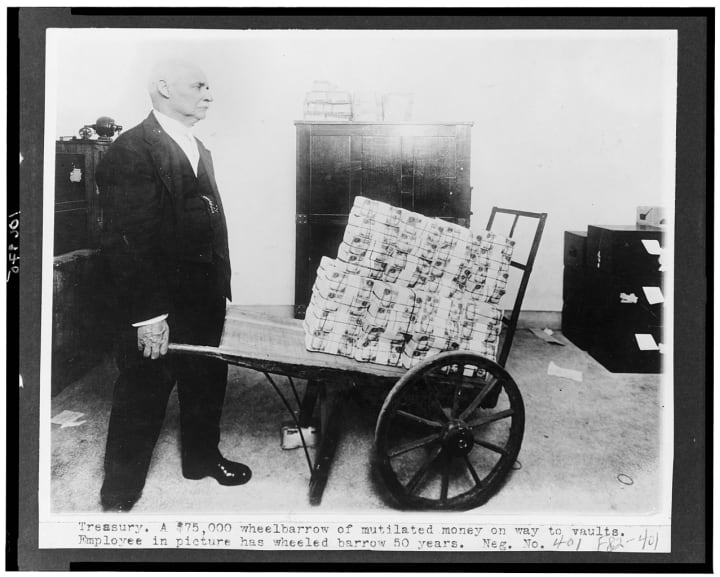
Although money creation could expedite inflation, it was not the cause of the historical examples that most people cite, such as Weimar Germany and Zimbabwe. Rather, the inflation was caused by supply shortages, or foreign debt, and money was created after to maintain the public sector.
The causation is that inflation increases the nominal need for cash and reserves, not that increased cash causes inflation. — Warren Mosler (hedge fund executive and professor of economics)
We can describe inflation with the equation, MV = Py. While increasing the money supply (M) could increase prices (P), the money may be saved, reducing the rate of spending (V). Alternatively, if the money is spent, businesses will seek to accumulate it by hiring workers and producing more goods and services (y). In either case, prices do not increase.
Inflation can occur if there is a lack of resources or labor, which is why it's usually a supply issue, and why quintupling the money supply in the past thirty years has not brought about Armageddon.
The National "Debt" Is Not Debt
A national "debt" of more than $35 trillion sounds scary. So scary that people are paid great deals of money to tell you how scary it is. The more afraid you get, the less likely you are to want public healthcare or climate action. How could we possibly afford that?
Much of this "debt" is Treasuries, which are savings accounts with the U.S. government that earn interest. Countries like China and Japan buy Treasuries because they earn dollars through trade and have nowhere better to put them. What this tells us is:
- Holders of U.S. "debt" do not want it repaid for the same reason that you don't want your bank to close your savings account.
- The government does not need the money. It creates all that it needs, and it created every dollar that has since been used to buy Treasuries.
- If the government wants to eliminate this "debt" it can phase out Treasuries and deposit the money into checking accounts.
- If anyone wants to withdraw their money, the government can create/print the withdrawal amount and give it to them (see video).
So the national "debt" is not a debt. When the government creates money, it offers people the chance to buy Treasuries of equal value. These Treasuries, plus cash left in the economy, are the money supply (the total of every budget deficit in history). Eliminating it, such as with less spending and more taxation would eliminate the money supply.
Nevertheless, fear-mongering about the "debt" has persisted for at least 88 years, when it was a thousand times smaller (see video). Normally, when someone predicts the apocalypse, they are discredited when their prediction fails.
Budget Surpluses Cause Recessions
A budget deficit occurs when the government has created and spent more money into the economy than it has removed in taxes. A budget deficit therefore puts more money into your pocket than it takes out.
A budget surplus occurs when more money is taxed out of your pocket than is spent in. This is not good for you, and it doesn't help the government either because taxes are not saved. But that doesn't stop corrupt politicians from appealing to popular intuitions about "saving for a rainy day" or the fact that surplus sounds positive and deficit sounds negative.
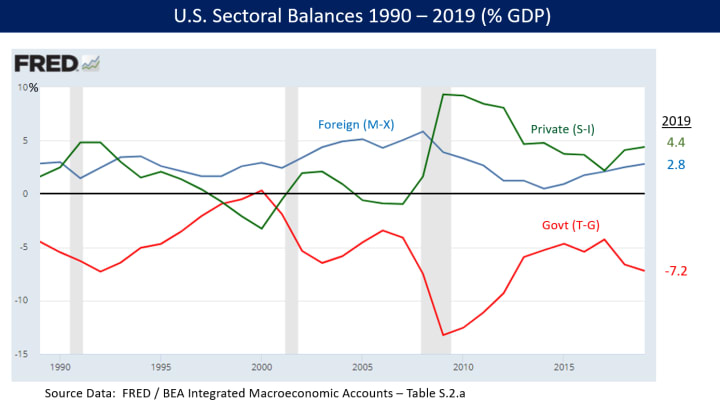
Politicians do this to discourage social spending. Furthermore, attempts to "balance the budget" or have a budget surplus cause cash-strapped people to accumulate private debt (i.e., real debt) that is held by the wealthy donors of these politicians. Unfortunately, this situation (see graph when the green line drops below zero) almost always triggers a recession (shaded areas of the graph).
Why Learning Economics Is Important
Every time a policy is proposed that could save lives, such as public healthcare or climate action, it is belittled with the following eight words: "how are you going to pay for it?"
Liberals propose taxes or cuts that conservatives disagree with, and the two sides have argued about these imaginary financial constraints for decades while millions have died.
The truth is that the government has no financial constraints. It only has resource constraints and the risk that its spending might cause a demand for resources that exceeds the economy's productive capacity (inflation). However, there is nearly always room to expand that capacity with construction, imports, education, and innovation.
In recent years, Modern Monetary Theory (MMT) and its advocates have popularized and informed people about the ideas presented here. Eventually, these ideas could transform society, causing it to focus less on the importance of money and more on what can be achieved with the real resources at its disposal.
It is no coincidence that every modern historical triumph, from reaching space to winning WW2, acknowledged the triviality of money. We did not say "we can't afford to fight Germany." Rather, we looked at what we could do with the resources we had and used money to incentivize people to contribute. A government can create as much incentive as it wants.
In my view, our collective understanding of these paradigm-changing ideas will bring about the greatest societal change of the 21st century. The imaginary financial constraints that our leadership class places upon itself will be removed. Instead of “we can’t afford that” we will say “how do we resource that?” and reduce suffering on a massive scale.
Of course, MMT already has its critics. Typically, they either do not understand the theory or do not want you to understand it. They create straw man versions to make it appear unreasonable, uncomplicated, and not the work of highly-credentialed academics and economists.
For example, you may have heard that MMT is "just about printing money,” that the theory does not consider inflation, or that it can only work while the dollar is the world's currency (the framework applies to any currency-issuing nation).
Many of these critics have careers or ideologies that have been sustained by their support for economic models that cause a recession every ten years. Other critics have reservations about what will happen to human society if these ideas become popular. Others are wedded to conspiracy theories that impede their ability to process the information.
Dispensing with the intuitive economic falsehoods that you have grown up with should not be entrusted to people whose careers or egos are sustained by them. Rather, MMT should be learned from the academics who developed the theory, such as those listed below.
Sources
- Kelton, S. (2020). The Deficit Myth: Modern Monetary Theory and How to Build a Better Economy. John Murray.
- Mitchell, W., Wray, L. R., & Watts, M. (2019). Macroeconomics. Bloomsbury Academic.
- Wray, L. R. (2022). Making Money Work for Us: How MMT Can Save America. Polity.
About the Creator
Thomas Swan
I am a scientist with the unusual distinction of having two PhDs (astrophysics, psychology of religion). My evidence-based work also covers social and political issues, macroeconomics (MMT), and the future of Western civilization.
Keep reading
More stories from Thomas Swan and writers in Education and other communities.
Tribalism in Politics: How to Spot a Partisan
To chart the moral decay of a culture, look no further than the rise of tribalism in its politics. For example, Western culture used to value democracy, compassion, justice, honesty, world peace, and free speech. Now, these principles are partitioned between two political tribes who only adopt them when it's convenient.
By Thomas Swan11 months ago in Humans
How Data and Analytics Are Powering Hospitality Marketplace Growth
The hospitality marketplace is evolving fast, and success now depends on more than great service and competitive pricing. Platforms, hotels, vacation rentals, and travel brands are leaning on data and analytics to make smarter decisions, improve guest satisfaction, and stay ahead of shifting demand. From pricing to personalization, analytics is shaping how businesses attract customers and increase revenue.
By Jason Nissen5 days ago in Education
Ai Basics Everyone Should Know for the Future
Artificial Intelligence (AI) is no longer a distant concept reserved for scientists or tech companies. It’s already shaping how we work, learn, communicate, and make decisions. From recommendation systems on streaming platforms to AI assistants that help write emails, analyze data, or generate images, AI has quietly become part of everyday life.
By Anthony Bahamonde8 days ago in Education
Affection and Healing for Yourself
During the night of the last quarter moon, I gathered my ritual supplies. I carefully handled the chunk of black tourmaline that would protect me from your overall negative and narcissistic energy. I carefully walked the house with my stick of selenite in hand, asking the universe to cleanse our working space.
By Alisha Wilkins ✒️🦋🖋️7 days ago in Fiction


Comments (4)
Thomas, I think you make a number of basic errors in your article - particularly on the subject of MMT. You might want to have a look at this short pamphlet which is highly critical of what it calls the "thin air" theory of modern banking https://www.worldsocialism.org/spgb/pamphlet/the-magic-money-myth/
Hi Thomas. Congratulations on a well-written article—I’d like to qualify a couple of points if you don’t mind. And please correct me where you think I’m wrong, as, like you, I’m striving to understand our monetary system as fully as possible before taking the bold step of educating the public. I recently revisited Stephanie Kelton’s paper, Can Taxes and Bonds Finance Government Spending?, as I found it difficult to absorb the first time, especially as a non-academic. While many aspects of MMT have helped me grasp monetary policy, the claim that taxes and bonds don’t fund government spending has always left me somewhat vexed. This uncertainty has kept me from being a more vocal proponent of MMT’s claims. A common example cited by MMT advocates—including the one you shared—is the 60 Minutes interview with Ben Bernanke. Around the 8-minute mark, he states that it wasn’t taxpayer money the Fed was using, but rather that the Federal Reserve simply marked up accounts with keystrokes. However, if you watch the full interview, you’ll notice he seems to contradict this in earlier comments. I used to think even Bernanke was confused, but in reality, he’s referring to two distinct types of monetary actions—one by the Fed and the other by the Treasury (via the TGA). At around the 5-minute, 40-second mark, Bernanke states that he was “angry that taxpayers had to bail out AIG.” In this instance, he’s referring to the U.S. government using taxpayer funds—specifically through the Troubled Asset Relief Program (TARP)—to rescue AIG and other “too big to fail” institutions. This was a direct use of taxpayer money to stabilize the financial system, as the payments came from the Treasury General Account (TGA). Later in the interview, Bernanke clarifies that when the Federal Reserve injects reserves into the banking system, it’s not using taxpayer money (the clip you shared). Instead, the Fed creates new money electronically—through quantitative easing (QE) or open market operations—to purchase assets or lend to banks. This money isn’t drawn from taxpayers but is newly created by the Fed, which operates independently of the Treasury. I believe this distinction needs to be better understood within the MMT community. Many MMT proponents seem to believe that all government spending involves the creation of new money, as they argue that taxes are “destroyed” once they leave the private banking system. However, if you follow the rules governing the TGA—where all government spending originates—this simply isn’t possible. The TGA can’t run a negative balance, and the only way it can fund itself is through taxation and bond sales. Since the Fed is prohibited from directly monetizing the debt (the Federal Reserve Act), this means that all government spending must come from taxes and bond proceeds. No new money is created when the TGA spends—new money creation only occurs when the Fed engages in QE. While this is an unnecessary, self-imposed restriction, it remains the way the system currently operates. You might also find this interview with Warren Mosler interesting. At around the 26:57 mark, he states that claiming “taxes don’t fund spending” has been a useful fiction for drawing people to MMT, but that you won’t hear him making that claim himself. https://mmt101.substack.com/p/warren-mosler-on-the-origins-of-modern?r=n5fhc&utm_medium=ios&triedRedirect=true Looking forward to your thoughts! Mark
Concise summary of MMT that ruins it all right out the gates by linking it with "climate action" - a talking point that is promoted by the corporate entertainment media, coddled academics & politicians, the exact same groups who lie and misinform about economics. And worse yet, it's repeated over and over. It has absolutely nothing to do with MMT and discredits the author in an instant. 99% of the audience you're trying to convert will stop reading right then and there, guaranteed. This is exactly how and why MMT gets such a bad rep. Keep your activist opinions out of MMT, you can address those on some climate subreddit for boomers or high schoolers.
Great article. Very well said, and easy for people digest. I will be sharing this often!