
PANGOLINS.
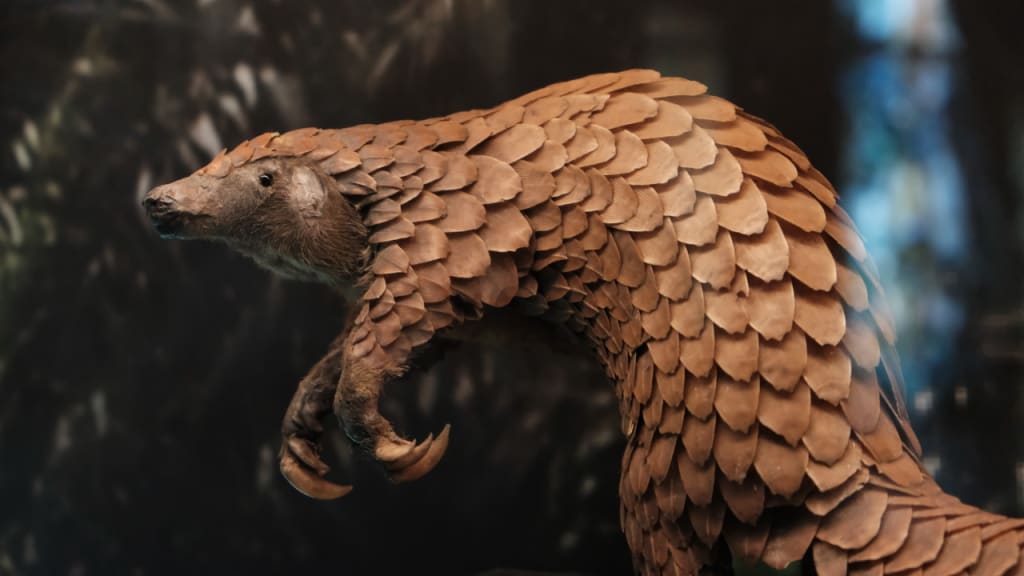
In today's article, we are going to discuss Pangolins. They are mammals wholly covered in scales and they use those scales to protect themselves from predators in the wild. If under threat, a pangolin will immediately curl into a tight ball and will use its sharp-scaled tails to defend itself.
The pangolins are typically found in parts of Africa and different tropical parts of Asia. pangolins are very unique looking. They have a couple different kinds of common names, sometimes they're called "the walking artichoke" or "anteater pine cones" because that's basically what they look like.
CHARACTERISTICS OF PANGOLINS.
They are covered in keratin scales and keratin, So they have this armor that covers the entirety of their body excluding their soft bellies. It acts as an armored defense against predators. They have really long tails that they can curl over their heads when they're threatened and they kind of hide in these little balls and the scales on their tail are serrated to a certain extent so they also will wiggle their tails around and act as a weapon.
Another reason I really like pangolins is that they are one of the only mammals that walk bipedally. You might notice that they have really formidable-looking claws on their forelimbs but they don't really use these for fighting and their claws are a little bit brittle, so they walk without putting any pressure on them, they kind of tuck them under their bodies and then they'll hobble when they walk and use their tail to help them balance, so they kinda look like little hobbits.
They use these claws for digging into termite and anthill mounds. A single pangolin can consume up to 70 million ants by itself annually and they do this because they have the longest tongue relative to its body size of any other mammal.
Their tongue is so long that it has muscle attachments on its pelvis. So they use this really long tongue to stick it all the way down into these anthills and suck up all these other ants; they don't have any teeth, so they will ingest rocks and other kinds of hard materials that help to grind up the ants in their stomachs.
Even though they are primarily ant eaters, they aren't actually "anteaters" as you might know them, they are in totally different orders than the giant anteater or even armadillos. They're kind of like a mash-up between an armadillo and an anteater but they're physiologically so unique that they're in their own order. As they are right now, pangolins aren't on any kind of threatened or endangered species list but, um, hopefully, that will change sometime soon, because they've been subjected to a lot of poaching and illegal trafficking.
For one thing, their meat is considered a delicacy so they're hunted freely without any kind of legal implications. Their scales--their keratin scales are also being used in Eastern medicine and as we know from learning about rhino horns and rhino poaching, keratin has no medicinal value whatsoever. It's a little unfortunate that that's a misconception and it's leading to a fast population decline with these species.
However, with awareness, we can hopefully change that because pangolins are awesome and I would love to see one someday In-person.
Pangolins lifespan.
Pangolin life span is unknown though they have reportedly lived as long as twenty years in captivity.
In conclusion, Pangolins are threatened by wildlife crime. You can help by joining a Stop Wildlife Crime campaign and pledging to protect endangered species, including the pangolin.
About the Creator
Keep reading
More stories from Damaris Kabura and writers in Education and other communities.
The beauty of nature
MOTHS AND BUTTERFLIES Moths aren't commonly associated with gastrointestinal problems, so you might want to see a doctor if you experience one. And it's OK to say that you're attracted to something like a firefly to a flame because both phenomena have their own unique attractions.
By Damaris Kabura 3 years ago in Education
The Blue Ridge Stalker
Tom had left the Ford down the way, its spark plugs finally exhausted and no mechanics for a dozen miles back through the foothills to Strossburg. No matter, he had worn his boots—almost as if he planned for this to happen. The puzzle he sought to solve emanated from the woods clinging to the slopes above; the valley behind held no mysteries.
By Stephen A. Roddewig6 days ago in Fiction


Comments
There are no comments for this story
Be the first to respond and start the conversation.