
Why IT Hiring Struggles Despite Plenty of Available Talent
How skills mismatches, rising expectations, and rapid tech shifts are keeping roles open in a talent-rich market

Companies have very well discovered that their open roles are unfilled, not because talent has suddenly vanished. It’s because their expectations have drifted away from what the available workforce can realistically deliver.
The Techreviewer’s IT labor market research outlines that the central issue is not the scarcity of professionals. 71.6% of respondents feel that tech talent is largely available. Rather, the issue is a pretty evident mismatch between current skills and employer requirements. And it’s further amplified by rapid technology shifts.
Here, structured upskilling and competency-focused recruitment can significantly improve placement outcomes for employers with retraining initiatives. Also, around 83.6% IT services firms believe upskilling is viable and cost-effective, compared to new hires in this tech climate.
This solution is quite practical: align the firm’s expectations and ultimately invest in workforce upskilling. Looking ahead, it may be wiser to redesign hiring processes around validated skills rather than fixate on inflated wish lists. The article sheds more light on Techreviewers' research and on how employers can effectively adapt the available candidate pools to IT profiles.
A Market That Looked Stable, But Was It?
Here’s the issue: Despite steady demand, with around 43.3% of employers reporting a rise, IT job growth signaled caution rather than expansion. In fact, Techreviewer’s findings also show continued hiring difficulty, especially in advanced roles (with 22.4% of respondents dissatisfied). And this is regardless of having a steady and available applicant flow, as per 71.6% employers.
The findings also divulge how overall hiring volumes remained active across software development and infrastructure roles. Nevertheless, the deeper metrics revealed a strain with prolonged time-to-hire for specialized positions. For instance, high-skilled roles such as AI-driven development and cloud engineering. These advanced roles now require grueling recruitment cycles, when compared to general IT positions.
So applicant numbers have increased in certain segments, for sure. But the hiring conversion rates did not rise proportionally. This gap points directly to challenges in aligning skills with requirements rather than to talent pipeline shortages.
The Skills Gap Hiding Behind the Numbers
Today, the skills discussion has shifted from broad shortages to deficiencies in skill depth. Even more so, with professionals who have foundational coding or infrastructure knowledge but are not ready for real-world execution. When, in fact, what employers actually need is execution-ready expertise in emerging tech systems.
According to Techreviewer’s findings, there’s a rising demand in:
- Artificial intelligence and machine learning integration
- Cloud-native architecture
- Frameworks for advanced cybersecurity
- DevOps automation pipelines
At the same time, hiring managers struggle to verify hands-on experience, particularly in these advanced areas. Candidates tend to list exposure, but often lack demonstrable project depth.
This gap, in turn, reflects a hybrid skill demand. Where technical proficiency must combine with operational adaptability.
Remote Work: Changing the Rules, Not Standards
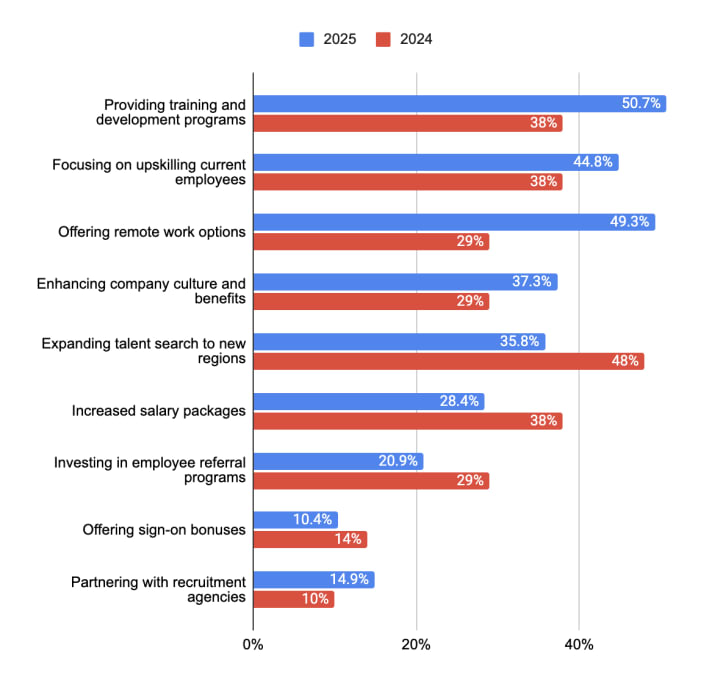
Remote hiring has clearly expanded candidate sourcing options throughout 2025, reaching 49.3%. Previously, it was only 29.0%. Also, there’s a deliberate openness to distributed teams, particularly for software development and DevOps roles.
This flexibility is unlikely to translate into lower expectations for skill set and job readiness. Companies have, instead, widened their geographic reach while maintaining strict skill benchmarks.
But even remote-first hiring can majorly improve access to mid-level engineers. The highly specialized AI and cybersecurity roles remain difficult to fill, regardless of location flexibility.
Upskilling: A Strategic Necessity
Looking closely, there’s also a shift from reactive hiring to proactive talent development. Hence, the survey also shows an increasing investment by employers in structured training programs. That too, with 50.7% employers invested in training and development programs.
These are the priority zones:
- Training or reskilling workshops that focus on cloud migration
- Training for better AI integration
- Cross-functional coaching for DevOps
Validated training pathways can help improve retention and performance outcomes. Instead of simply chasing perfect-on-paper external candidates, firms have now started cultivating capability from the talent they already have internally.
This approach directly addresses the primary pain point. If the IT labor market cannot instantly produce advanced and relevantly trained specialists, companies must build them internally.
Retention Overtook Aggressive Expansion
One more defining shift is the high focus on retention. Techreviewer’s reports examine how companies have increasingly prioritized retaining experienced engineers. Moreover, this is prioritized over rapid external expansion. Check out these retention strategies:
- Clear technical growth paths. A defined progression map helps remove guesswork and replace it with direction.
- Sponsored advanced certifications. Funding employees' credentials typically signals their long-term commitment. It also tells employees their expertise is worth deepening, not replacing.
- Flexible work models. When employees have autonomy over work location and schedule, it builds trust and then productivity may follow suit.
- Role redesign around evolving tools. Presently, instead of forcing talent to fit outdated job descriptions, companies are keen on reshaping the roles to match the modern tech stacks. It can help keep the candidate skills relevant and teams more engaged.
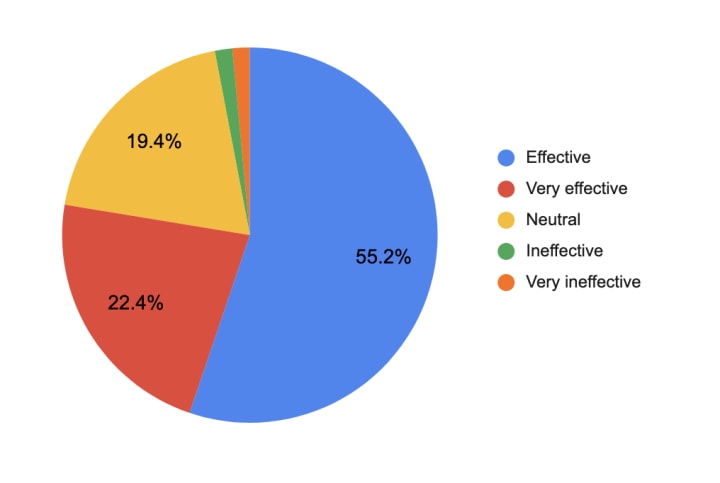
In practical terms, companies in 2026 have recognized that replacing specialized professionals is much harder than retraining their existing talent. Retention can work more as a defensive strategy against the ever-widening skills gap, with 77.6% of respondents rating their strategies as working.
The Demand: Moving From 2025 to 2026
According to Techreviewer’s research and common knowledge, demand for AI-enabled systems, cybersecurity infrastructure, and cloud modernization is set to rise. Further, the pattern is also consistent: skill and experience depth matter more than mere breadth in employee numbers.
Resultantly, the future demand will likely concentrate on those employees and firms who combine:
- Advanced technical specialization within their tech/IT teams
- Effective cross-team collaboration skills
- The ability to quickly adapt to the required tool stacks, even as they evolve with tech advancement
Conclusion
The IT labor market shows that the talent undoubtedly exists. Though the job expectations have escalated faster than the skills have evolved. There’s a need for better alignment, more flexibility, and sustained workforce upskilling.
Plus, remote access broadens reach, but structured development is what can help close the capability gaps. With these factors in focus, hiring success may really be achievable.
About the Creator
Keep reading
More stories from Techreviewer and writers in Education and other communities.
AI in Development Workflows: Balancing Speed, Security, and Responsibility
AI is changing how software engineers build and deliver solutions at an incredible rate. With more than 84% of developers using AI, according to Techreviewer’s research, it’s obvious that it’s now commonplace. From helping developers write code to debugging, it streamlines the entire development process.
By Techreviewer3 months ago in 01
Why Textile Recycling Is Becoming Essential for Sustainable Fashion?
In the global fashion and textile industry, one of the biggest recent developments in creating a more sustainable system has been the creation of more textile recycling capacity and initiatives․ Companies and consumers are beginning to realize there are greater benefits to recycling discarded clothing and fabric scraps rather than throwing them away․
By deepanshu Thakur5 days ago in Education
Train Bold: How High Performers Use Fitness to Stay Focused and Fearless
High achievers rarely leave their success to chance. They build daily habits that sharpen the mind and strengthen the body. One of the most powerful habits they rely on is movement. In fact, how high performers use fitness to stay focused and fearless is not a mystery. It is a repeatable system built on simple actions. They train with purpose, and that purpose shapes their thinking, their energy, and their courage.
By Richard Ceffalio Jr.6 days ago in Education




Comments
There are no comments for this story
Be the first to respond and start the conversation.