
Why Does Time Slow Down Near Massive Objects?
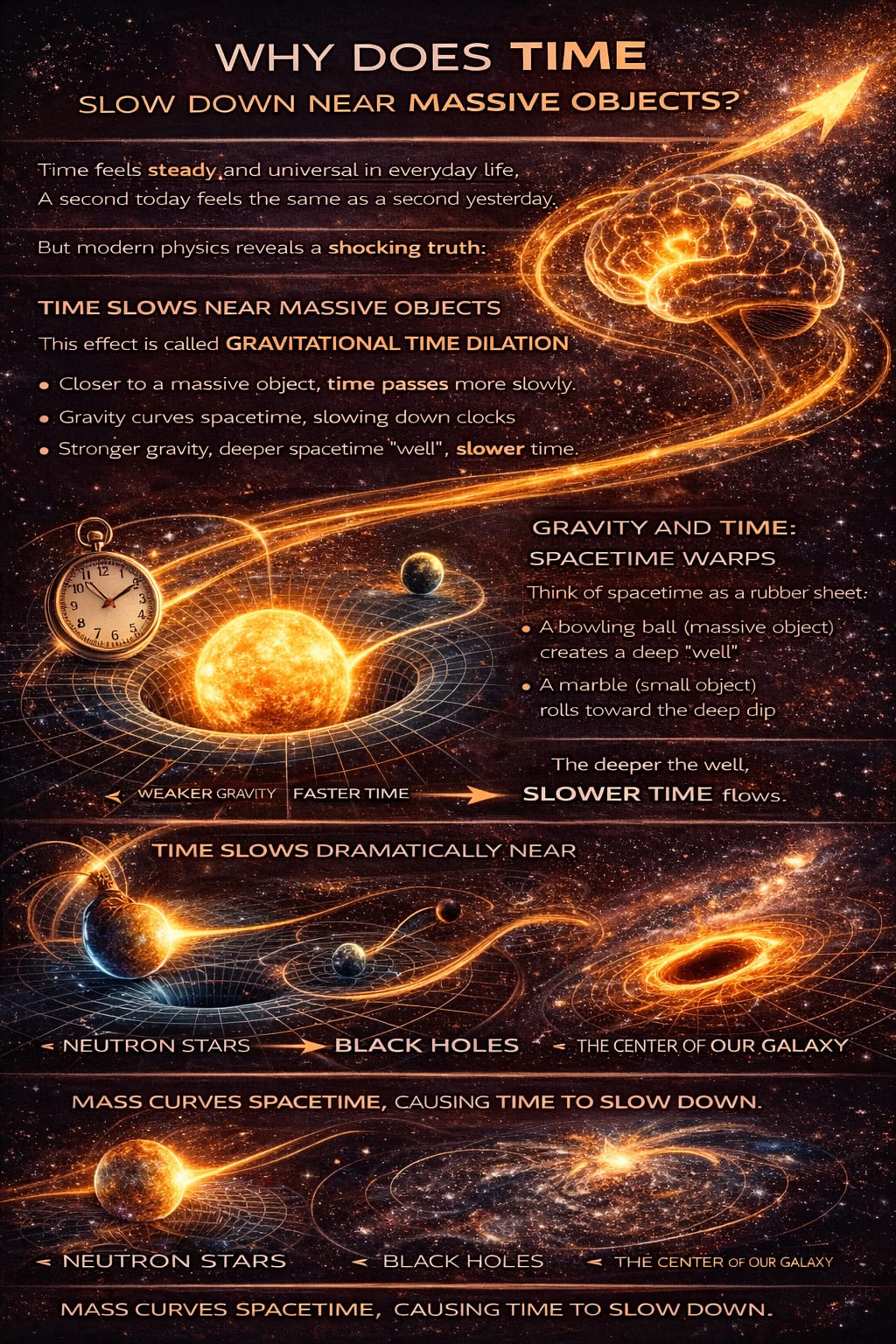
Time feels steady and universal in everyday life. A second today feels the same as a second yesterday. But modern physics reveals a shocking truth: time does not flow at the same rate everywhere in the universe. Near massive objects such as planets, stars, neutron stars, and black holes, time actually moves slower compared to regions with weaker gravity. This strange effect, known as gravitational time dilation, is one of the most fascinating predictions of Einstein’s theory of relativity—and it has been experimentally confirmed many times. So why does mass affect time? How does gravity slow down clocks? And what does this tell us about the nature of reality? Let’s explore the physics behind one of the universe’s most mind-bending phenomena

The Old View: Time as Absolute
Before the 20th century, scientists believed time was absolute.
Newton’s Concept of Time
• Time flows uniformly everywhere
• It is independent of matter and space
• All observers share the same universal clock
This idea worked well for everyday physics, but it failed when dealing with extreme speeds and strong gravity.
________________________________________
Einstein’s Revolutionary Insight
Albert Einstein changed our understanding of time forever through his theories of relativity.
• Special Relativity (1905) showed that time depends on speed
• General Relativity (1915) revealed that time depends on gravity
Time was no longer separate from the universe—it became part of its structure.
________________________________________
Spacetime: Space and Time United
Einstein showed that space and time are not independent. They form a four-dimensional structure called spacetime.
Key Idea
• Mass and energy curve spacetime
• Objects move along paths in this curved spacetime
• Time itself is affected by this curvature
Gravity is not just a force—it is the bending of spacetime.
________________________________________
What Is Gravitational Time Dilation?
Gravitational time dilation means:
The stronger the gravitational field, the slower time passes.
A clock closer to a massive object ticks more slowly than a clock farther away.
This effect is tiny near Earth but becomes dramatic near extremely dense objects.
________________________________________
Why Mass Slows Time
Massive objects warp spacetime more strongly.
Deeper Gravity = Slower Time
• More mass → stronger spacetime curvature
• Stronger curvature → slower passage of time
• Time stretches in gravitational “wells”
In simple terms, gravity changes how fast time flows.
________________________________________
An Everyday Analogy
Imagine spacetime as a stretched rubber sheet.
• A heavy bowling ball creates a deep dip
• A marble rolling nearby follows a curved path
• The deeper the dip, the stronger the effect
Mass creates dents in spacetime—and time slows inside those dents.
________________________________________
Light, Gravity, and Time
Light plays a crucial role in understanding time dilation.
Gravitational Redshift
• Light climbing out of gravity loses energy
• Its wavelength stretches toward red
• This indicates slower time at the source
If time didn’t slow down, energy conservation would be violated.
________________________________________
Time and the Speed of Light
The speed of light is constant for all observers.
To maintain this:
• Space can stretch
• Time can slow
• Or both
Near massive objects, time slows to preserve the cosmic speed limit.
________________________________________
Einstein’s Equations and Time
Einstein’s field equations directly link:
• Mass and energy
• Spacetime curvature
• The flow of time
Gravitational time dilation is not optional—it is mathematically inevitable.
________________________________________
Experimental Proof of Time Slowing Down
Gravitational time dilation is not theoretical—it is measured.
Key Experiments
• Atomic clocks placed at different altitudes
• Clocks flown on airplanes
• Satellite timing measurements
All confirm that clocks closer to Earth run more slowly.
________________________________________
Time Slows Down on Earth Too
Even everyday gravity affects time.
• A clock at sea level ticks slower than one on a mountain
• Your feet age slightly slower than your head
• The difference is tiny—but real
Gravity affects time everywhere.
________________________________________
GPS Depends on Time Dilation
Global Positioning System satellites rely on relativity.
Why It Matters
• Satellites experience weaker gravity
• Their clocks tick faster than Earth clocks
• Without correction, GPS errors would grow rapidly
Relativity keeps navigation accurate.
________________________________________
Time Near Neutron Stars
Neutron stars are incredibly dense.
• Mass greater than the Sun
• Diameter of a city
• Enormous gravitational pull
A clock on a neutron star would tick much slower than one on Earth.
________________________________________
Time Near Black Holes
Black holes represent extreme gravity.
Near the Event Horizon
• Time slows dramatically
• From far away, clocks appear to freeze
• Light struggles to escape
This creates the illusion that time stops.
________________________________________
Does Time Actually Stop at a Black Hole?
It depends on perspective.
For a Distant Observer
• Time near the horizon appears frozen
• Objects never seem to cross
For a Falling Observer
• Time flows normally
• The event horizon is crossed smoothly
Time is relative—not absolute.
________________________________________
Inside the Black Hole
Inside a black hole:
• All paths lead toward the center
• The singularity lies in the future
• Time becomes unavoidable rather than frozen
Time does not stop—it becomes directional.
________________________________________
Gravity vs Speed: Two Ways Time Slows
There are two types of time dilation:
1. Velocity Time Dilation
• Due to motion
• Faster speed → slower time
2. Gravitational Time Dilation
• Due to gravity
• Stronger gravity → slower time
Both effects are real and measurable.
________________________________________
Why We Don’t Notice Time Slowing
Human senses are not precise enough.
• Effects are extremely small at Earth’s gravity
• Atomic clocks are required to detect them
• Daily life hides relativistic effects
Physics reveals what senses cannot.
________________________________________
Time Is Not Universal
Einstein taught us a profound lesson:
There is no single universal “now.”
Different observers experience time differently depending on:
• Gravity
• Speed
• Position in spacetime
Time is personal to each path through the universe.
________________________________________
Is Time an Illusion?
Time is real—but not absolute.
• It stretches and slows
• It depends on gravity and motion
• It is woven into spacetime
The flow of time feels constant only because gravity around us is nearly uniform.
________________________________________
Why This Matters for the Universe
Gravitational time dilation affects:
• Star evolution
• Black hole physics
• Cosmology
• The fate of the universe
Understanding time is essential to understanding reality.
________________________________________
Philosophical Implications
If time depends on gravity:
• Past, present, and future are not universal
• The universe is a four-dimensional structure
• Reality is deeper than human intuition
Physics reshapes how we see existence.
________________________________________
Does Gravity Create Time?
Gravity does not create time—but it shapes how time flows.
Matter tells spacetime how to curve, and spacetime tells matter how to move.
Time is part of this cosmic dialogue.
________________________________________
Why This Discovery Changed Physics
Gravitational time dilation:
• Confirmed general relativity
• Enabled modern technology
• Revealed spacetime’s true nature
It shows that time is not separate from the universe—it is part of it.
________________________________________
Conclusion: Why Time Slows Near Massive Objects
Time slows near massive objects because mass curves spacetime, and time is inseparable from that curvature. Gravity doesn’t just pull objects—it reshapes the flow of time itself.
Near planets, the effect is tiny.
Near stars, it is measurable.
Near black holes, it becomes extreme.
Time is not a universal clock ticking across the cosmos. It is a flexible dimension shaped by mass, motion, and energy.
And the closer you get to gravity’s deepest wells, the slower time flows.
About the Creator
Keep reading
More stories from shahkar jalal and writers in Education and other communities.
Bridging Strategy and Growth: The Synergy of Financial Planning and Investment Management
Achieving long-term financial security requires more than simply saving money or picking promising stocks. It demands a thoughtful strategy that connects day-to-day financial decisions with long-term aspirations. Financial planning and investment management represent two essential pillars of this strategy. When they work together, they create a cohesive framework that supports sustainable wealth-building.
By Winston Feng6 days ago in Education
How I Learned to Calm My Mind
For a long time, my mind never felt truly at rest. Even when everything around me was calm, my thoughts were not. They rushed from one worry to another like waves that never stopped moving. I would think about the past, replaying old mistakes, or I would jump into the future, worrying about things that had not even happened yet. I did not realize at first that this was not just “normal stress.” It was my mind asking for care and attention.
By Haroon Pasha7 days ago in Education




Comments
There are no comments for this story
Be the first to respond and start the conversation.