
Is Time an Illusion Created by the Human Brain?
Time feels undeniable. Seconds tick, days pass, memories fade, and futures unfold. We schedule our lives around clocks, age with birthdays, and measure existence in moments. Yet one of the most provocative questions in modern science and philosophy is this: Is time real—or is it an illusion created by the human brain? Physicists, neuroscientists, and philosophers have all wrestled with this question. Some argue that time is a fundamental part of the universe. Others suggest it is an emergent concept—something that arises from how our brains process change. To understand whether time is an illusion, we must explore physics, neuroscience, psychology, and cosmology.

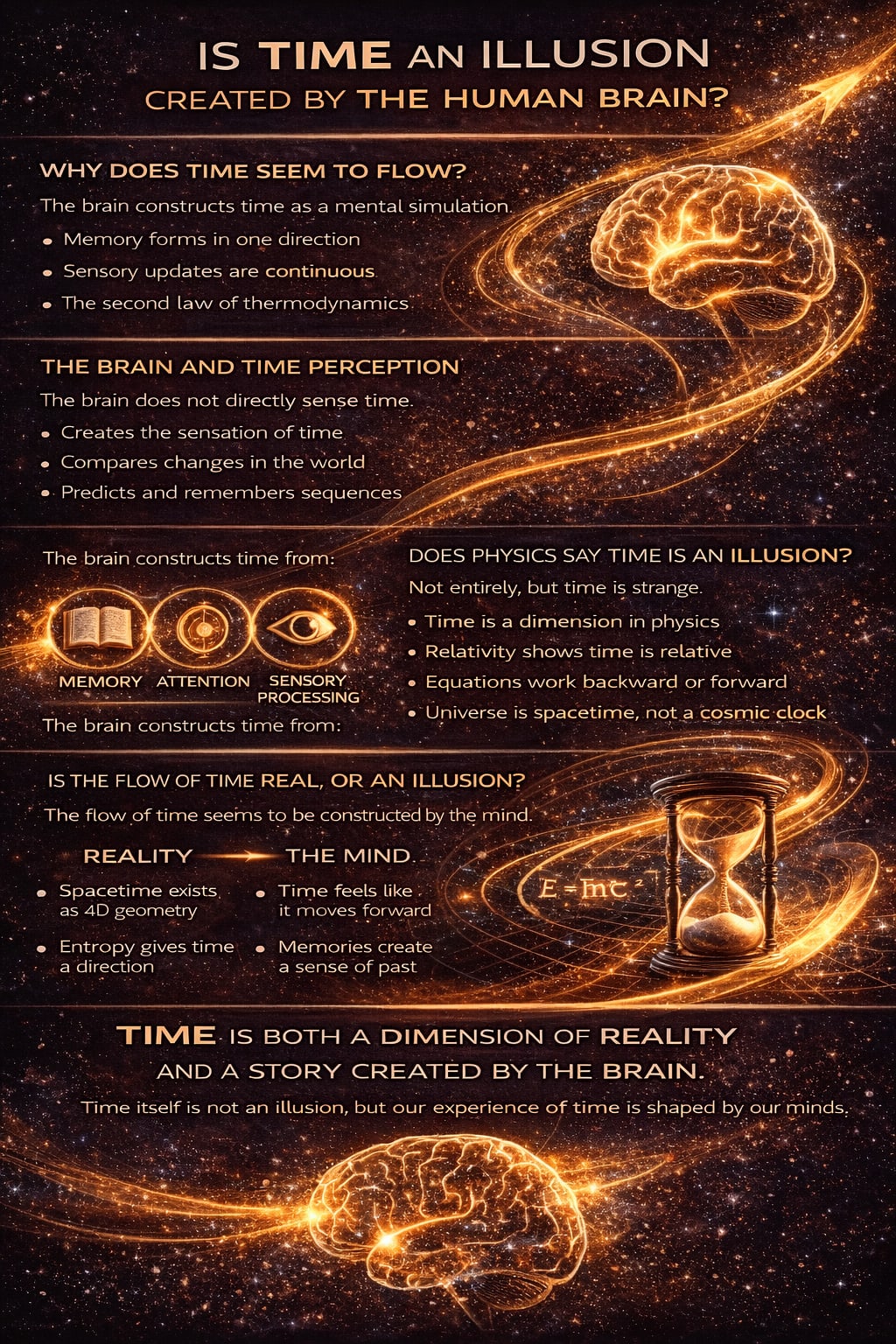
What Do We Mean by “Time”?
Before asking whether time is an illusion, we must define it.
In everyday life, time means:
• A sequence of moments
• A flow from past to future
• A way to measure change
In physics, time is:
• A dimension, like space
• A variable in equations
• A coordinate in spacetime
Already, we see that “time” means different things in different contexts.
________________________________________
The Human Experience of Time
Our experience of time is deeply psychological.
Subjective Time
• Time feels fast when we are busy
• Time feels slow when we are bored or afraid
• Memories compress long periods into brief impressions
This suggests that our perception of time is flexible, not fixed.
________________________________________
How the Brain Creates Time Perception
The brain does not contain a single “time organ.”
Instead, time perception emerges from:
• Memory
• Attention
• Sensory processing
• Neural rhythms
The brain constructs a sense of time by comparing changes.
________________________________________
The Present Moment Is Not Instantaneous
Neuroscience shows that:
• The brain integrates information over short intervals
• The “present” lasts a fraction of a second
• Conscious awareness lags behind reality slightly
What we call “now” is a mental construction.
________________________________________
Why Time Feels Like It Flows
The sensation of time flowing comes from:
• Continuous sensory updates
• Memory accumulation
• Entropy increase in the brain
The brain creates a narrative of change—and we call it time.
________________________________________
Memory and the Arrow of Time
We remember the past but not the future.
Why?
Because memory formation:
• Requires energy
• Increases entropy
• Leaves physical traces in the brain
This gives our experience of time a direction.
________________________________________
Psychological Arrow vs Physical Time
The psychological arrow of time aligns with the thermodynamic arrow of time.
• Entropy increases
• Records accumulate
• Causes precede effects
Our brains evolved to track this direction.
________________________________________
Does Physics Say Time Is an Illusion?
Physics gives a more complicated answer.
________________________________________
Time in Classical Physics
In Newtonian physics:
• Time is absolute
• It flows the same everywhere
• It exists independently of observers
This view is now known to be incomplete.
________________________________________
Einstein and the End of Absolute Time
Einstein’s theories of relativity transformed time.
Key Discoveries
• Time depends on motion
• Time depends on gravity
• There is no universal “now”
Time is relative—not absolute.
________________________________________
Spacetime: Time as a Dimension
In modern physics:
• Time is fused with space into spacetime
• Events exist as points in a four-dimensional structure
• The universe can be viewed as a “block”
In this view, the past, present, and future all exist.
________________________________________
The Block Universe and the Illusion of Flow
Some physicists argue:
• The universe is timeless
• All moments exist equally
• The flow of time is a mental illusion
We move through time psychologically, not physically.
________________________________________
Is the Flow of Time Real?
Physics equations do not include a “flow” of time.
• They describe relationships between events
• They do not privilege the present moment
• “Now” has no special status in equations
This supports the idea that the feeling of time flowing is subjective.
________________________________________
Entropy: The Physical Source of Time’s Direction
Even if time itself doesn’t flow, something creates direction.
That something is entropy.
________________________________________
The Second Law of Thermodynamics
Entropy tends to increase.
This creates:
• Irreversibility
• Cause-and-effect order
• A distinction between past and future
Without entropy, time would lose meaning.
________________________________________
Is Time Just Change?
Some philosophers argue:
• Time is nothing more than change
• Without change, time would not exist
• A frozen universe would be timeless
In this view, time is a measure—not an entity.
________________________________________
Quantum Physics and Timelessness
Quantum theory deepens the mystery.
Some quantum gravity equations:
• Do not include time at all
• Treat time as emergent
• Suggest time arises from relationships between states
At the deepest level, time may not be fundamental.
________________________________________
Does the Universe Need Time?
Certain theories propose:
• The universe is fundamentally timeless
• Time emerges at large scales
• Conscious observers create temporal narratives
This is still an open scientific question.
________________________________________
Why Evolution Shaped Our Sense of Time
Our ancestors needed to:
• Predict danger
• Plan actions
• Learn from past experiences
A sense of time provided survival advantages.
The brain evolved to construct temporal order—even if time itself is not fundamental.
________________________________________
Why Time Feels Real Even If It Isn’t
Illusions can still be useful.
• Colors are brain interpretations of wavelengths
• Sound is brain interpretation of vibrations
• Time may be brain interpretation of change
Illusion does not mean false—it means constructed.
________________________________________
Is Time an Illusion or an Emergent Reality?
The most accurate answer may be both.
• Time exists in physics as a dimension
• The flow of time is a mental construct
• Direction comes from entropy
• Experience comes from the brain
Time is real—but not in the way we intuitively think.
________________________________________
Common Misconceptions
❌ Time is completely fake
❌ Physics proves time doesn’t exist
❌ Past and future are illusions
✅ Time is relative
✅ The flow of time is subjective
✅ Change and entropy give time meaning
________________________________________
What About Free Will and Time?
If time doesn’t flow:
• Does free will disappear?
• Is the future fixed?
Not necessarily.
• Quantum uncertainty remains
• Complexity limits prediction
• Experience unfolds moment by moment
Time’s nature does not erase choice.
________________________________________
Why This Question Matters
Understanding time affects:
• Physics and cosmology
• Consciousness studies
• Artificial intelligence
• Philosophy of reality
Time sits at the intersection of mind and universe.
________________________________________
Is Time Real Enough to Matter?
Whether time is fundamental or emergent:
• We live within it
• We age within it
• We remember and anticipate within it
Time structures human experience.
________________________________________
Final Answer: Is Time an Illusion Created by the Brain?
The flow of time is largely a mental construction—but time itself is not purely an illusion.
• Physics shows time does not “flow” objectively
• The brain creates the experience of passing moments
• Entropy gives time direction
• Spacetime provides structure
Time is not a ticking cosmic clock—it is a relationship between change, memory, and the laws of nature.
________________________________________
Conclusion: Time Is Real, But Not What It Seems
Time may not be a river flowing through the universe. Instead, it may be a dimension without motion, combined with a brain that creates the sensation of flow.
The universe may be timeless—but conscious beings bring time to life.
And in that sense, time is both a feature of reality and a story told by the human mind.
About the Creator
Keep reading
More stories from shahkar jalal and writers in Education and other communities.
Cutting for Impact: How Film Editing Shapes Powerful Stories Behind the Scenes
When audiences watch a great film, they rarely think about the countless decisions made in the editing room. Performances feel seamless, scenes flow naturally, and emotions rise at precisely the right moments. Yet behind this smooth experience lies a complex creative process. Film editing is often called the invisible art because, when done well, it goes unnoticed. However, its influence on storytelling is profound and far-reaching.
By Nigel Sinclairabout 20 hours ago in Education


Comments
There are no comments for this story
Be the first to respond and start the conversation.