
Why Does Anything Exist at All? Exploring the Ultimate Mystery of Reality
Why does anything exist at all? It is arguably the deepest question ever asked. Before science, before philosophy, before human language, existence was already here. Stars burned. Galaxies formed. Matter moved. Time flowed. And eventually, conscious beings emerged and began to wonder:

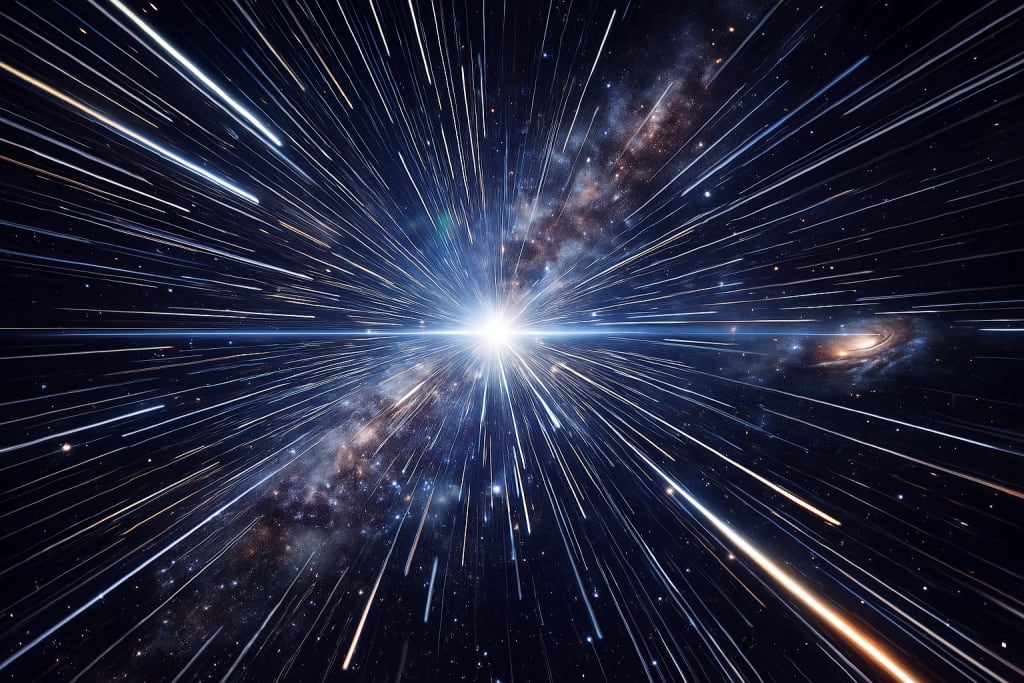
Why does anything exist at all?
Why is there something rather than nothing?
In this in-depth, SEO-optimized article, we explore whether physics can fully explain existence, what modern cosmology reveals about the origin of the universe, the limits of scientific explanation, and whether the ultimate answer may lie beyond physics itself.
________________________________________
What Does “Existence” Mean?
Before asking whether physics can explain existence, we must clarify what existence means.
Existence refers to the fact that reality is present — that matter, energy, space, time, and conscious beings are here rather than absent. It is not merely about how things behave, but why there is a universe at all.
Physics traditionally answers how questions:
• How do particles interact?
• How do stars form?
• How does gravity curve spacetime?
But the question of existence asks something deeper:
• Why are there physical laws?
• Why is there a universe governed by mathematics?
• Why is there something instead of nothing?
This shifts the discussion from mechanics to foundations.
________________________________________
The Big Bang and the Beginning of the Universe
Modern cosmology describes the universe beginning approximately 13.8 billion years ago in an event known as the Big Bang.
The Big Bang was not an explosion in space — it was the rapid expansion of space itself from an extremely hot, dense state.
According to current models:
• Space and time emerged during this early phase.
• The universe expanded and cooled.
• Matter formed from energy.
• Galaxies, stars, and planets developed over billions of years.
But even this remarkable theory does not answer the ultimate question.
It describes how the universe evolved from its earliest observable moment — not why it exists.
________________________________________
Can the Universe Come from Nothing?
Some physicists argue that the universe could arise naturally from quantum processes.
Quantum mechanics allows for fluctuations even in empty space. Tiny energy fluctuations can spontaneously create particle–antiparticle pairs.
In some cosmological models:
• The universe emerges from a quantum vacuum.
• Spacetime tunnels into existence.
• Inflation drives rapid expansion from a tiny region.
However, a quantum vacuum is not true nothing.
It still contains:
• Physical laws
• Quantum fields
• Mathematical structure
So when physics explains the universe emerging from “nothing,” it typically means a structured quantum state — not absolute nonexistence.
The deeper question remains: Why do these laws exist at all?
________________________________________
The Role of Physical Laws
Physics describes reality through mathematical laws.
Gravity follows precise equations.
Electromagnetism behaves predictably.
Quantum particles obey statistical rules.
But where do these laws come from?
Are they:
• Fundamental features of reality?
• Abstract mathematical truths?
• Necessary structures?
• Or simply brute facts?
If laws exist independently, then existence may be grounded in mathematical necessity.
If laws require explanation, then physics may not be enough.
This leads to one of the most intriguing ideas in modern thought.
________________________________________
Is Reality Fundamentally Mathematical?
Some thinkers propose that reality is inherently mathematical.
According to this view:
• The universe is not just described by mathematics.
• The universe is mathematics.
If existence is equivalent to mathematical structure, then perhaps existence requires no further explanation.
Mathematical truths do not need causes. They are logically necessary.
If physical reality is a mathematical structure, then existence may be inevitable rather than contingent.
However, this perspective remains philosophical rather than experimentally proven.
________________________________________
The Multiverse Hypothesis
Another possible explanation involves the multiverse.
Some theories suggest that:
• Our universe is one of many.
• Physical constants vary across universes.
• Universes emerge naturally from underlying laws.
If countless universes exist, then our universe may not require special explanation. It is simply one outcome among many.
However, this shifts the question rather than solving it.
Why does the multiverse exist?
Why are there underlying laws generating universes?
The chain of explanation continues.
________________________________________
Does Physics Reach a Limit?
Physics excels at describing processes within the universe.
But explaining existence itself may require stepping outside the universe — something physics cannot do.
Science operates through observation and measurement. It analyzes what exists.
If there were absolute nothing, there would be nothing to observe.
This suggests a possible limitation:
Physics may explain how existence unfolds, but not why existence is present at all.
________________________________________
Philosophical Approaches to Existence
Philosophy has long grappled with the question of existence.
Necessary Existence
Some philosophers argue that something must exist necessarily.
If nothing existed, nothing could begin to exist.
Therefore, existence may be logically unavoidable.
Contingency
Others argue that existence is contingent — it could have been otherwise.
If so, why did this particular universe come into being?
Brute Fact
Some thinkers suggest that existence may simply be a brute fact — something that requires no deeper explanation.
This possibility can feel unsatisfying, but it may reflect the limits of explanation itself.
________________________________________
Consciousness and Existence
Another dimension of the question concerns consciousness.
The universe not only exists — it is aware of itself through conscious beings.
Physics explains neural processes and brain activity. But explaining why subjective experience exists remains one of science’s greatest challenges.
If existence includes conscious awareness, then explaining existence may require explaining mind as well.
This deepens the mystery.
________________________________________
Information as the Foundation of Reality
Modern physics increasingly emphasizes information.
Black hole thermodynamics connects entropy and spacetime geometry.
Quantum theory treats particles as excitations of fields carrying information.
Some theorists propose that information is more fundamental than matter.
If reality is built from information, then existence may be the presence of informational structure.
Yet the question persists:
Why does information exist at all?
________________________________________
Could Nothing Be Impossible?
One provocative idea is that nothingness may be impossible.
If absolute nothing existed:
• There would be no laws preventing something from emerging.
• There would be no structure maintaining emptiness.
• There would be no logical framework.
Some argue that “nothing” is unstable or incoherent.
Perhaps existence is more natural than nonexistence.
If nothing cannot exist, then something must.
This would mean physics does not need to explain existence — because nonexistence was never an option.
________________________________________
The Limits of Human Understanding
Human cognition evolved to understand patterns within reality, not necessarily the origin of reality itself.
Our language assumes causation:
Everything has a cause.
Everything has an explanation.
But existence itself may not fit within causal frameworks.
If time began with the universe, then asking what caused existence may be meaningless.
Cause and effect require time.
If time emerges with the universe, then existence may not require a prior cause.
________________________________________
A Balanced Perspective
So, can physics explain existence itself?
Physics can explain:
• The evolution of the universe
• The behavior of matter and energy
• The emergence of structure
• The development of life
But when it comes to why there is something rather than nothing, physics may reach its conceptual boundary.
Some possibilities include:
• Existence is mathematically necessary.
• Nothing is impossible.
• The multiverse generates universes naturally.
• Existence is a brute fact.
At present, no definitive scientific answer exists.
________________________________________
Conclusion: The Deepest Mystery
The question of existence lies at the intersection of physics and philosophy.
Modern science has illuminated the structure of the cosmos with extraordinary precision. It has revealed quantum fields, curved spacetime, and cosmic evolution.
Yet the ultimate question remains:
Why is there anything at all?
Perhaps existence requires no explanation.
Perhaps it is logically inevitable.
Perhaps future discoveries in quantum gravity will reveal deeper insight.
Or perhaps the mystery of existence will always remain beyond the reach of physics.
What makes the question so powerful is that it touches every aspect of reality — including the mind asking it.
We are part of the universe attempting to understand why the universe exists.
And in seeking that answer, physics reaches its most profound frontier.
About the Creator
Keep reading
More stories from shahkar jalal and writers in Education and other communities.
Can Physics Explain Existence Itself? Exploring the Ultimate Question of Reality
Why does anything exist at all? Why is there something rather than nothing? In this in-depth, SEO-optimized article, we explore whether physics can fully explain existence, what modern cosmology reveals about the origin of the universe, the limits of scientific explanation, and whether the ultimate answer may lie beyond physics itself.
By shahkar jalalabout 2 hours ago in Education
When Day Turns to Night: The Longest Solar Eclipse of the Century Now Has an Official Date
The sky has always held humanity’s attention, but every so often, it offers a spectacle so rare and dramatic that it feels almost otherworldly. Soon, day will briefly turn into night as the longest solar eclipse of the century now has an official date. Astronomers and space agencies around the world are already preparing for what experts describe as an exceptional event marked by its remarkable duration and rare visibility.
By Aqib Hussain3 days ago in Education
“Why ‘Just Try Harder’ Isn’t Real Advice”
Start wri“Just try harder.” Those three words followed me longer than any lesson I ever learned. They were said with good intentions. Teachers said them when I struggled. Family members said them when I looked tired. Friends said them when I felt stuck. It sounded simple, almost comforting—as if effort alone could untangle every problem. As if all failure was just laziness wearing a disguise. But no one ever explained how to try harder when you were already giving everything you had. I remember sitting at my desk long after midnight, eyes burning, mind numb, rereading the same page again and again. I wasn’t distracted. I wasn’t careless. I was exhausted. Still, when results didn’t match expectations, the conclusion was always the same: you didn’t try hard enough. That sentence slowly carved something into me. It taught me that struggle was a personal flaw. That if I couldn’t keep up, the problem wasn’t the system, the pressure, or the circumstances—it was me. “Just try harder” ignores context. It doesn’t ask about mental health, financial stress, learning differences, or burnout. It doesn’t ask if you’re carrying responsibilities no one sees. It assumes everyone starts from the same line, with the same resources, the same energy, the same safety net. They don’t. Some people are running uphill while others are on flat ground. Some are sprinting with invisible weights tied to their ankles. Telling them to “try harder” doesn’t make the path easier—it just makes the failure feel more personal. I believed that advice for years. I doubled down. I pushed through headaches, anxiety, and constant self-doubt. I learned to ignore my limits because limits were treated like excuses. Rest felt like weakness. Asking for help felt like admitting defeat. When I couldn’t meet expectations, shame filled the gaps. I started measuring my worth by how much pain I could tolerate. If I was exhausted, it meant I was working. If I was breaking down, it meant I wasn’t strong enough yet. The problem with “just try harder” is that it only works when effort is the missing piece. But often, effort isn’t the issue—direction is. Or support. Or time. Or healing. Sometimes people don’t need more pressure. They need understanding. They need tools, not commands. They need space to fail without being labeled a disappointment. I’ve seen people burn out not because they didn’t care, but because they cared too much. They tried harder every day until trying became all they were doing. Until their lives shrank to a cycle of effort and disappointment. And when they finally collapsed, the advice didn’t change. “Push through.” “Don’t give up.” “Everyone else can do it.” But everyone else isn’t living their life. This kind of advice also teaches us to silence ourselves. To ignore our own signals. Hunger, fatigue, anxiety—those become inconveniences instead of warnings. We stop listening to what our bodies and minds are telling us because we’re afraid of being seen as weak. I wish someone had told me that struggling doesn’t mean you’re failing. That needing rest doesn’t mean you’re lazy. That trying harder is not always the answer—sometimes trying differently is. Sometimes the bravest thing you can do is stop forcing yourself into a shape you were never meant to fit. Real advice asks questions. Real advice listens. Real advice adapts. It sounds like: What’s making this hard? It sounds like: What support do you need? It sounds like: Maybe the problem isn’t you. We live in a world obsessed with grit and hustle, but allergic to nuance. It’s easier to tell someone to push than to understand why they’re struggling. It’s easier to blame individuals than to fix broken systems. So we keep repeating the same phrase, hoping it works eventually. But words matter. And “just try harder” often does more harm than help. It turns pain into silence. It turns confusion into self-blame. It turns complex human experiences into simple moral failures. I’m learning to unlearn that voice in my head. The one that says rest is weakness. The one that says my best is never enough. The one that repeats advice that was never meant to heal. Trying matters. Effort matters. But so does compassion—for others and for yourself. Because sometimes, you’re not failing. You’re just human.ting...
By Faizan Malik4 days ago in Education
The Pride Flag and the Diversion
For nearly a decade, the LGBTQIA Pride Flag rippled in the wind at Christopher Park, a kaleidoscope of color staked into the soil of America’s first national monument to LGBTQIA+ liberation. That flag came down this week. Federal officials, citing new guidance from the Trump Administration, silently lowered the rainbow flag from its pole across the street from the Stonewall Inn. The birthplace of the modern gay rights movement now flies only the United States flag.
By Tim Carmichael3 days ago in Pride



Comments
There are no comments for this story
Be the first to respond and start the conversation.