
When Day Turns to Night: The Longest Solar Eclipse of the Century Now Has an Official Date
Experts Reveal Why This Rare, Record-Breaking Eclipse Will Be One of the Most Extraordinary Celestial Events of Our Time
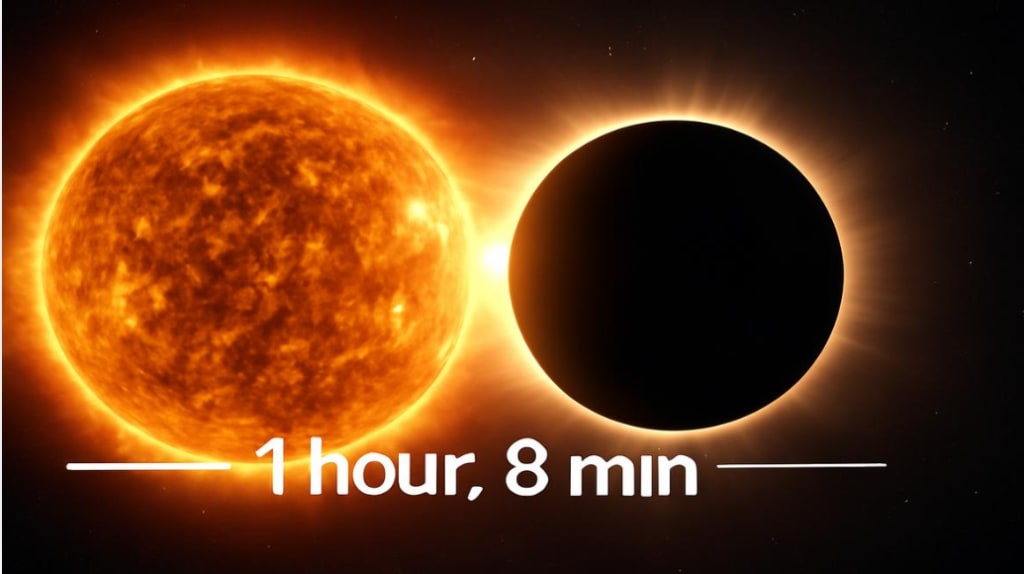
The sky has always held humanity’s attention, but every so often, it offers a spectacle so rare and dramatic that it feels almost otherworldly. Soon, day will briefly turn into night as the longest solar eclipse of the century now has an official date. Astronomers and space agencies around the world are already preparing for what experts describe as an exceptional event marked by its remarkable duration and rare visibility.
A total solar eclipse is one of nature’s most awe-inspiring displays. It occurs when the Moon moves precisely between the Earth and the Sun, completely blocking the Sun’s light for a short period. While partial eclipses are relatively common, a total solar eclipse—where the Sun is fully covered—is far rarer. What makes this upcoming eclipse even more extraordinary is its length. According to experts, it will be the longest total solar eclipse of the 21st century, offering an unusually extended period of totality.
Why This Solar Eclipse Is So Exceptional
Not all solar eclipses are created equal. The duration of totality—the period during which the Sun is completely obscured—varies depending on several astronomical factors. These include the distance of the Moon from Earth, the Earth’s distance from the Sun, and the exact alignment of all three celestial bodies.
In this case, experts highlight that the Moon will be at a position in its orbit that makes it appear slightly larger in the sky. At the same time, Earth will be positioned in such a way that the Sun appears marginally smaller. This combination allows the Moon to cover the Sun for a longer time than usual. As a result, some regions along the eclipse’s path will experience over six minutes of total darkness—a rare occurrence in modern times.
To put that into perspective, most total solar eclipses last only two to three minutes in any given location. Extending that window to more than six minutes provides scientists, photographers, and skywatchers with a significantly longer opportunity to observe and document the event.
Day Turns to Night: What to Expect
When the longest solar eclipse of the century unfolds, those within the path of totality will witness a dramatic transformation of their surroundings. As the Moon slowly moves across the Sun, daylight will begin to dim. Shadows will sharpen, temperatures may drop noticeably, and an eerie twilight glow will envelop the landscape.
Then, at the moment of totality, the Sun’s bright disk will vanish entirely, replaced by the ethereal solar corona—a faint, glowing halo of plasma surrounding the Sun. Stars and planets may become visible in the darkened sky. Birds may fall silent, and nocturnal animals might stir, confused by the sudden onset of darkness.
This temporary night during the middle of the day is what makes a total solar eclipse such a profound experience. For centuries, eclipses inspired myths, legends, and even fear. Today, they inspire scientific curiosity and global excitement.
Rare Visibility Across Key Regions
Another reason experts are emphasizing the significance of this eclipse is its rare visibility. The path of totality will stretch across several densely populated areas, giving millions of people the chance to witness the event firsthand. While solar eclipses occur somewhere on Earth approximately every 18 months, they often pass over oceans or sparsely inhabited regions.
This time, however, the alignment favors landmasses with major cities and accessible viewing locations. Tourism boards and local governments in regions along the path are already anticipating a surge in visitors. Hotels are expected to book up years in advance, and eclipse-chasing enthusiasts are planning their travel to secure the best vantage points.
For those outside the path of totality, a partial solar eclipse will still be visible, though it will not produce the same dramatic “day turns to night” effect. Experts strongly encourage anyone hoping to witness totality to travel into the precise path, as even a small distance can mean the difference between a partial and total eclipse.
Scientific Opportunities and Discoveries
Beyond its visual spectacle, the longest solar eclipse of the century presents a valuable opportunity for scientific research. During totality, scientists can study the Sun’s corona in ways that are otherwise impossible. The corona, which is normally outshone by the Sun’s intense brightness, becomes visible only during a total solar eclipse.
Researchers use this time to examine solar flares, magnetic fields, and other phenomena that influence space weather. Understanding these processes is crucial, as solar activity can impact satellite communications, power grids, and even GPS systems on Earth.
The extended duration of this eclipse provides scientists with more time to collect data and conduct experiments. High-resolution imaging, spectroscopy, and other advanced observational techniques will be deployed to maximize the scientific return from this rare event.
Preparing for the Big Day
With the official date now confirmed, anticipation is building worldwide. Experts advise early planning, especially for those who want to experience the eclipse from within the path of totality. Securing accommodations, scouting viewing locations, and monitoring weather forecasts will all be key to ensuring a successful viewing experience.
Safety is also paramount. Looking directly at the Sun without proper eye protection can cause permanent eye damage. Certified eclipse glasses that meet international safety standards are essential for viewing the partial phases of the eclipse. Only during totality—when the Sun is completely covered—is it safe to briefly look without protection.
Communities along the path are expected to host educational events, viewing parties, and public outreach programs. Schools, universities, and observatories are planning special activities to help people understand the science behind the spectacle.
A Once-in-a-Lifetime Moment
While the 21st century will see many astronomical events, the longest solar eclipse of the century stands out as a once-in-a-lifetime moment for most people alive today. Its exceptional duration and rare visibility combine to create a truly historic occasion.
When day turns into night and the sky reveals one of its rarest wonders, millions will pause to look upward in shared amazement. In a world often divided by borders and differences, a total solar eclipse serves as a reminder that we all live under the same sky—connected by the same cosmic rhythms.
As the official date approaches, excitement will continue to grow. And when that day finally arrives, those fortunate enough to stand in the Moon’s shadow will witness history written not in ink, but in light and darkness across the sky.
About the Creator
Keep reading
More stories from Aqib Hussain and writers in Education and other communities.
Tumbler Ridge School Shooting: Teacher and Students Hid for Hours During Canadian Attack
When news broke of the Tumbler Ridge school shooting, few could believe that such a tragedy had unfolded in a quiet Canadian town known more for its mountain views and tight-knit community than for violence.
By Aqib Hussainabout 18 hours ago in Education
Unlocking Your Potential: A Journey of Personal Growth and Professional Development
Personal growth and professional development are closely linked. As people grow personally, they often unlock new skills that help them at work. In the same way, professional development can lead to more confidence and personal satisfaction. Both areas support one another and move together in a cycle of improvement. Understanding this connection is the first step toward lasting success.
By Greg Deshields7 days ago in Education
Why the Bancassurance Market Is Redefining the Way Financial Protection Is Delivered?
The financial services industry is evolving rapidly as institutions seek more integrated and customer-focused service models. Consumers today prefer convenience, streamlined processes, and trusted relationships when managing their financial needs. Within this changing environment, the bancassurance market has gained increasing importance by combining banking services with insurance distribution under a unified framework.
By Akshay Kumar31 minutes ago in Education




Comments
There are no comments for this story
Be the first to respond and start the conversation.