

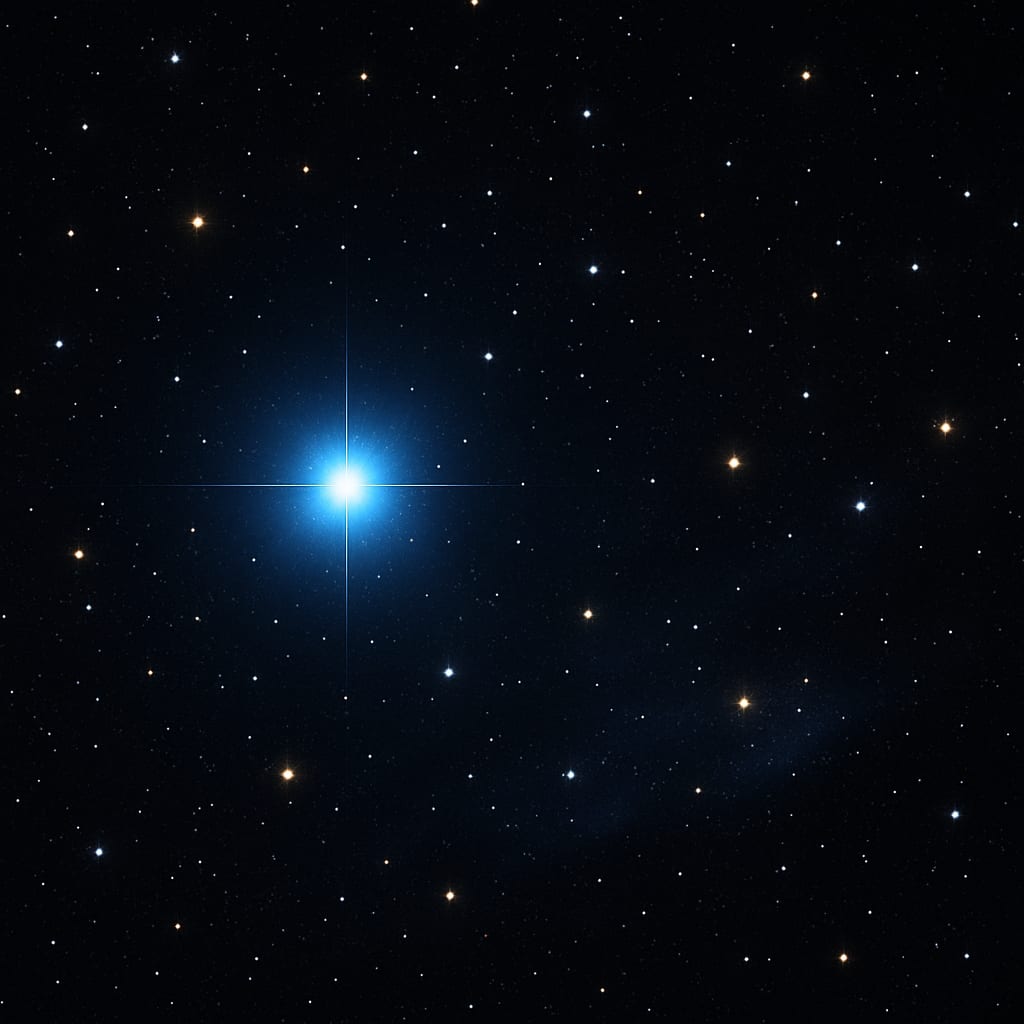
When we look up at the night sky, it often feels timeless and familiar. The stars twinkle like scattered jewels, and most appear white or slightly yellowish to the naked eye. Yet, if you observe carefully—or even better, through a telescope—you’ll notice that not all stars share the same shade. Some gleam in a striking blue light, brighter and sharper than their neighbors. But why are certain stars blue? What cosmic secrets are hidden behind this intense color?
The Science of Stellar Color
The color of a star is not random. It’s directly linked to the star’s surface temperature. Just like metal that glows red, orange, or white when heated, stars also shift in color depending on how hot they are.
Cooler stars (around 3,000 °C / 5,400 °F) shine in reddish or orange tones.
Medium-temperature stars, like our Sun (about 5,500 °C / 10,000 °F), radiate a yellow-white glow.
Extremely hot stars—those exceeding 10,000 °C (18,000 °F)—appear blue.
This means that a star’s color is essentially a cosmic thermometer. Blue stars are the hottest of all, often burning at more than 20,000 °C. That’s several times hotter than the Sun, and their brilliant hue is proof of their enormous energy output.
Meet the Blue Giants
Most blue stars belong to a category known as blue giants. These stars are truly cosmic furnaces—much more massive than the Sun and shining thousands of times brighter. Because of their immense mass, nuclear fusion in their cores happens at a furious pace. Hydrogen fuel burns rapidly, producing colossal amounts of energy, which streams outward in the form of dazzling blue light.
A famous example is Rigel, the brightest star in the constellation Orion. Though it’s located more than 800 light-years away, Rigel is so luminous that it can be spotted with ease by the naked eye. Its intense blue-white glow is a perfect example of the power contained in these stellar giants.
Another iconic blue star is Sirius, also known as the “Dog Star.” It’s the brightest star in Earth’s night sky and shines with a bluish-white sparkle. For centuries, Sirius served as a vital navigation point for sailors who used it as a celestial compass when crossing the seas.
Short Lives, Explosive Endings
There’s a catch to all this brilliance: blue stars don’t live long. While smaller stars like the Sun can burn steadily for billions of years, blue giants consume their fuel in just a few million years. That may sound like a long time to us, but on the cosmic scale, it’s the blink of an eye.
And their endings? Nothing short of spectacular. Once a blue star runs out of fuel, it often dies in a supernova explosion—one of the most powerful events in the universe. The collapse and explosion scatter heavy elements into space, which eventually become the building blocks for new stars, planets, and even life. Depending on their mass, the remnants of blue stars may form neutron stars or even black holes, some of the most extreme objects known to science.
Why Do We See Them as Blue?
So why does our eye register these stars as blue? The answer lies in light wavelengths. Blue light has a shorter wavelength and carries more energy than red or yellow light. The hotter the star, the more its radiation shifts toward these shorter wavelengths, making the star look blue to our eyes.
In essence, when we see a blue star, we’re witnessing raw energy—photons bursting with incredible power, a direct result of the star’s extreme temperature.
Blue Stars as Beacons
Throughout history, blue stars played an important role in human culture and science. Their unusual brilliance made them natural celestial markers. Mariners of the past relied on stars like Sirius and Rigel for navigation, while ancient civilizations saw them as symbols of divinity or power. Even today, amateur stargazers point to these stars first, since their brightness makes them stand out among the countless pinpricks of light in the sky.
A Glimpse of Cosmic Drama
Blue stars remind us that the universe is not static but dynamic and ever-changing. Their beauty comes with a sense of urgency: they shine brilliantly but briefly, living fast and dying young. Watching them is like catching a glimpse of a cosmic firework in progress—one that will eventually end in a dramatic explosion, seeding the galaxy with new materials for the next generation of stars and worlds.
When you spot a blue star twinkling in the sky, you’re not just looking at a pretty light. You’re seeing the powerful engine of stellar evolution in action—a living reminder that the cosmos is vibrant, restless, and constantly renewing itself.
In short, stars are blue because they are incredibly hot—hotter than almost anything we can imagine on Earth. Their brilliant color reflects both their fiery energy and their fleeting lives. Blue stars are cosmic storytellers, whispering tales of creation, destruction, and the endless cycle of life among the stars.
About the Creator
Keep reading
More stories from Holianyk Ihor and writers in Education and other communities.
Micronovae: The Lesser-Known Cosmic Explosions
When most people hear the word explosion in the context of space, their minds usually leap to spectacular events like supernovae—massive stellar outbursts that light up entire galaxies and mark the end of a star’s life. Others may think of novae, sudden but relatively less destructive flares that occur when white dwarfs steal matter from nearby stars. But hidden in the cosmic playbook lies a far quieter, far shorter, and only recently discovered kind of explosion: the micronova.
By Holianyk Ihor5 months ago in Education
Why Certification Protects Transcription Careers in the Age of AI
Artificial Intelligence has rapidly transformed the transcription industry. Speech-to-text tools now promise instant results, lower costs, and effortless productivity. For businesses focused purely on speed, AI often appears to be the perfect solution. However, beneath this promise lies a critical reality: speed without accuracy creates risk.
By Mahesh Kumar3 days ago in Education
How Japan saved its biggest city from collapse
400 years ago, modern-day Tokyo was known as Edo, and it was already one of the biggest cities in the world, with a population approaching 1 million. However, it was on the verge of ecological collapse. Years of intense logging had led to massive deforestation. The city now faced timber shortages and the impacts of severe erosion and frequent flooding that threatened food supplies. But over just a few decades, Edo will transform and become one of the most sustainable and efficient cities in history.
By Munesh Yadava day ago in Education




Comments
There are no comments for this story
Be the first to respond and start the conversation.