
Micronovae: The Lesser-Known Cosmic Explosions
Space

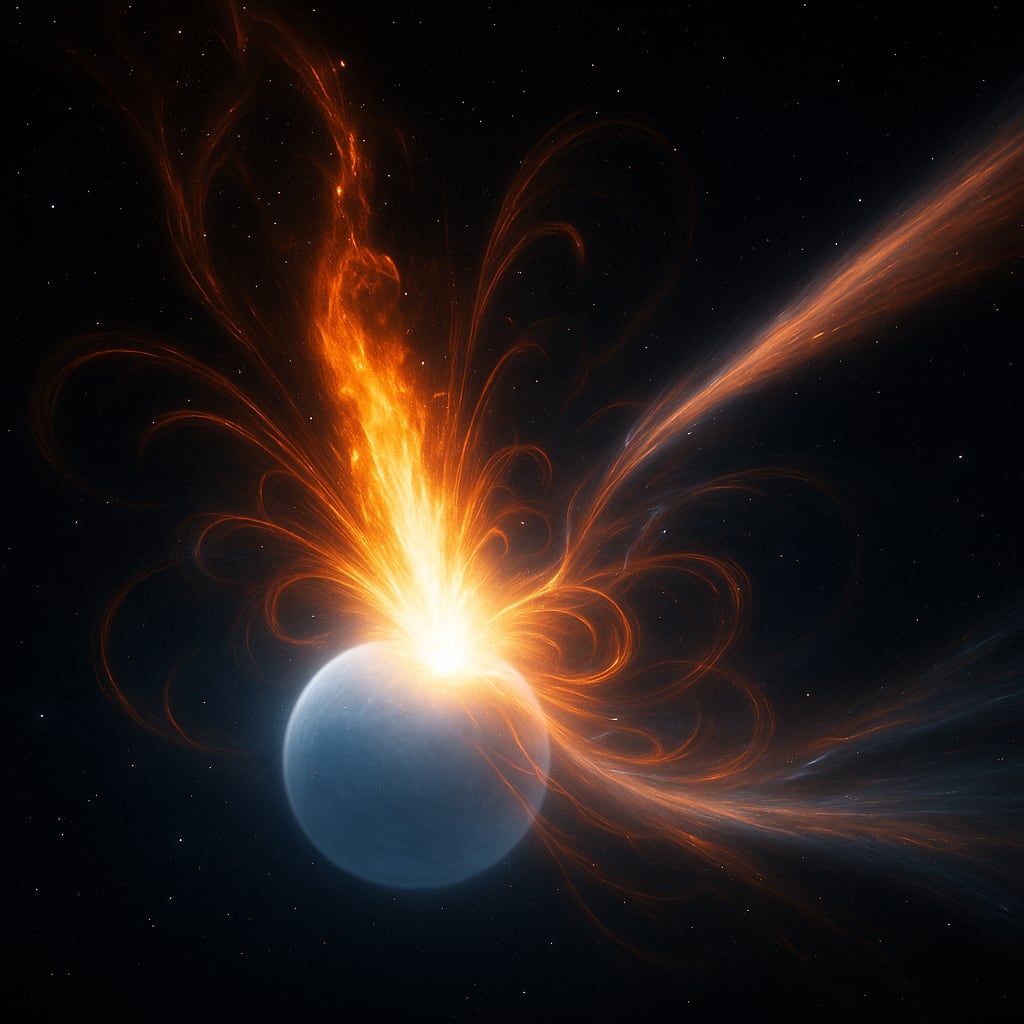
When most people hear the word explosion in the context of space, their minds usually leap to spectacular events like supernovae—massive stellar outbursts that light up entire galaxies and mark the end of a star’s life. Others may think of novae, sudden but relatively less destructive flares that occur when white dwarfs steal matter from nearby stars. But hidden in the cosmic playbook lies a far quieter, far shorter, and only recently discovered kind of explosion: the micronova.
Although “micro” might suggest something small and insignificant, micronovae are anything but trivial. They are fleeting thermonuclear flashes that last mere hours, yet in that time they unleash energy equivalent to billions of trillions of nuclear bombs. By human standards, they’re catastrophic; by cosmic standards, they’re surprisingly subtle—so subtle that we only learned of their existence a few years ago.
What Exactly Is a Micronova?
A micronova is a localized thermonuclear explosion that occurs on the surface of a white dwarf. A white dwarf is the dense, Earth-sized remnant of a star that has already burned through its nuclear fuel. Many white dwarfs exist in binary star systems, orbiting closely with a companion star. Over time, the white dwarf’s gravity siphons material—mostly hydrogen—from its partner.
When enough of this material piles up on the dwarf’s surface, the pressure and temperature rise until nuclear fusion ignites. If the layer is thin, the explosion is relatively modest and localized, producing a micronova. Unlike larger novae, where the ignition can wrap around the star’s entire surface, micronovae are more like isolated firestorms contained in one or a few magnetic regions of the star.
Small by Name, Huge by Nature
The prefix micro can be misleading. Compared to novae and supernovae, yes, these explosions are “small.” But a single micronova still releases an astonishing amount of energy. Imagine every nuclear weapon on Earth detonating at the same instant—and then multiply that by billions. That’s the scale of destruction happening in just a few hours.
Yet from a galactic perspective, these events are delicate sparks rather than cosmic infernos. They don’t obliterate the star, they don’t tear apart a solar system, and they don’t shine across half the universe. Instead, they’re quick bursts that flare up and vanish before telescopes even have much of a chance to track them.
This brevity makes them particularly difficult to study. Supernovae can blaze for weeks or even months, but a micronova might appear and disappear overnight. For astronomers, it’s like trying to photograph a firework when you don’t know when or where it will launch.
The Discovery of Micronovae
Micronovae remained hidden from astronomers until very recently. In 2022, a team of scientists analyzing data from TESS (the Transiting Exoplanet Survey Satellite) stumbled upon three peculiar flashes. TESS was designed to search for exoplanets, but its continuous monitoring of stars also makes it excellent at detecting sudden changes in brightness.
What they found didn’t fit the profile of a nova, supernova, or any other known stellar outburst. These were shorter, fainter, and highly localized. After careful analysis, researchers realized they had discovered a brand-new class of stellar explosions—micronovae.
Even more fascinating, evidence suggests that these explosions occur only in certain regions of the white dwarf, where magnetic fields channel the inflowing material. In other words, magnetic lines act like cosmic funnels, directing hydrogen into confined patches that then erupt in fiery bursts. It’s as if the star is firing off mini nuclear flares from its magnetic “poles.”
Why Do Micronovae Matter?
The discovery of micronovae challenges existing ideas about stellar behavior. For decades, astronomers assumed that nuclear explosions on white dwarfs had to engulf the star globally. Micronovae show us that the universe is far more creative.
Studying these subtle explosions may help us:
- Understand white dwarfs more deeply. Far from being inert stellar corpses, these remnants are active, magnetic, and capable of dynamic outbursts.
- Explore the role of magnetic fields. Magnetism shapes not only planets like Earth but also the lives of stars, influencing how matter flows, where it accumulates, and how it detonates.
- Rethink stellar evolution. If micronovae are common, they could play a bigger role than expected in shaping the fate of white dwarfs and their binary partners.
Cosmic “Pressure Cookers”
One way to picture a micronova is to think of a pot of milk boiling on a stove. For a while, nothing seems to happen. Then, suddenly, the milk overflows in one spot with a quick, messy burst. Micronovae operate on the same principle: a small patch of star “boils over” once it has enough hydrogen to ignite.
Unlike a nova or supernova, the star survives intact after the event. It may even repeat the cycle, drawing more material from its companion and producing another outburst in the future. In this way, a white dwarf can experience multiple “micro-flares” throughout its lifetime.
A Mystery Still Unfolding
Right now, scientists have more questions than answers. How common are micronovae across the galaxy? Do they occur only in specific types of white dwarfs, or are we just beginning to see the tip of the iceberg? Could repeated micronovae eventually build toward something larger, or are they entirely self-contained events?
Each new observation provides clues, but the rarity and short duration of these explosions make them difficult to capture. Future telescopes with faster and more continuous monitoring may reveal hundreds, perhaps thousands, of hidden micronovae that occur every year across the Milky Way.
The Universe’s Hidden Fireworks
If supernovae are the universe’s dazzling fireworks displays and novae are bright sparklers, then micronovae are like fleeting sparks from a flint—small, short, but packed with power. They remind us that the cosmos is not just about grand spectacles but also about hidden, subtle phenomena that take patience and luck to uncover.
The discovery of micronovae is a perfect example of how astronomy continues to surprise us. Every time we think we’ve seen the full range of stellar drama, the universe reveals yet another trick, proving that even its “micro” events are far grander than anything we could imagine here on Earth.
About the Creator
Keep reading
More stories from Holianyk Ihor and writers in Education and other communities.
Bioreactors for Space: Living Factories of the Future
As humanity moves closer to the age of long-term space exploration and colonization, one practical challenge grows louder: how can we sustain life far from Earth? Rockets can’t simply carry endless supplies of food, oxygen, and clean water for astronauts heading to Mars or building habitats on the Moon. The solution may lie in an elegant fusion of biology and engineering — bioreactors, compact “living factories” designed to keep astronauts alive and thriving beyond our planet.
By Holianyk Ihor5 months ago in Education
What Are Snapchat Planets and How Do They Work
Introduction to Snapchat Planets Snapchat planets are a visual feature that helps users understand how interaction works inside the Snapchat app. Many users notice planets next to friend profiles and feel curious about their meaning. Snapchat planets are designed to represent digital interaction levels in a simple and visual way rather than using numbers or charts.
By AWAIS TARIQ5 days ago in Education
Top 10 SEO Experts In Pakistan In 2026
Introduction Search optimization in 2026 no longer revolves around keywords or isolated ranking tactics. Google’s AI Overviews, entity-based indexing, and answer-first systems have changed how visibility is earned. Search engines now evaluate meaning, credibility, and contextual authority rather than mechanical signals.
By Sajid Ali Sharabout 2 hours ago in Education



Comments
There are no comments for this story
Be the first to respond and start the conversation.