
What School Never Teaches You About Money
How school failed us on the most important subject: personal finance

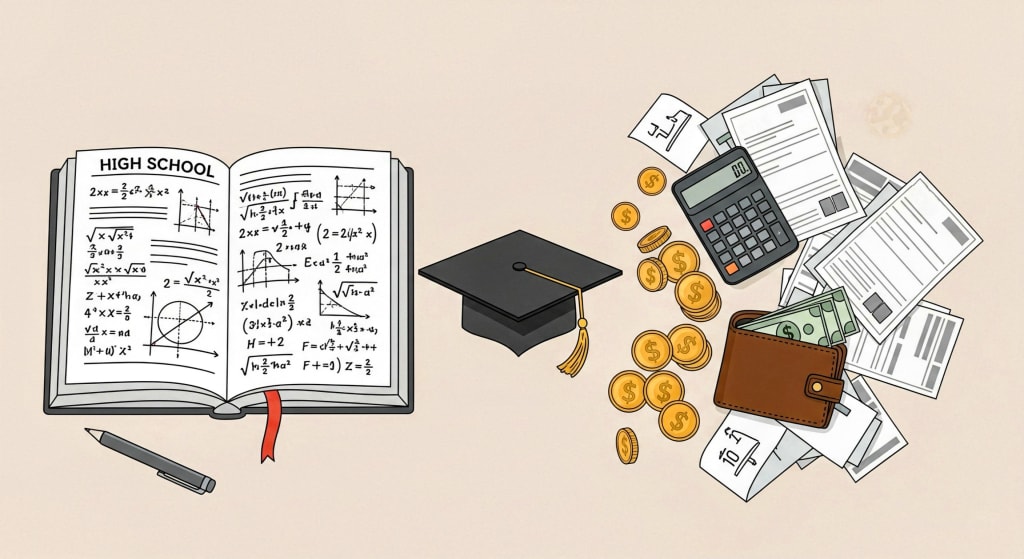
You graduate, get your degree, and get started on your life… But you realize that no one taught you how to manage your money, pay your rent, pay your taxes, or invest for your future. In high school, we learned how to prepare for essays, tests, and exams—but we didn’t prepare for the financial aspects of real life.
Most of us spent a decade memorizing historical dates, grammar rules, and scientific formulas. We learned how to analyze literature and solve chemical equations. But we barely learned about personal finance, interest rates, or even how to fill out a simple tax return. As college and living costs rise, this gap is costing us dearly. While student debt is the biggest financial burden of this generation, Gen Z is finding that we lack certain skills when we leave school.
I also encountered this problem when I started my online sneaker business. I planned in advance for a month of sales revenue of 300 thousand soums: I wanted to save 100 thousand for advertising, 100 thousand for packaging and shipping costs, and 100 thousand for the next batch. But advertising costs increased, packaging materials unexpectedly became more expensive, and in the end I had no money left. At that moment I realized: managing income correctly is even more important than generating income, and if you don’t create a real budget, your plans will fall apart.
1. Compulsory interest and long-term savings
In school, we learn the formula A = P (1 + r/n)^(nt), but we rarely hear about its power (or danger) in real life. The accumulated interest, penalties, and low credit rating on one late credit card payment can cost you thousands of dollars. In contrast, investing $100 a month at age 18 can turn into hundreds of thousands of dollars by age 40. But students often don’t understand the precise calculations of interest rates and their long-term effects.
2. Budgeting is not “a light version of math.”
Even if you’ve learned to solve for x, in real life it’s hard to choose between “needs” and “wants.” Budgeting confronts us with desires, showing us the need for impulse and bargaining. Teachers teach equations with beautiful examples, but in real life, rent is variable, income is uncertain, and wants are endless. Saving money for a night out with friends or canceling subscription services is a challenge in budgeting, but it’s never taught in school.
3. Credit Score – The Most Important, But “Unsupervised” Exam
A credit score is one of the most important grades in your life, but it’s also hidden from your school grades. No one explains the impact of a score on costs, debt limits, or strict verification requests. As a result, the difference in interest rates and averages learned in school, not knowing the priorities of debt, can cause you to pay 3% or 30% annual interest in the future.
4. Taxes, Loan Agreements, and Fine Text
Filling out tax returns, reading loan terms, and understanding insurance policies are essential “literature” in educational fields, but many people don’t study them. We interpret works of art, but we skip reading about the fine text of financial contracts (origination fees, interest rate changes, insurance exclusions). As a result, hidden fees, variable interest rates, and insurance premiums can hit us when we least expect them.
Schools teach us the foundation for critical thinking and problem-solving, but they often replace life lessons about money. True financial literacy should teach us how to manage the power of interest, control impulse purchases, understand credit algorithms, and work with the finer points of contracts. If we want to graduate with not just knowledge but also financial confidence, it’s time to make real-world finance classes—budgets, credit management, and tax filing—mandatory in the curriculum. Otherwise, every diploma will have a little asterisk next to it: “Congratulations—now you need to learn how to handle it yourself.”
About the Creator
Saidakmal Nuriddinov
Gen Z with a brain and a bias for questions. I write about money, meaning, and why following the crowd isn’t leadership
Reader insights
Outstanding
Excellent work. Looking forward to reading more!
Top insights
On-point and relevant
Writing reflected the title & theme
Easy to read and follow
Well-structured & engaging content
Expert insights and opinions
Arguments were carefully researched and presented
Eye opening
Niche topic & fresh perspectives
Masterful proofreading
Zero grammar & spelling mistakes
Keep reading
More stories from Saidakmal Nuriddinov and writers in Education and other communities.
Productive but Powerless
“Be productive!” — all the motivational aphorisms that encouraged us to be productive are now in our minds. “Productivity hack” videos on my phone, colorful charts and “to-do” lists on my desk… Every morning when I wake up, the first thing I do is look at the keyboard, and read about new ideas. But when I go to bed at night, my body is tired and my soul is filled with depression, and I realize that I haven’t done any real work during the day. For Gen Z, this has already become commonplace: we put ourselves forward, but often end up looking like we haven’t even come out of the box, like a sleepwalker.
By Saidakmal Nuriddinov7 months ago in Motivation
The Great Library of Imagination*:
The Great Library of Imagination In the heart of the city, where the streets were lined with ancient trees and the buildings whispered secrets to each other, there was a small, unassuming door tucked away in a narrow alley. The door was old and worn, with intricate carvings of fantastical creatures and symbols that seemed to shift and shimmer in the flickering light of the street lamps. Few people noticed the door, and even fewer knew what lay beyond it.
By Talhamuhammad5 days ago in Education
Building Success from the Ground Up: Foundations for Personal and Professional Growth
Personal and professional success begins with a strong foundation. It is more than achieving goals or earning recognition; it is the result of deliberate choices, consistent habits, and an understanding of what truly drives you. Without a solid base, even significant accomplishments may feel unsatisfying or fleeting. By focusing on the principles that sustain growth and resilience, individuals can create a life and career that are meaningful, productive, and aligned with their values.
By Philip Raymond Baquie5 days ago in Education



Comments
There are no comments for this story
Be the first to respond and start the conversation.