
What's "Really" Wrong with American Education?
Endless critiques; what signs of progress?

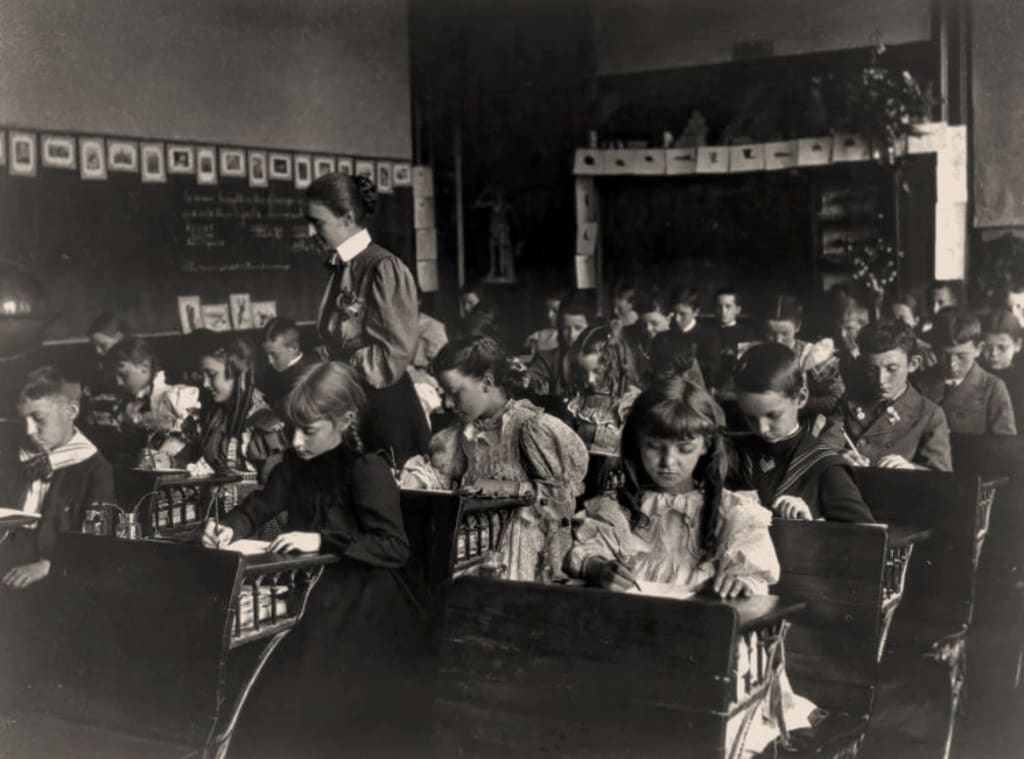
For several decades now American education has been the object of keen criticism, if not scorn, from every quarter. Employers claim recent graduates lack required skills. Professors complain similarly of underprepared collegians. Parents feel the system fails too many and may not serve their own children well. Politicians on the right rail against ideological content and political correctness, as those to the left protest for more equity and inclusiveness in hiring, support and curricula. High school students doubt the very worth of higher education. Measures on national and international tests suggest that American students, relative to the rest of the world and now even the nation's own recent past, are at best mediocre performers, after years of experiment and reform still stagnating and even falling further behind.
This mosaic of criticisms is in part an expected reflection of the mosaic, patch-work nature of the institutions and demographies that constitute one rhetorically assumed "system." Unlike advanced economies in Europe and East Asia, education in the United States is highly decentralized, with multiple forces that push and pull it into odd shapes and sizes across the continent. Suburban, urban, prep, parochical, technical, sports leagues, clubs ad infinitum: configurations based mainly on where one lives, and above all parental income, for due entry.
America's educational patterns are, of course, linked to the demographic biases of its other institutions.
Some might knee-jerk hail the proliferation of different models as evidence of the "choice" or "opportunity" uniquely American--even while the dismal statistics show a distinctly deterministic dynamic. The more honest and concerned of us recognize the disparities, and their consequences.
What goes unquestioned, always, in this "post-industrial" "mass-media"
If Americans expect up-to-date, savvy and above all fair schools then they must find the will to fund essential programs everywhere, and equally, as the first step. Adjustments to class size, teacher quality, curriculum balance must follow. Sorting by geography, residence and age ought to be re-thought.
Most of us learn best, and most deeply, in an environment of strong support and exceptional openness. That may be the model in Finland, and even partially elsewhere.
Best of luck in finding anything like it in USA ongoing.
It's not just the forces arrayed against meaningful, structual change. All society is at a crazy, unpredictable inflection point. ...What will AI mean for, and do to, labor markets and subsequently education? Prognosis is, nothing to benefit the whole, necessarily.
In contemporary societies education is the handmaiden of industry. Schools follow the industrial model of production, and reduction. ...What if education, instead, took the lead? What if highly skilled and widely instructed pupils seized the day, upended markets both labor and consumer, set the standards and rewards?
Apart from the statistics, personal experience persuades that the industrial model of education as current in USA is an overall failure. And that, in addition, as part of the general eco-structure, it does seem intentionally designed to keep separate the haves from the have-nots.
What AI and a coming economic evolution will bring are yet dim unknowns. But surely, though few see or would admit it, the American educational model as it stands now is not only broken, but resistant to true change. It may, more or less, have worked during the last century, but it lags during the 21rst, like a horse buggy trailing a car.
American education need not follow the stereotyped Asian style of rote memorization and absolute adherence to authority, but it surely needs some discipline in its gait, some recovery of general academic standards that care about science, history, literacy and not so much politics, or disputable identity, either left or right.
About the Creator
Mark Francis
Published translator of verse and original writer of haiku, senryu, lyric, occasional and genre poetry and speculative fiction.
Keep reading
More stories from Mark Francis and writers in Education and other communities.
7 AI Tools That Can Replace Hours of Work in 2026 (And Help You Make Money Online)
Artificial intelligence is no longer just a futuristic idea—it’s quickly becoming one of the most powerful tools for productivity and online income. In 2026, AI tools are transforming how people work, create content, start businesses, and automate daily tasks.
By Majus Jasulaitisabout an hour ago in Education



Comments (1)
I very much appreciate this comprehensive summary of the deep problems of the educational system in today's USA. It isn't merely critical, like so many others' writings are, but constructive, by naming the concrete problems and suggesting different possible models. Let me add just one more subject to his "recovery list", the deeply neglected art education. Thank you Mr. Francis.