
What is Risk Management
Definition, Steps/Processes of Risk Management

The project operates in an environment that is surrounded by numerous uncertainties. There is a lot of uncertainty, including project financing, resource availability, and potential technical issues. And these uncertainties create project risks. But what is Risk Management? What are the steps or Processes of Risk Management?
I’ll help you answer all these questions in this post.
What is Risk Management?
There is a Manager for every project. However, the manager’s job is not only to measure the risk but also to devise ways to reduce and control the risk. And this work will be done through risk management. Generally, risk management refers to the process by which potential risks are identified and analyzed and precautionary measures are taken to address the risks. Different authors have defined risk management in different ways. The following are some notable definitions:
According to J.K. Pinto, “Risk Management is defined as the art and science of identifying, analyzing and responding to risk factors throughout the life of a project and in the best interest of its objectives.”
According to Business Dictionary, “Risk Management is the identification, analysis, assessment, control and avoidance, minimization or elimination of unacceptable risks.”
In light of the above definitions, risk management is the process of identifying unwanted risks, analyzing, evaluating, and taking precautionary measures to reduce, control, or avoid risks.
Want more Definitions? Learn From Here.
Steps of Risk Management
Risk management is a process where some interrelated steps are followed. The risk management process is described below:
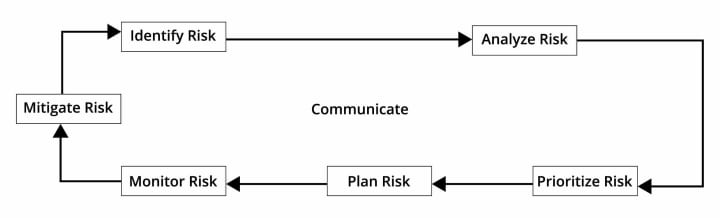
- Identify Risk: The first step in the risk management process is to identify the risks associated with the project. Project risks can be related to production costs, financing, schedules, contracts, relationships, diplomacy, etc. that affect the project in many ways. In addition to identifying risks, risk factors are identified and who will be responsible for risk management?
- Analyses Risk: The next step after risk identification and assessment is to analyze the risk. Identified risk is converted into decision-making information through risk analysis. As a result, the probability of each risk is considered and judged and the decision is made considering the severity of the risk.
- Prioritize Risk: Not all risks are equally important. There are some risks that have a very low impact or the risk is very low or both. Again there are some risks that have a very high impact or the risk is very high or both. Therefore, the risk manager prepares the list by selecting the risk on the basis of priority. The risks that are most likely to occur and the risks that are most affected are displayed at the top of the table. And the risks that are less likely to occur, and the risks that are less effective are displayed at the bottom of the table. In this case, banking is done by determining the amount of risk.
- Plan Risk: The risk manager will plan the risk based on the importance and priority of the risk so that precautionary measures can be taken to deal with the risk.
- Mitigate Risk: The risk manager will formulate some strategies in line with the risk plan to minimize the risk potential and the impact of the risk.
- Monitor Risk: After identifying the risk, analyzing, prioritizing, planning the risk, and determining the steps to be taken to mitigate the risk, it is necessary to examine the existing risk of the project and the effectiveness of the risk mitigation/control strategy. The risk manager will regularly monitor the risk and take corrective action if necessary.
- Communicate: Maintain ongoing and effective communication about project risk with managers, development teams, marketing, and buyer representatives for successful risk management. Communication is said to be the cornerstone of effective risk management as all information is communicated through communication.
About the Creator
Shahinur Ahmed
I dislike most talking about myself, but I'm obliged to do so here! I am Shahinur Ahmed Sobuj, a final year Computer Science and Engineering Student.
Keep reading
More stories from Shahinur Ahmed and writers in Education and other communities.
Project Organization Structure
The project does not have a single organizational structure. The project organization structure is established according to the type of project. All project structures are designed in such a way that project activities can be completed efficiently and effectively.
By Shahinur Ahmed3 years ago in Education
Why Great Customer Service Is Non-Negotiable for Modern Businesses
Excellent customer service is no longer something businesses can choose to offer later. It is a basic requirement in today’s fast-moving market. Customers expect respect, clear communication, and fast solutions. When they do not get these things, they leave. This is why excellent customer service is non-negotiable for businesses that want to survive and grow.
By Apex Service Partners7 days ago in Education
The Devil's Cut
“Comrade, finally you’re awake.” The voice was smooth, sensual. A flickering incandescent bar was all that lit the white, sterile room. All Vladimir remembered was everything going black. He tried to move his arms and found them strapped to the gurney.
By Matthew J. Fromm5 days ago in Fiction


Comments
There are no comments for this story
Be the first to respond and start the conversation.