
Project Organization Structure
All You Need to know about Project Organization Structure


The project does not have a single organizational structure. The project organization structure is established according to the type of project. All project structures are designed in such a way that project activities can be completed efficiently and effectively.
What is Project Organization?
A project organization is a framework that makes it easier to coordinate and carry out project tasks. Its major purpose is to facilitate interactions among team members with the least number of disruptions, overlaps, and conflict. The type of organizational structure that will be employed for the project is an essential choice in project management.
And project management organizational structure is used to establish the hierarchy and authority of those participating in a particular project. On a chart, the structure specifies each team member’s function and the reporting lines for team members to refer to during a project.
Organizational Structure of a General Project
Each project is unique, and the design of an organizational structure should take into account the organizational environment, the project characteristics in which it will work, and the amount of power assigned to the project manager. A project structure can take many different shapes, each with its own set of pros and cons.
One of the key purposes of the project organization structure is to reduce the uncertainty and misunderstanding that typically occurs in the project’s initial phase. The structure describes the interactions among project management members as well as the ties with the outside world.
A properly designed project organization structure is essential to project success. The organizational structure of a general project is presented below –
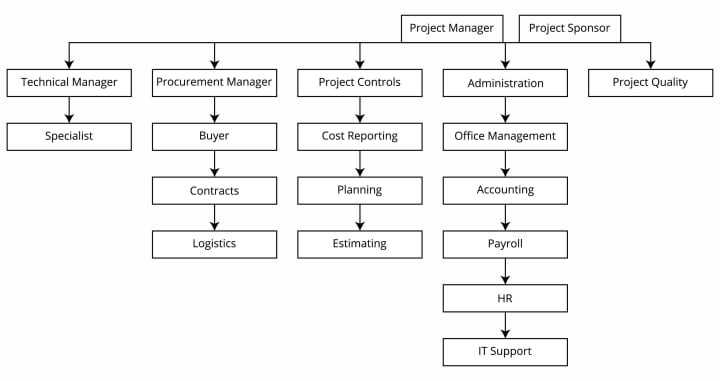
- Project Sponsor: The project entrepreneur does not perform the day-to-day functions of the project. Entrepreneurs provide project resources and remove project barriers. The initiator of the project plays the role of the leader of the parent organization. The entrepreneur performs all the tasks including providing project input, providing information, and providing guidance for the success of the project. The success of the project depends on the collaboration of the project entrepreneur.
- Project Manager: The project manager is the chief executive officer (CEO) of the project. The project manager decides on staffing, asset allocation, and work processes in order to get the project started quickly. Moreover, the project manager gives important directions to the project technical team to complete the project work. The project technical team leader performed his duties in the light of the project manager’s direction. In a word, the project manager completes all the tasks to complete the project successfully.
- Project Control: The project controller is an important part of the project planning by which the progress of the project is carried out as planned. Project Control provides important information about other activities of the project and the project manager evaluates the project cost schedule by analyzing all this information.
- Project Procurement: To complete the project one has to procure supplies and machinery and equipment. In some projects a specific person is given the responsibility to carry out the collection work properly. He buys product materials. Arranges purchase agreements, arranges for the installation of new equipment and tools, and arranges training to introduce new technologies as needed. What is needed for the project? When needed? The person in charge of the collection Informs the project manager about this. The person in charge of the collection plays an important role in the decision making regarding the input and scheduling and scheduling of the project. All in all, the person engaged in the collection work of the project provides the right products and equipment at the right place at the right time, that is, with logistical support.
- Technical Management: The main task of technical management is to observe the technical aspects of the project. The project needs to apply new technologies and make arrangements to address technological challenges. Apart from that, introducing new technology to the staff is one of the major tasks of this department. In the case of high technology, many times an expert is hired who advises the technical manager about the new high technology.
You can Learn More Here.
About the Creator
Shahinur Ahmed
I dislike most talking about myself, but I'm obliged to do so here! I am Shahinur Ahmed Sobuj, a final year Computer Science and Engineering Student.
Keep reading
More stories from Shahinur Ahmed and writers in Education and other communities.
The Importance of Strong Leadership in IT and Cybersecurity Teams
In today’s rapidly evolving digital landscape, IT and cybersecurity are no longer support functions—they are central to business success and resilience. With growing threats, complex infrastructures, and constant technological change, these departments face intense pressure to perform at the highest levels. At the heart of their performance is a critical factor that often determines whether a team succeeds or struggles: strong leadership.
By Keith Brautigam6 days ago in Education


Comments
There are no comments for this story
Be the first to respond and start the conversation.