
What Is Quantum Tunneling? How Particles Pass Through the Impossible
What Is Quantum Tunneling? How Particles Pass Through the Impossible Quantum physics reveals a universe far stranger than everyday experience suggests. One of its most astonishing phenomena is quantum tunneling—a process that allows particles to pass through barriers they should never be able to cross. According to classical physics, if an object lacks enough energy to climb over a barrier, it must stop. In the quantum world, however, particles can appear on the other side without ever crossing over the top. This “impossible” behavior is not theoretical speculation. Quantum tunneling is real, measurable, and essential to many natural processes and modern technologies. In this article, we explore what quantum tunneling is, how it works, why it occurs, where it appears in nature, and why it reshapes our understanding of reality.

The Classical View: Barriers Cannot Be Crossed
In classical physics:
• A ball cannot roll over a hill higher than its energy
• An electron cannot pass through a wall
• Objects must overcome barriers to move forward
Energy must always be greater than the obstacle.
If it isn’t, motion stops.
This rule holds perfectly in everyday life.
________________________________________
The Quantum World Breaks the Rules
At microscopic scales, particles behave not like tiny balls—but like waves.
These waves:
• Spread through space
• Interfere with themselves
• Do not have precise boundaries
Because of this wave nature, particles behave probabilistically rather than deterministically.
This allows quantum tunneling to occur.
________________________________________
What Is Quantum Tunneling?
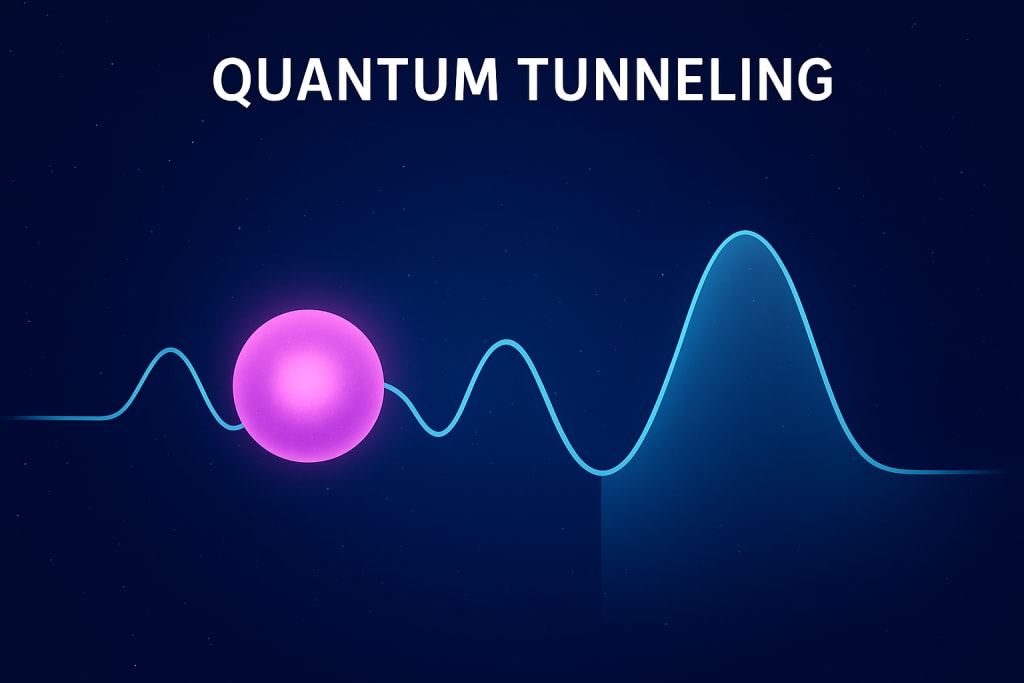
Quantum tunneling is the phenomenon in which a particle passes through an energy barrier—even when it does not have enough energy to overcome it.
In simple terms:
A particle can appear on the other side of a barrier without going over it.
It does not break the barrier.
It does not gain energy.
It does not tunnel like a drill.
It simply exists beyond the barrier because quantum mechanics allows a non-zero probability of doing so.
________________________________________
Why Tunneling Happens
Quantum particles are described by wavefunctions, which represent probabilities.
When a wave encounters a barrier:
• Most of it is reflected
• A small portion penetrates the barrier
• If the barrier is thin enough, some of the wave emerges on the other side
If the wave appears beyond the barrier, the particle may be detected there.
That detection is quantum tunneling.
________________________________________
Important Clarification
The particle does not travel through the barrier in the classical sense.
Instead:
• Its wavefunction extends into forbidden regions
• Probability leaks through
• Measurement reveals the particle beyond the obstacle
Quantum physics does not ask how the particle crosses—only where it may appear.
________________________________________
The Mathematics Behind Tunneling
In quantum mechanics, particles obey the Schrödinger equation.
This equation allows solutions where:
• Energy is less than the barrier height
• The wavefunction decays exponentially
• Probability never drops completely to zero
Because probability is not zero, tunneling becomes possible.
________________________________________
Factors Affecting Quantum Tunneling
The probability of tunneling depends on:
• Particle mass
• Barrier thickness
• Barrier height
• Particle energy
Light particles tunnel more easily.
Electrons tunnel far more often than protons.
Macroscopic objects almost never tunnel because the probabilities become unimaginably small.
________________________________________
Why We Don’t Walk Through Walls
Technically, quantum tunneling could allow you to pass through a wall.
But the probability is so tiny that:
• It would take longer than the age of the universe
• You would likely never succeed
• All atoms would need to tunnel simultaneously
For large objects, tunneling is effectively impossible.
________________________________________
The Double Nature of Matter
Quantum tunneling exists because matter is both:
• Particle-like
• Wave-like
This wave–particle duality is fundamental to quantum mechanics.
Without the wave nature of matter, tunneling could not occur.
________________________________________
Quantum Tunneling in Nature
Quantum tunneling is not rare—it is essential to the universe.
1. Nuclear Fusion in Stars
Inside the Sun:
• Protons repel each other electrically
• Classical physics says fusion should not occur
Quantum tunneling allows protons to pass through this repulsion and fuse.
Without tunneling:
• Stars would not shine
• Life would not exist
________________________________________
2. Radioactive Decay
Alpha decay occurs when:
• Particles tunnel out of the atomic nucleus
• Even though they lack sufficient energy
This explains why radioactive decay happens at precise rates.
________________________________________
3. Biological Processes
Quantum tunneling plays a role in:
• Enzyme reactions
• DNA mutations
• Cellular respiration
Life itself depends on quantum tunneling.
________________________________________
Technologies That Use Quantum Tunneling
Tunnel Diodes
Electrons tunnel across barriers, enabling ultra-fast electronics.
Flash Memory
Electron tunneling stores digital information.
Scanning Tunneling Microscopes
These devices image individual atoms by measuring tunneling current.
Quantum Computers
Tunneling allows qubits to explore multiple energy states.
________________________________________
Is Energy Conserved?
Yes.
Quantum tunneling does not violate energy conservation.
The particle never gains extra energy—it simply appears in a region allowed by probability.
________________________________________
Does Tunneling Violate Causality?
No.
Tunneling:
• Does not transmit information faster than light
• Does not violate relativity
• Does not allow time travel
It remains fully consistent with known physics.
________________________________________
Why Quantum Tunneling Matters
Quantum tunneling shows that:
• Nature is not strictly deterministic
• Possibility is as real as certainty
• The universe operates on probabilities
• Classical intuition breaks down at small scales
It reveals that reality is not limited to what seems physically possible.
________________________________________
Quantum Tunneling and the Nature of Reality
Tunneling suggests that:
• Barriers are not absolute
• Boundaries are probabilistic
• Physical impossibility is not absolute
At the quantum level, reality is fluid rather than rigid.
________________________________________
Current Research
Scientists are studying tunneling in:
• Superconductors
• Quantum dots
• Chemical reactions
• Biological systems
Understanding tunneling may lead to:
• Faster electronics
• More efficient energy systems
• Advanced quantum technologies
________________________________________
Final Conclusion
Quantum tunneling is one of the clearest demonstrations that the universe does not obey everyday logic.
Particles can cross barriers without crossing them. Energy limits are not absolute. The impossible becomes possible—not through force, but through probability.
From the light of the Sun to the operation of computers, quantum tunneling quietly powers reality at its most fundamental level.
It reminds us that beneath the solid world we experience lies a deeper quantum universe—one governed not by certainty, but by chance.
About the Creator
Keep reading
More stories from shahkar jalal and writers in Education and other communities.
Think Before You Build: How to Test a Business Idea the Smart Way
Launching a business without validation is like setting sail without checking the weather. You may feel confident at the start, but unseen risks can quickly turn excitement into regret. Many entrepreneurs lose time and money not because they lack skill or effort, but because they skipped the crucial step of validating their idea before committing fully.
By Rushi Mancheabout 23 hours ago in Education
Rethinking Math Education in the 21st Century: Lessons from the Casie Hynes Perspective
Mathematics has long been considered a fundamental pillar of education. It develops critical thinking, nurtures problem-solving abilities, and plays an essential role in science, technology, engineering, and finance. Yet despite its importance, math remains one of the most challenging and misunderstood subjects for students worldwide. As we step deeper into a data-driven era, reforming how we approach math education is more urgent than ever.
By Casie Hynes5 days ago in Education




Comments
There are no comments for this story
Be the first to respond and start the conversation.