
What is a Threaded Binary Tree?
A threaded binary tree is a special type of binary tree designed to make tree traversal more efficient by reducing the need for stack or recursive methods.

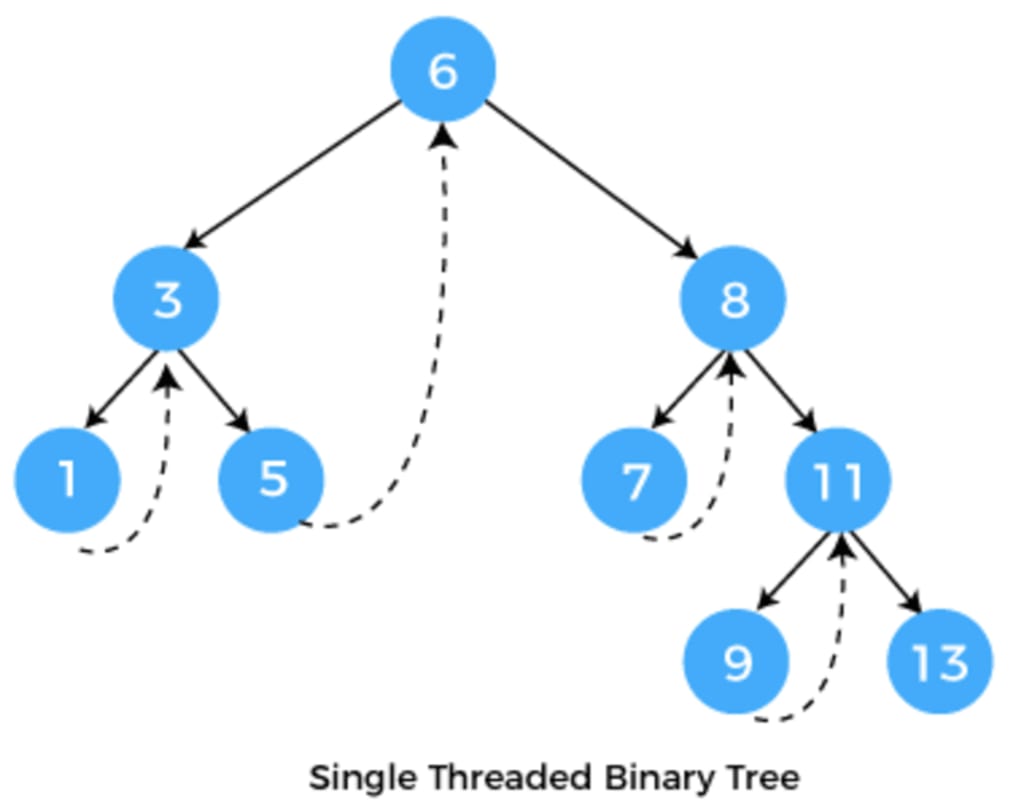
In the world of computer science and data structures, trees play a critical role in organizing information for efficient access and manipulation. Among various types of binary trees, the Threaded Binary Tree stands out due to its unique structure designed to make tree traversal more efficient without requiring additional memory overhead. This article delves into what a threaded binary tree is, why it’s useful, and how it differs from conventional binary trees.
Understanding the Binary Tree Basics
Before diving into the concept of a threaded binary tree, it is important to understand the basics of a binary tree. A binary tree is a hierarchical data structure where each node has at most two children—often referred to as the left and right children. Common operations on a binary tree include insertion, deletion, and traversal. The most frequent traversals are inorder, preorder, and postorder.
Inorder Traversal in Binary Trees
In inorder traversal, the process is:
Traverse the left subtree.
Visit the root node.
Traverse the right subtree.
In a typical binary tree, this traversal is often implemented using recursion or a stack to backtrack after visiting the left subtree. However, both approaches require extra space, which becomes inefficient for large trees.
This is where threaded binary trees come into play.
What is a Threaded Binary Tree?
A Threaded Binary Tree (TBT) is a variation of the binary tree that eliminates the need for stack-based backtracking during tree traversal. In a standard binary tree, many of the child pointers are NULL, especially in leaf nodes (which have no children). A threaded binary tree takes advantage of these null pointers by replacing them with pointers to inorder predecessors or inorder successors. These additional links are called “threads.”
The main idea behind this structure is to make inorder traversal faster by avoiding recursive calls or the use of external data structures.
Types of Threaded Binary Trees
There are two main types of threaded binary trees:
Single-Threaded Binary Tree:
In this type, either the NULL left or right pointer is replaced by a thread.
If the left pointer is NULL, it can point to the inorder predecessor of the node.
If the right pointer is NULL, it points to the inorder successor of the node.
Double-Threaded Binary Tree:
In a double-threaded tree, both left and right NULL pointers are replaced by threads.
This means each node contains a thread for both its inorder predecessor (using the left pointer) and its inorder successor (using the right pointer).
Example
Consider the following binary tree for illustration:
markdown
Copy code
10
/ \
5 15
/ \ / \
3 7 12 20
In a threaded binary tree, the NULL left pointer of node 3 could point to the node's inorder predecessor (in this case, 5), and the NULL right pointer of node 7 could point to its inorder successor (in this case, 10). This threading mechanism allows the inorder traversal to directly move from one node to its next without recursion or an explicit stack.
Benefits of Threaded Binary Trees
Efficient Traversal: The most significant advantage of a threaded binary tree is the speed and efficiency of traversal. Inorder traversal becomes simpler and faster as there’s no need to maintain a stack or use recursion. The threads allow direct movement from one node to its successor or predecessor.
Reduced Memory Overhead: Because the tree takes advantage of the already existing NULL pointers, there’s no need for additional structures like stacks during traversal. This reduces the memory overhead, especially for large trees.
Simplified Algorithms: Threaded trees simplify the implementation of certain algorithms, especially those involving traversal. With proper threading, iterative traversal can be achieved without complex coding.
Minimal Extra Space: Since threading only involves utilizing existing NULL pointers, it doesn’t require significant additional space.
Limitations
Insertion and Deletion Complexity: While traversal is optimized, insertion and deletion operations can become more complicated due to the presence of threads. Care must be taken to correctly update these threads when a node is added or removed.
Extra Complexity in Construction: Initially building a threaded binary tree involves more work than building a standard binary tree, since threads need to be correctly assigned during tree construction.
Use-Case Dependent: Threaded binary trees are particularly beneficial when traversal is a frequent operation, but they may not offer significant advantages in cases where the focus is more on insertion and deletion.
Practical Applications
Threaded binary trees are useful in applications where space is limited or where fast, non-recursive traversal is needed. They can be found in scenarios like:
Database indexing: Where efficient access and minimal memory usage are critical.
Compiler design: For syntax trees where frequent inorder traversal is needed.
Symbol tables: In interpreters and other data structures used in compilers.
Conclusion
A threaded binary tree offers a clever way to optimize tree traversal by utilizing the otherwise wasted NULL pointers in standard binary trees. By pointing these NULLs to inorder predecessors and successors, threaded trees can achieve fast and memory-efficient inorder traversal. Although more complex to implement, they offer significant performance advantages, especially in systems where traversal is a frequent operation.
About the Creator
Pushpendra Sharma
I am currently working as Digital Marketing Executive in Tutorials and Examples.
Keep reading
More stories from Pushpendra Sharma and writers in Education and other communities.
Software Quality Metrics
In software development, the assurance of high-quality products is essential for success. Quality metrics are significantly important, offering measurable standards to evaluate different facets of software performance and dependability. These metrics assist teams in pinpointing problems, making knowledgeable choices, and enhancing the software they deliver. This article delves into the crucial software quality metrics, their significance, and their impact on software development and upkeep.
By Pushpendra Sharmaabout a year ago in Education
A brief history of alcohol
This chimpanzee stumbles across a windfall of overripe plums. Many of them have split open, drawing him to their intoxicating fruity odor. He gorges himself and begins to experience some… strange effects. This unwitting ape has stumbled on a process that humans will eventually harness to create beer, wine, and other alcoholic drinks. The sugars in overripe fruit attract microscopic organisms known as yeasts. As the yeasts feed on the fruit sugars they produce a compound called ethanol— the type of alcohol in alcoholic beverages.
By Munesh Yadav2 days ago in Education
The Lean Advantage: How Small Improvements Create Massive Business Wins
In today’s fast-moving market, businesses don’t always need massive overhauls to see major growth. The real competitive advantage often comes from Lean process improvement—small, consistent changes that reduce waste, improve speed, and strengthen customer value. With a proactive approach, companies can spot inefficiencies early, prevent recurring problems, and build smarter systems before minor issues become costly setbacks.
By Duke Valentour4 days ago in Education
Autonomy Is The Real Privilege
Good morning, freedom-seekers! Today we’re gonna be looking at autonomy. A strange word, I know; one many would probably look at blankly and run away from on sight. We’re gonna figure out what it actually means, consider how it’s achieved, and decipher just how deeply most of us are tangled up in dependence without realising it.
By That ‘Freedom’ Guy2 days ago in Humans



Comments
There are no comments for this story
Be the first to respond and start the conversation.