
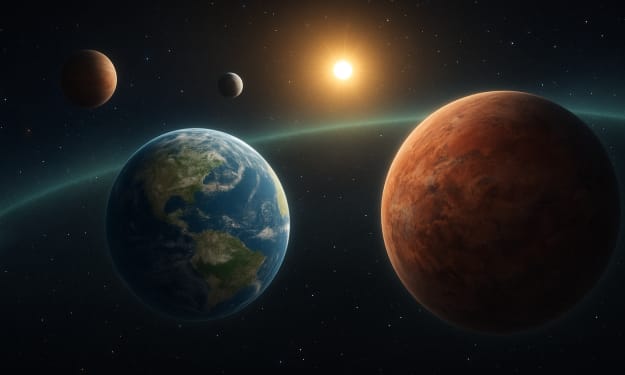
What if a rogue planet entered our solar system and disrupted all orbits?
The Silent Intruder | Gravitational Fury | Eternal Drift


The Silent Intruder
High in the Atacama Desert, wind whipped across the observatory domes, carrying the faint scent of dust and distant ocean salt. Dr Lena Cortez adjusted the focus on the thirty-meter telescope, her breath fogging the control room glass. Midnight shifts blurred into one another, stars wheeling overhead in crisp, unpolluted darkness. Then the anomaly appeared—a faint gravitational perturbation, tugging at Kuiper Belt objects like invisible fingers.
Lena's heart quickened. She ran the numbers again. Mass: roughly eight Earths. Velocity: screaming in from the Oort Cloud at forty kilo meters per second. Trajectory: a hyperbolic plunge straight through the outer solar system. No reflection, no infrared glow. A rogue planet, shrouded in eternal freeze, exiled from some long-dead star.
She alerted the team. Screens lit up with trajectories. Neptune would feel the closest brush—mere millions of kilo meters—enough to fling its moons into chaos and scatter cometary hail inward. Lena's fingers flew across the console, modeling cascades. Asteroids nudged. Orbits destabilized over years, not days.
News leaked slowly. Observatories worldwide confirmed. In Washington, briefings turned heated; in Beijing, strategists mapped fallout. Lena fielded calls, voice calm while her mind raced. At home in Santiago, her husband Marco packed emergency bags, their twins—Sofia and Mateo—asking why the stars looked angry tonight.
She stole a moment on the balcony, telescope in hand. The intruder remained invisible to the naked eye, but she knew it was there, a silent predator closing in. Simulations worsened: Pluto ejected, Uranus tilted wildly. Earth safe—for now.
As dawn bled across the horizon, the first outer comet shifted course dramatically, ice tail igniting under solar wind. Lena watched the feed, coffee cold in her grip. The invasion had started without a sound.
Gravitational Fury
Sirens wailed through Miami's flooded boulevards, seawater crashing over seawalls in relentless, moon-pulled tsunamis that tasted of brine and despair. Evacuees clambered onto rooftops, their skin prickled by whipping winds, as Venusian comets scarred the Martian horizon in distant telescope feeds—crimson explosions blooming like fatal fireworks. From a fortified vault beneath the Swiss Alps, Lena Cortez orchestrated global defenses, her voice cracking over encrypted lines to launch fleets of orbital interceptors armed with fusion warheads. Sweat beaded on her brow under the harsh LED glare; equations danced across holographic displays, predicting the rogue's gravitational lasso yanking Jupiter's moons into erratic spins.
In the Arctic tundra, Marco bundled Sofia and Mateo into a rumbling convoy, snow crunching under tires, their breaths fogging windows as auroras twisted unnaturally bright from polar axis shifts. Whispers of betrayal echoed in UN halls—nations hoarding fuel cells, sparking skirmishes in scorched Australian out backs where dust storms choked the air with red grit.
Probes pierced the rogue's veil, cameras capturing subsurface seas bubbling with extremophile bacteria, thriving in ammonia-laced depths. Lena's team cheered briefly, then silenced: these microbes spewed volatile gases, accelerating atmospheric decay on nearby worlds. As Saturn's rings fragmented into lethal shrapnel belts, Lena slammed her fist down. "This wanderer brings genesis—and our apocalypse."
Eternal Drift
Steel corridors of the orbital ark *Resilience* vibrated with the low growl of ion thrusters fighting the rogue's lingering tug. Outside the viewport, Earth hung like a bruised marble, its oceans sloshing in unnatural bulges, continents cracked by relentless quakes that belched sulfurous plumes into a sky streaked with meteor fire. Lena Cortez floated in the command bay, her hair silvered by radiation, bones aching despite calcium infusions. Screens showed the final reshuffle: Mars spiraling inward toward a scorched fate, Jupiter swelling as it swallowed the rogue into a bloated embrace, rings glittering like shattered glass.
Below, the last surface enclaves fell silent. Marco's convoy had vanished weeks ago beneath Antarctic ice sheets that calved into steaming seas. Yet a faint beacon pulsed—Sofia's voice, cracked but alive, broadcasting from a geothermal shelter: "We saw seeds from the rogue's plumes take root in lava fields. Green shoots, Dad says. Life that doesn't need our Sun."
Lena wept soundlessly in zero gravity, tears beading like pearls. She initiated the grand slingshot: a thousand arks firing in sequence, nudging Earth's battered bulk into a wider, colder orbit where winters would stretch centuries, summers brief and fierce. Billions had burned or drowned, but microbial invaders from the rogue—tough, photosynthetic extremophiles—now carpeted polar craters, weaving alien forests that glowed faint teal under starlight.
The rogue settled as a massive, icy moon around the new super-Jupiter, its oceans cracked open to space, venting geysers that seeded comets anew. Humanity's survivors—fewer than a million—scattered across habitats orbiting a quieter Sun, constellations forever warped into unfamiliar patterns.
Lena's final log entry echoed through the fleet: "We lost our cradle, but inherited a wilder cosmos. The intruder didn't destroy us. It scattered us—like spores." She closed her eyes as the ark drifted into perpetual twilight, the universe vast, indifferent, and strangely fertile once more.
About the Creator
crypto | Science
Crypto enthusiast exploring free earning methods in 2025 | Sharing beginner guides, real withdraw stories & tips | No investment journeys from zero to payouts | Let's learn and earn together! 🚀💰 #Crypto #FreeEarning #Web3
Keep reading
More stories from crypto | Science and writers in Education and other communities.
What if a gamma-ray burst scorched Earth from a collapsing star?
The Invisible Arrow High atop Mauna Kea, the thin air carried a razor-sharp chill that seeped through observatory walls. Dr. Mira Solari nursed a mug of tepid tea, its bergamot scent faint against the sterile hum of cooling systems. Starlight poured through the open dome, silvering the massive mirror of the Keck telescope as it tracked a distant galaxy cataloged as WR-47b.
By crypto | Science2 months ago in Education
Why the Sun Appears Yellow: The Science Behind the Color of Our Star
The True Color of the Sun Although people often describe the Sun as yellow, scientists classify it as a white star. The Sun emits light across the entire visible spectrum, including red, orange, yellow, green, blue, and violet wavelengths.
By shahkar jalal8 days ago in Education
Atlas Aluminum Corp Parts Catalog: Aerospace Manufacturing, Aviation Hardware, and Industrial Aluminum Components
Introduction: My Research Into Atlas Aluminum Corp Parts Catalog While exploring aerospace hardware suppliers and industrial component manufacturers, I came across the Atlas Aluminum Corp Parts Catalog listed on the NSN platform. What fascinated me most was how manufacturers like Atlas contribute to the broader ecosystem of aerospace engineering, aviation structures, and industrial aluminum components.
By Beckett Dowhan4 days ago in Education



Comments
There are no comments for this story
Be the first to respond and start the conversation.